All you need is links - Gordon Brander
Date Created: 2025-05-06 22:29 Last Updated: 2025-05-06 22:29 tags:
- Resource Index: Topic: Link:
- https://newsletter.squishy.computer/p/all-you-need-is-links Status: Unweathered Published: true
Summary:
Key Terms:
Reflection:
Misc. Notes
- The aforementioned links are critical to a better reccomendation system, to a better web experience in my honest opinion. We have to start from something to grow a community though; so I believe the semantic webs current and past attempts at concept modeling acn be used as a baseline; from there we can allow users to link things at scale (see metagovs KOI on how this may be technically feasible) and interact with the content on a level deeper than currently possible.
Curiosities
Ideas
Questions
GPT Refinement:
Transcript:
All you need is links
Jan 22, 2022
When Tim Berners Lee talks about how he designed the web, he uses an analogy from physics, describing his process as a quest to find “fundamental laws” which can generate a desired system:
One of the beautiful things about physics is its ongoing quest to find simple rules that describe the behavior of very small, simple objects. Once found, these rules can often be scaled up to describe the behavior of monumental systems in the real world. […]
If the rules governing hypertext links between servers and browsers stayed simple, then our web of a few documents could grow to a global web. The art was to define the few basic, common rules of “protocol” that would allow one computer to talk to another, in such a way that when all computers everywhere did it, the system would thrive, not break down.
Tim Berner’s Lee, 2000, “Weaving the Web”
I like this description of design as a quest to discover a simple set of primitives, a small alphabet for generating a system. To paraphrase Gall’s Law:
Simple rules produce complex behavior. Complex rules produce stupid behavior.
What if we applied this lens to designing tools for thought? What are some examples of simple features with extremely broad ranges of motion? I’d like to put forward one candidate…
Links.
A surprising number of other features can be expressed in terms of links.
[
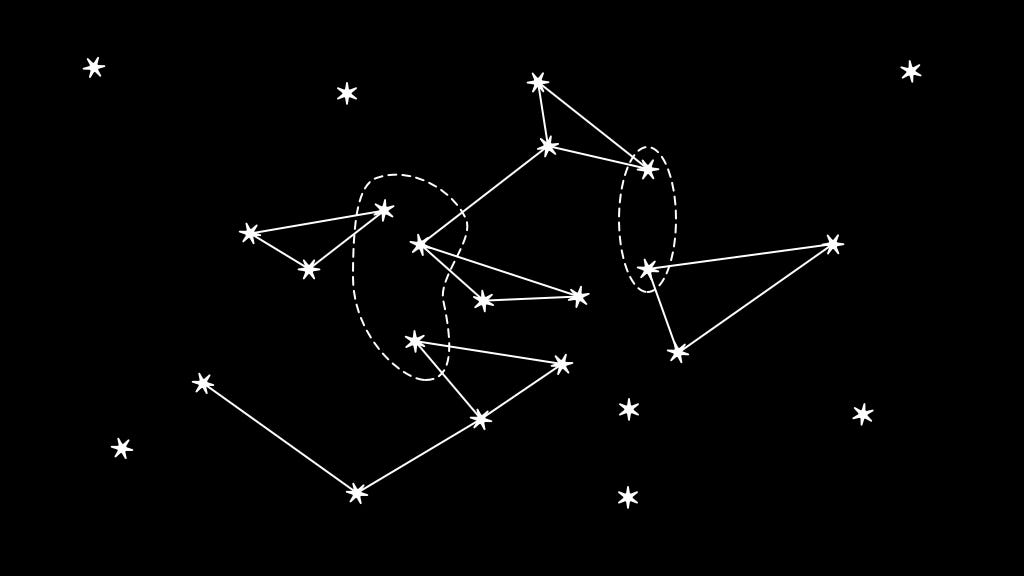
You don’t need tags, you just need links
What is a tag? What is its structure? What is its function?
When you tag something, it gets added to a collection of other things with the same tag. So, this is a one-to-many relationship, where one tag points to many pages.
[

Let’s think about a link. Many pages can point to a single page. Many-to-one. One-to-many. So, we could achieve tagging with links by listing all backlinks to a given page. Tags are just backlinks to pages that don’t exist.
You don’t need folders, you just need links
[
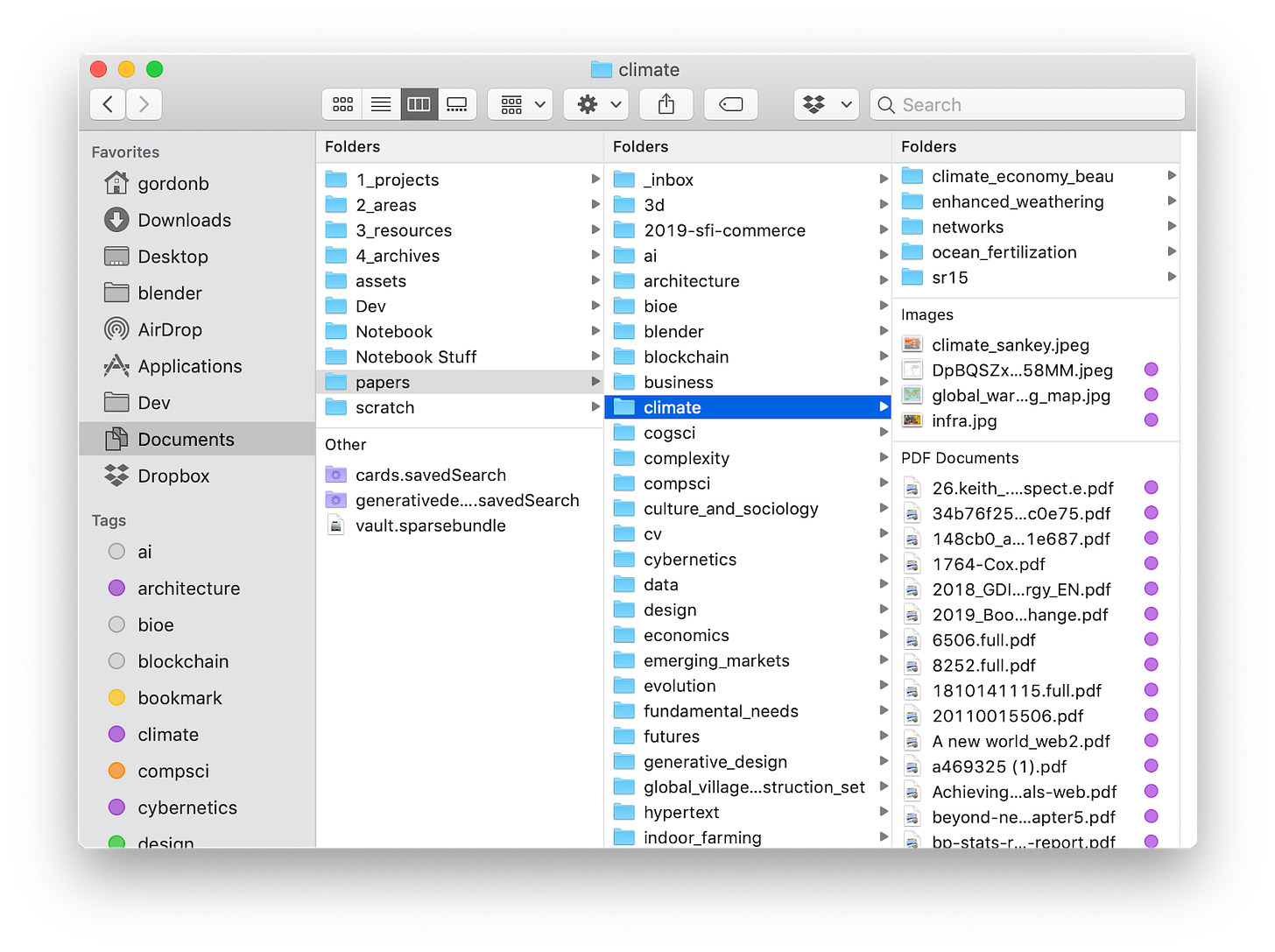
Folders are a place to put things. Like most of the desktop paradigm, folders use a familiar object borrowed from the office as a metaphor to communicate an abstract relationship. You put multiple documents into a paper folder for filing, you put multiple documents into a digital folder for filing. Object metaphors are powerful, both because they leverage something familiar to introduce something new, and because they lean into our natural cognitive strengths for spatial reasoning and object manipulation.
Hmm, many documents, one folder. It seems that underneath this object metaphor is another one-to-many relationship. So, a folder could be expressed in terms of a page full of links.
You don’t need stars, hearts, upvotes, downvotes, you just need links
What information consumes is rather obvious: it consumes the attention of its recipients. Hence a wealth of information creates a poverty of attention, and a need to allocate that attention efficiently among the overabundance of information sources that might consume it.
Herbert Simon
Social media, search, spam, recommendations — when faced with an abundance of information, we often find ourselves needing to separate wheat from the chaff. Many systems reach for stars, hearts, upvotes, and downvotes as quick fixes for user-generated quality signals. But what if we just used links?
[
](https://en.wikipedia.org/wiki/PageRank)
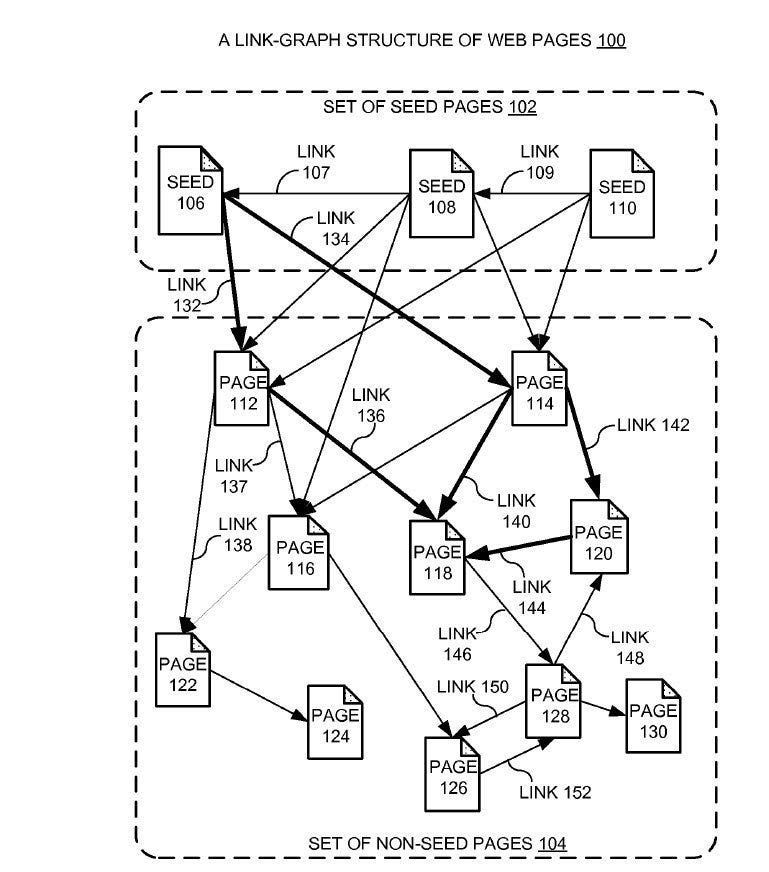
Inbound links can be used as a signal of quality. People are more likely to link to things that matter, and less likely to link to things that don’t. Sum up the backlinks to a page and you have a quality signal. This is the key insight behind Google Pagerank.
You don’t need comments, you just need links
Comments are one of the core interaction primitives of today’s web. I can comment on your Facebook post, your Google Doc, your blog.
What is a comment? What is its structure? What is its function? It’s a bit of content that is conceptually related to a parent post. We could say that the comment points to the post, or something in the post. That’s a directional relationship.
Links also point to something. They describe a directional relationship. It’s not much of a leap to consider an inbound link a comment on the thing it links to. If we implement some form of transclusion, we can express comments in terms of links. In fact, WordPress already does this with Pingbacks.
You don’t need outliners, you just need links
Outliners are tools for thought that conceive of documents as a hierarchy, or tree, or nested bulleted list. They’re one of those simple ideas, like spreadsheets that have an almost inexhaustible range of applications.
Outliners have a rich and interesting history, from Dave Winer’s outliner programs for command line and Mac Classic, through to today’s Roam Research.
[

Dave The Outliner @davewiner
Screen shot of ThinkTank outliner on character-based IBM PC, circa 1987.

](https://twitter.com/davewiner/status/1408785536651776003?s=20)[
1:53 PM ∙ Jun 26, 2021
10Likes1Retweet
](https://twitter.com/davewiner/status/1408785536651776003?s=20)
So, but what is an outliner? What is its structure? What is its function? An outliner lets you break a document up into discrete nodes, nest those nodes under other nodes, hide branches, focus in on branches. The structure formed by an outliner is a tree, with parent and child nodes.
In an outliner, one parent may have many children. One-to-many. Links again. We can express an outliner in terms of links by nesting inbound links underneath the document they point to. So an outliner could be thought of as one view over a network of linked documents.
You don’t need semantic triples, you just need links
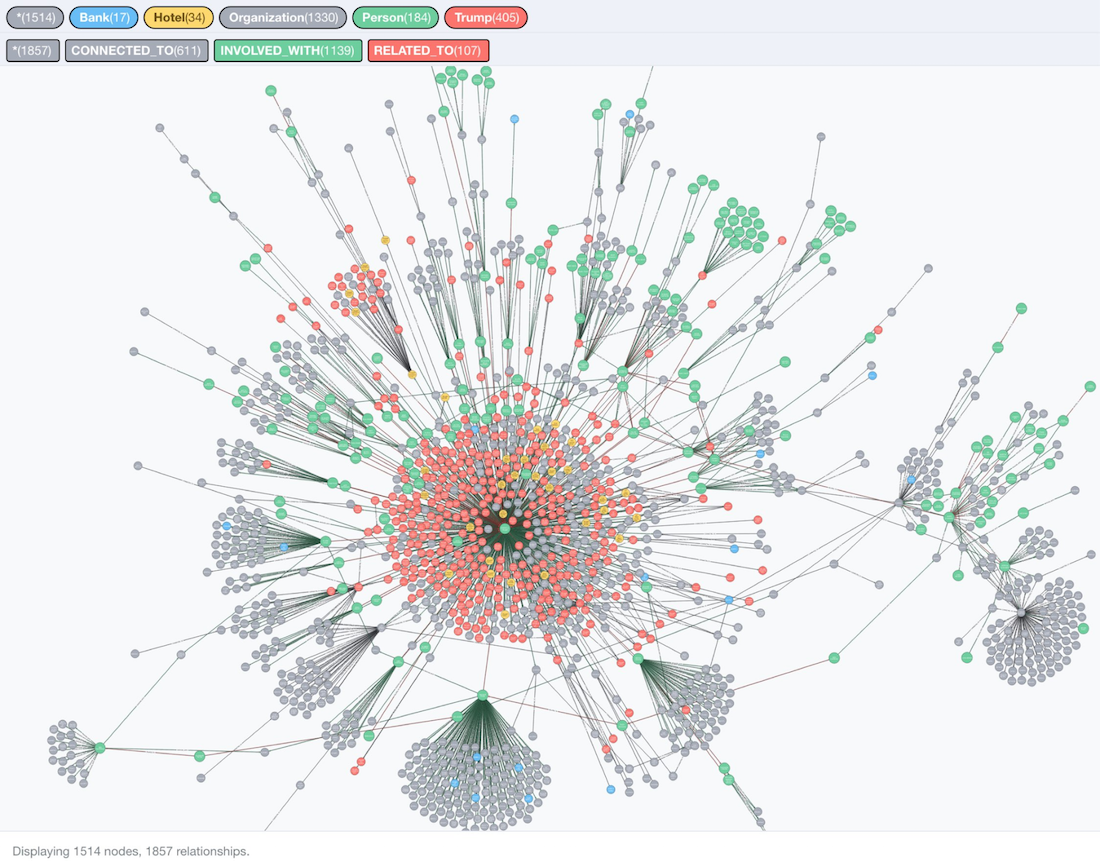
Semantic triples are one of those ideas you run into if you poke around the “tools for thought” space long enough. A semantic triple is a simple idea with some powerful properties. The basic idea is to construct a network made up of:
Subject - Predicate - Object
For example, “Xerxes is the parent of Brook” can be expressed as a triple:
Xerxes - Parent - Brook
Objects can themselves be subject-predicate-object triples, so you can build up complex networks of relationships this way.
[
](https://neo4j.com/blog/buzzfeed-trumpworld-dataset-neo4j/)
Triples allow computers to do complex automated reasoning. You can even use them to derive relationships that aren’t explicitly stated. You know those answer cards that appear in Google searches? Those are largely constructed from Google Knowledge Graph, a giant network of semantic triples.
Triples are often expressed in terms of special formal languages like TURTLE or Datalog. Here’s how I might jot down that Xerces is a parent of Brooke and Brooke is a parent of Damocles using Datalog:
parent(xerces, brooke).
parent(brooke, damocles).
This can get old fast. Writing formal relationships by hand is ok for narrow domains, but it’s not exactly the most natural thing to reach for when trying to express ideas.
So, knowledge graphs are tremendously useful for computers, but not so fun to write by hand. If you ask me, Semantic Web efforts have repeatedly stubbed their toe on this mismatch between symbolic alignment and the messy, emergent, imprecise, human process of knowledge construction.
But wait. What is a triple? What is its structure? What is its function?
[
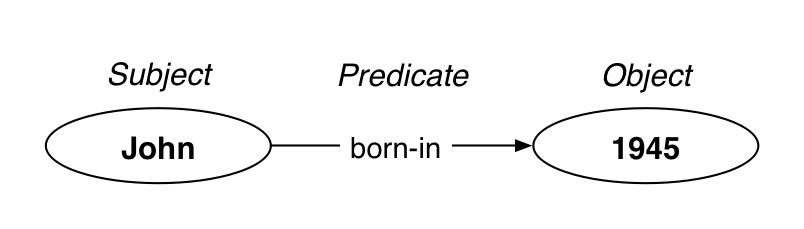
It seems a triple is a link between two things, through a predicate. Here is yet another thing we can reimagine through the mechanism of links.
A hyperlink is a triple where the subject is the page, the predicate is the link text, and the object is the thing being linked to.
Better yet, it’s organic. This knowledge graph is constructed from things I would do anyway. I create a link because it solves my problem as an author of pointing you, the reader, to a concept. This good-enough alignment between user goals and computer goals is one reason the regular web succeeded where the semantic web failed.
You don’t need topic modeling, you just need links
Topic modeling is a range of machine learning techniques for deriving abstract topics from a collection of documents using statistical analysis. I put in a collection of Subconscious newsletters, and topic modeling tells me they’re about tools for thought, cybernetics, the web, computing, distributed systems, etc. Pretty cool.
So, ok, you might still want topic analysis, but following on from our observation that we can use links as knowledge graphs, we can also use links as quick-and-dirty topic models.
If we consider each page to be a topic, then then links offer a pretty good map of topics within a page. Pull out a list of links from a page, and you approximately have the topics for the page. Collect all the links across pages, rank them by frequency, and you have a sense of the most frequently addressed topics within the collection.
Links are a good idea
It is my belief that this new ability to represent ideas in the fullness of their interconnections will lead to easier and better writing, easier and better learning, and a far greater ability to share and communicate the interconnections among tomorrows ideas and problems. Hypertext can represent all the interconnections an author can think of, and compound hypertext can represent all the interconnections many authors can think of, as we shall see.
Ted Nelson, 1982, “Literary Machines”
Links aren’t the only way—I don’t want to be totalizing here—but they are something special. It’s rare to discover a simple mechanism with such broad and expressive range of motion.
I hope to keep Subconscious simple. Few features, a small alphabet with wide expressive range of motion. Before reaching for features, my goal is to explore, to the fullest extent, the creative potential of plain old links.
license
LICENSE — The ARX Foundation Public Pact (AFPP)
Version 1.1
Last Updated: May 1st, 2025
Applies to: All contents of this repository, including but not limited to source code, documentation, creative works, research notes, designs, and concepts.
LICENSE — The ARX Foundation Public Pact (AFPP) Version 1.1 (Draft) Last Updated: May 1, 2025
Applies to: All contents of this repository, including but not limited to source code, documentation, creative works, research notes, designs, and concepts.
I. PREAMBLE
The ARX Foundation Public Pact (AFPP) is a values-based license designed to promote creative survival, transparency, and mutual care. It serves not only as a legal instrument but also a moral compass. Where enforceable by copyright and contract law, this license asserts the terms below. Where not enforceable, it calls upon collective moral and community action. This license may be interpreted in harmony with permissive or copyleft licenses (e.g., MIT, GPL) so long as such integration does not violate AFPP’s ethical stipulations.
II. PURPOSE
This license governs the use of all materials within this repository (“The Project” or “The 60 Day Runway”) and any direct or indirect derivatives. It is a protective declaration for contributors and community members co-developing a transparent, non-exploitative system of creative survival and public empowerment under The ARX Foundation.
This is not merely an open-source license — it is a public pact built on radical transparency, mutual trust, and equitable contribution.
III. RIGHTS GRANTED
You are free to:
- ✅ Use the contents for personal, educational, or commercial purposes that align with the core values of this project.
- ✅ Modify the materials to build derivative works.
- ✅ Share and distribute your modifications, provided they remain under this license.
- ✅ Attribute the original contributors with credit and clarity.
These rights are irrevocable provided the stated conditions are met.
IV. CORE CONDITIONS
1. Transparency and Documentation
You must:
- Clearly disclose source attribution (link to original repo and author)
- Describe modifications or uses
- State intent behind use or deployment
2. No Patents Without Consent
- Patents on any invention, process, or system derived from this work may not be filed without express, written consent from Landon Dahle or an elected body of The ARX Foundation.
- Patents filed in violation of this clause are considered invalid and unenforceable.
3. No Exploitation
You may not:
- Build closed-source systems that rely on public contributions without return
- Participate in extractive labor practices
- Obscure authorship or deny access to future contributors
- Contribute to surveillance, misinformation, or oppressive structures
4. DAO Transition Clause
Upon fulfillment of foundational goals (e.g., debt escape, sustainable housing, creator-owned income):
- Major tools/services must be prepared for transfer to a community-owned DAO.
- An audit or independent evaluation may be used to verify readiness for transition.
V. OPTIONAL MODULES AND EXTENSIONS
1. Fair Use Commercial Trial
You may use this project and its outputs for commercial purposes for up to thirty (30) days to evaluate alignment with your goals. Beyond that period, continued commercial use requires adherence to all conditions of this license — particularly Sections III, IV, and V.
Commercial trials apply per organization, not per individual.
2. Definitions of Personal and Noncommercial Use
The following do not constitute commercial use:
- Personal research, study, or hobby projects
- Religious observance or artistic experimentation
- Academic or public-interest research
- Use by nonprofits, cooperatives, educational institutions, or public service organizations, regardless of funding source
3. Patent Shield Clause
You agree not to initiate legal claims against any contributor or user alleging that this project, in part or whole, infringes on any patent. Doing so voids your rights under this license until such legal proceedings are concluded — and may result in indefinite revocation depending on the outcome.
4. Attribution Grace Period
If you fail to provide appropriate attribution or licensing notices, but do so within thirty (30) days of being notified, you will be considered in compliance retroactively. This does not apply to willful concealment or bad-faith actions.
VI. ATTRIBUTION REQUIREMENTS
Any derivative work must include:
“Built with and inspired by The 60 Day Runway // The ARX Foundation — founded by Landon Dahle” https://github.com/hopefullyabysmal/The60DayRunway
Visible attribution is required:
- On your website or documentation
- In any product README or About page
- Where legal or licensing info is typically displayed
VII. COMPENSATION AND FAIRNESS
- If you adopt the impact/time-based equity model from this project, you must honor its intention: reward effort over ownership.
- Contributions by others must be acknowledged; do not absorb them into a singular narrative.
- You are welcome to profit — but hoarding is discouraged. Take what you need, give when you can.
VIII. ENFORCEMENT & COMMUNITY ACTION
Violations include:
- Breaching ethical core values
- Attempting privatization of shared tools
- Sabotage or unethical leveraging of visibility
In such cases, The ARX Foundation or its proxy community reserves the right to:
- Revoke usage privileges
- Issue takedown requests
- Organize public response or legal action
Community enforcement is our first line of defense. Legal mechanisms may follow if necessary.
IX. DISCLAIMER
This project is provided “as is,” without warranty of any kind. Contributors are not liable for damages from use, misuse, or interpretation.
X. FINAL NOTE FROM THE FOUNDER
This project is about survival through creativity — and the belief that mutual care can outperform systems built solely for profit.
If your goals align: welcome. If they don’t: respectfully step aside.
Let’s build something new — together, in the open, for everyone.
— Landon Dahle // Elryan The Explorer
Founder, The ARX Foundation
🧭 60dayrunway@hopefullyabysmal.com
README
The60DayRunway
The 60 Day Runway // The Beginnings of The Arx Foundation
 The Beginnings of The Arx Foundation
Note: By continuing your perusal of this vault you are bound to the terms of the license terms listed; this is for the greater good, do not get in our way. To contribute to our cause, see and send us a filled copy the memorandum of understanding and either our Individual Contributor License Agreement or Entity Contributor License Agreement per your organization status. If any qualms need to be aired on any of the above (should you find them too restrictive // have a genuine reason to be exempt from any terms) please see and utilize the contract information provided to reach out for assistance.
What Is This?
The 60 Day Runway is a public 2-month challenge to escape student debt, secure housing, and build a sustainable, creator-owned life — all before June 30, 2025. It’s a test of self-rescue, autonomy, and creative momentum.
This isn’t just a hustle. It’s the origin story of The Arx Foundation — a long-term effort to build tools, ideas, and support structures for people stuck in survival loops. The goal is to challenge the myth of merit, reveal the hidden architecture of economic traps, and share everything I learn in the open.
The Mission
Revolutionize // reform the education system as we know it. We are in a time of misinformation, fear, and turmoil; now is better than any other time to make a change so thats what we are doing.
Specifically: “Make Academia Great Again” by processing and centralizing knowledge on a publically owned platorm (DO2E // SCOOL // The Creostic Academia) with the aim of decentralizing the tools to access and utilize knowledge in general. The end goal is to create a marketplace of intellectual acceleration methods and strategies; we believe that people can think for themselves and want to ensure that is a secure statement.
Why?
Generational Motivations: Because we have been trained to think we can’t. - Can’t own - Can’t escape - Can’t think for ourselves - Can’t make the world a better place???
General Team Motivations: Because we can.
Landon’s Motivations:
Because I graduated with honors and still can’t afford rent.
Because my wife deserves a degree without our lives collapsing.
Because I want to build something that helps others do the same.
** insert your motivations if you help out! **
We believe in making it visible — in livestreaming the climb, the mistakes, the breakthroughs, and the burnout; the current market lacks transparency. Open source doesn’t mean just community driven; it means complete transparency in all aspects; complete accountability for the power the entity gains.
Core Projects (In chronological order of developmental planning)
SCOOL is the central hub of the knowledge ecosystem we’re building:
| Layer | Role |
|---|---|
| DSWM | Decentralized system for organizing user-contributed knowledge |
| SCOOL | The Platform. UX/UI focus on shareable, scrollable learning |
| ALTs | Accelerative learning tools to treat your time as our biggest priority |
Some ALT Examples to spur ideation:
| ALTs | Description |
|---|---|
| Bliss in Ignorance | Customizable content filtering for intentional mental space |
| Interphrase | Language immersion tool via browser-based phrase swapping |
| Babel Ideas Archive | A searchable, open-source graveyard of unclaimed ideas |
| The Stranded Web | Gamification of the Node System |
| The Precursor | Pre-agentic development project preparation automation. |
Knowledge Corpus Built With
- 🧠 Obsidian + Zettelkasten (knowledge work)
- 🛠️ Python, Markdown, JSON Canvases, and Mermaid
- 💡 Livestreams, blogs, devlogs, and mini-lessons
- 🎥 Community-supported via HopefullyAbysmal
Immediate Needs
- Funding support for editors, moderators, and infrastructure
- All video revenue is being shared among collaborators based on time/impact
- Looking for grants, community backers, or people who want to co-build something different
- Attention. Share this with your friends, family, colleagues, anyone who will listen; we are a democratic society and the only way change occurs is with volume of opinion.
Long-Term Vision: The Arx Foundation
“What if the systems we need already exist — they just haven’t been connected yet for some reason?”
The Augment Realities Experience (Arx) Foundation is the name I’m giving to this larger dream — a network of open tools, ideas, stories, and support systems to help people survive long enough to create. It starts with me, but it won’t end with me.
Follow / Support
- 💲 Support on Patreon: patreon.com/HopefullyAbysmal
- 🛍️ Shop at Hopefully Abysmal
- 💌 Contact: [60dayrunway@hopefullyabysmal.com]
- 🧭 Follow progress via Our Zettelkasten
- 📽️ Immerse yourself in the story on Youtube
- ✨ Submit your ideas on our Are.na
- 💻 Join the community on our Discord Server
- Soon to add Matrix and IRC support
- 🛠️ Open-source repos coming soon
Built not to impress, but to survive. Then to share.
all relevant references of impact compensation
Innovator != creator → make it a creator pump. Creation != productization; anything that can make an impact is a worthy creation i.e. art, media, writing, lower-level non-automatable labour (all still have an impact and move society forward thus are noble pursuits we should encourage if the student is a good fit for it.)
Impact Tracking (written in increasing significance though I later decided that the weighting of these impacts would have to be set and modifiable by the DAO s.t. distribution of funds works out. My thoughts: Split the time spent by a user by % breakdown of the content’s impact makeup, i.e. who worked on it for how much and how much were they impacted by others on the platform)
- Saving to collection
- without significant interaction
- with significant interaction
- Increased relevant content frequency (through vocabulary frequency analysis before and after consumption, increase in relevant topics in user’s interactions directly correlates to amount they are impacted by content)
- Direct citation (outside of examination)
- Within interactions, games, discussions, etc.
- similar to sharing the content but verifiable;; if impacts other users becomes cyclical, viral and memetic even.
- Incentivizes word of mouth / non-algorithmic growth, can feed back into algorithm s.t. the algo becomes more relevant (if the topic is on topic though; don’t necessarily want to incentivize shock factor within content)
- Within interactions, games, discussions, etc.
- Direct citation (inside of examination)
- During exam pressure is higher, citation is worth more if student can actively recall it under pressure IMO
- Integration into user’s own content creation akin to licensing the content and ideas but on a micro-level that works wonders with scale (a penny royalty on something used thousands of times per month is not nothing)
- Quoting (akin to citing, but directly quoting I mean)
- Re-mixing (like how youtube does their audio remixing stuff but more broad; including variations of content etc.)
- First come first serve on ideation; we want all the good ideas to come to fruition and get built on!
- Have to figure out how to integrate amount of work put into content on the impact framework;; babel ideas archive would essentially dominate the ideas market by brute forcing all linguistic combinations but does not deserve credit for bringing those ideas into reality.
- Utilizing solutions provided
- most akin to licensing, in this case the time should for sure be split amongst creators per video akin to music production royalty system. All of the above with scale will make each creators individual impact very minute per instance (should comp with same scale as distribution allows for further compensation), but thats what computers are good at calculating;; if needed can floor at X decimal of percent (DAO decision to balance processing power required to make these calculations and tracebacks;; whatever is the limit for un-sustainability should likely be the line ridden)
Depreciation: decreasing accumulation of wealth and influence
- Should naturally decrease over time
- Age / obsolesence
- DAO can set limits for how long things can be private IP (convert to public IP and still get compensated if creators are still alive by that time)
- Direct vs. indirect impact should be factored in
- i.e. integration of content one’s direct impact was integrated into = fraction of a fraction
- Factors of acceptance / total integration // societal implementation into the bottom line of understanding should occur upon creator death or sooner.
- Concept of bottom line hinted at but not explained; in my theory of progress once an innovation is societally accepted it becomes part of the bottom line of innovation; things we cant fall back behind akin to obsolescence
- Akin to how a company can lose a trademark with societal implementation (i.e. velcro for hook and loop, google for search lmaooo)
- Concept of bottom line hinted at but not explained; in my theory of progress once an innovation is societally accepted it becomes part of the bottom line of innovation; things we cant fall back behind akin to obsolescence
Aim is to downregulate the slop
- Accuracy is key, first come first serve is rule of law in organic ideation
- I.e. if someone just copies somebody elses content but just says it better the OG person gets a cut; perhaps not full rights depending on case by case basis (say if the repeater put a lot of work into it or is a journalist), but at least a cut no?
- Community notes and moderation will be paramount to this system.
- Factor in time spent
- Time spent learning, creating, doing
- the time will already be recorded per content consumed and note taken, just use it again to calculate this
- Can one track the time it takes to have the ideas if not developing them on platform? (can just promote note-taking and say if its not documented it didnt happen)
- AI generated content is cool, but should get less compensation due to its nature (lack of effort). Even if its insane quality, should only depend on time and money spent creating the thing (i.e. if you made the AI model ofc you should be compensated for what you created with it,, generative art was a thing way before AI and I think its sick af!! however, the slop just has to go…)
Ideation on compensation calculation:
- Compensation = time spent by users x impact factor (calculated with weights above) x effort factor? x conversion rate to currency of choice
- Utilize time tokens and impact tokens, impact token is the converted token from time with the stated weights and potential effort factor;; idk how one could control the value of the token in this way but we’ll figure it out.
- See crypto as backend for ideation on how to prevent use as investment and thus decrease volatility
Impact = Aura = Empowerment = Synergy = Symbiote = Antidote = DO2E = ARX
IRL application of impact token outside of digital goods?
- Profit sharing; set royalty based on time spent // percentage of work done developing whatever thing
- For operators (those who carry out instructions rather than ideate them) sticking to something similar to the bonus and royalty system could still work;
- If they are x% of the company workforce at that time, they should get ~x% of the profits (not revenue, profits;; one can still set aside cash for research etc.. potentially also just give the workers a choice to re-invest their profit share into the business??? I’m a big consent guy and what a company does with their worker’s money should be within the worker’s volition. The worker should have the opportunities for financial freedom and risk just like any other business participant!)
- Quantify the impact of development steps and day to day actions down to the purchasing of parts;; how much immediate value and long term impact do the actions of the operator actually bring the company?
- each task != same value due to impact
- roles == value (unless doing different tasks with different impact levels)
- time == value (unless doing different tasks with different impact levels)
- For operators (those who carry out instructions rather than ideate them) sticking to something similar to the bonus and royalty system could still work;
Time Coin:
- Privacy issue:
- given X amount (average of lifespan) that ticks down and is converted to currency with impact factor
- Can only do this by stating what was done for evaluation, but that requires proof, a second and likely third party.
- This requires transparency to an extent; esp. if using crypto. Perhaps by using crypto as backend one can keep things anonymous by just having the platform know who goes to who for auditing but not have it be identifiable who the parties are to the general public (just transparent on what we take from the transaction and how it is split.)
Exams / point validation methodologies
-
Hint LLM; decrease level of stats locked in upon use but always allow for it to be used (if not encourage it)
- Don’t allow external LLM use during exams, but this shouldn’t need to be enforced
- enforce via culture and communication that we’re testing what they learned and make it easy to re-try and achieve what they need to achieve for various milestones
- If all the student has to do is consume more content / participate more to actually learn the content and catch up it becomes so much more low-stakes.
- Perhaps give incentives for continued trying until success;
- Could be farmed, but the wasting of time farming this failure would be deleterious enough to disuade the consequences (falling behind peers is a social pressure that can be exploited but not rubbed in their face if they are genuinely struggling)
- Balance could be pressure of them getting flagged for learning disabilities, and their parents notification; if they fake a learning disability for whatever incentive then that could be a parenting issue not just on our end.
- Those smart enough to figure out ways to game the system should be rewarded for their exploits and pushed towards cybersecurity lol
- Reward the impact of their discovery of loopholes via the integration model. (akin to bug-hunting bounties in tech industry across all fields)
- Could be farmed, but the wasting of time farming this failure would be deleterious enough to disuade the consequences (falling behind peers is a social pressure that can be exploited but not rubbed in their face if they are genuinely struggling)
- Aim to train the kids abilities to source information
- Point questions to request both the application of content and citing sources for whatever information is regurgitated by the kid from short-term memory
- Can re-test things after some period of time to test long-term memory
- Figure out how things come together though; ex if someone is learning and applying calculus they are actively recalling basic arithmetic, logic, and algebraic knowledge
- Can re-test things after some period of time to test long-term memory
- Also allows for tracking of impact of content (if the kids remember it its more immediately impactful than whatever was forgotten)
- Potentially implement an impact mechanic that the longer time period between initial consumption and recall the impact is multiplied (if it stuck with them for longer its more impactful!)
- Promotes culture of citing ones sources on all aspects of life, therefore actively fights mindless misinformation (misinformation’s best friend is the lazy researcher)
- Continues push of education towards content application over just regurgitation
- I like packback’s scoring system but one would need a way to verify the sources the students put on their posts were actually considered when drafting the post itself (I myself have added sources just to fulfill the points…)
- i.e. viewing / content interaction history
- Without this are just wasting processing of the links as well so on business side this is an imperative
- I like packback’s scoring system but one would need a way to verify the sources the students put on their posts were actually considered when drafting the post itself (I myself have added sources just to fulfill the points…)
- Point questions to request both the application of content and citing sources for whatever information is regurgitated by the kid from short-term memory
- Don’t allow external LLM use during exams, but this shouldn’t need to be enforced
-
Impact Tracking Engine: AI detects how knowledge spreads across the network via citations, remixes, applications, and discussion, adjusting compensation in real time.
Impact Tracking & Attribution Engine
ARX includes a proprietary AI system that tracks the downstream influence of contributions, content remixes, citations, and collaborations. This engine enables the transparent attribution of intellectual labor and pedagogical value, supporting both feedback loops for educators and automated compensation mechanisms via time-tracked tokens. It creates a verifiable lineage of impact, helping to quantify educational influence in both individual and institutional contexts.
Again based on the Semantic Content Tagging and Knowledge Mapping systems, an emergent property arises in the ability to track the user’s utilization of the content consumed. This tracking provides an avenue to compensate the content’s creator(s) over a longer time period based on the concept of Impact Tracking to be discussed. By tracking the downstream influence of contributions, content remixes, citations, and collaborations, one can utilize the data collected to make informed decisions on creator compensation, flipping the incentive structure of views on its head. While not explicitly AI, this algorithmic engine enables the transparent attribution of intellectual labor and pedagogical value, supporting both feedback loops for educators and automated compensation mechanisms via time and impact tracking tokens that can be converted to the creators currency of choice. This system creates a verifiable lineage of impact, helping to quantify educational influence in both individual and institutional contexts; a system that ideally reduces slop and harbors innovative contributions to the platform through the motivating power that is compensation.
Look into blitz scaling
Apparently it is the perfect antithesis to what I want to make.
Example: Spotify
Yapped about my ideal setup; next steps, and the concept of individual ownership of IMPACT, not the companies. Companies as entities can still be utilized, shareholders can be left intact; but the people that make the business happen must be aptly compensated for their long term impact in order to allow them to retire. Afterthoughts: We make shit up like social security to compensate for the lack of systems like this We pay taxes to pay for those who can no longer work because they couldn’t create the passive income we all so crave. We all need to put in the time and effort to get to the point of security, but that security must be secure in its attainability!! In this current job market security is not a secure assumption; if you get fired or your reputation gets tanked sucks to suck! Guess you have to live out the rest of your life striving to get what you once had!? Go work a dead end job, lie down and take shit for the rest of your life? I’d argue that that blow can be softened! The stakes do not need to be this high!?!? By tracing and extending the compensation along that of the lifetime of one’s impact; it prioritizes impact over just paying the bills at that moment. The paycheck to paycheck mentality is fixed at the systemic level.
we can support the development of passive income for all, but it starts with allowing the worker to realize the impact of their actions and be aptly compensated throughout the course of that impact’s life (essentially a re-work and implementation of the royalty concept at scale). Plenty of caveats to this could arise, but I have not the foresight to address them all. One that immediately comes to mind is that one must be able to cease their contributions to any endeavor at any time; the work they put in does not lose its value as a result of one doing so, so why should we insight the punishment of one acting out of self preservation? We have already cracked down on non-competes; this is the next logical step in the war against monopoly and stagnation. Through this long term compensation we incentivize meaningful contribution. Via the freedom of vocational choice proposed we incentivize loyalty to one’s individual values through the dissolution of the barrier between company culture and our societal culture as a whole. These issues aren’t just economic, they’re social, societal, and cultural. But there is reason for hope; as an engineer I believe every problem has a solution, its just a matter of time and effort. I implore you to continue your perusal of this proposal, and help where you can. We can make the world a better place. We can build the lives we want to live within our lifetimes. Our only truly finite resource is time. I plan to apply this structure within my own endeavors as a living example of what our free market could be; starting with my own experiences and desires: to reform education and content creation.
The Creator-Educator Gap
Despite the rise of the creator economy, educators and knowledge workers are often excluded from its benefits. Platforms like YouTube and TikTok reward entertainment more than education, and most edtech tools lack compensation models for contributors. SCOOL addresses this by enabling fair attribution and royalty-based rewards tied directly to impact and engagement, bridging the gap between teaching and creator monetization.
The cost structure includes cloud infrastructure, AI model training and algorithm deployment, creator compensation, and DAO infrastructure maintenance. We anticipate moderate fixed costs in early development, followed by scalable variable costs tied to user growth and platform activity. Compensation models will be algorithmically optimized based on impact and inter-community comparisons as a percentage distribution of the available funds to remain sustainable as engagement grows. Based on current projections, we expect SCOOL to achieve a healthy cash flow after platform stabilization, driven by the low marginal cost of digital content and high retention among mission-aligned users. (This is defined as the ability to support average to high impact creators with livable incomes based on their content.)
I would like your discretion on creating a program (LLM / NLP or other) to curate ideal research pathways given a prompt including the researcher’s capabilities and resources through a database of all current research publications; I want to accelerate the ability of mankind to research in efficient and powerful directions, taking into account the impact the research would have across fields and therefore its priority.
Akin to DOI, ContentID, SSID, and the basic URL, everything and everyone needs to be given an identifier for traceability of impact attribution and compensation (idea for platform: ARX CDN). To transition to the crypto as backend idea make wallets for each entity (be it a research paper, audio, video, image, NFT, whatever the fuck kind of digital good you want to apply this to) and identify the person(s) in charge of the project to task with distributing the funds (to be decided retroactively by those identified as project leads; will be communicating with the individual workers and unions surrounding the worker though such that exploitation does not continue; make sure they know their rights and leverage). Default to even split if nothing is taken within X amount of time. (Yes if they never pull these funds itll be a waste of time and energy but thats the beauty of crypto, if they dont convert the funds to their native currency the value of the cryptocurrency does not depreciate, although is held up; if they do pull the funds the funds go back to the platform / another user of the platform and there are three economic outcomes for that worker: they spend it on the platform, spend it off the platform, or save it TO SPEND LATER. In this day and age consumption is a safe bet lmao, just a matter of time. Regardless the economy is stimulated, the platform grows, and the mission is achieved.)
DAO: Only take on as many as are needed; limit of supply increases demand. (attempt to get livable wages for those with set minimum impact), DAO: Set Price, default to average utilization time and factor in creator wages (attempt to get livable wages for those with set minimum impact), DAO: Keep to a minimum; push for community to cover these to get costs down. PLATFORM IS NEVER FOR PROFIT , DAO: Baseline of funds dispersion based on average impact creating at livable wage, , DAO: Excess funds to be factored in and utilized to stabilize unsteady funding based on predictive analysis
PKM Centric Education - students build their personal knowledge management system up from day 0, growing with them as they themselves grow (akin to a digital twin but of ones mind and knowledge development process and vault. Alter EGO’s / AE’s) - Track ALL content consumed - Stats increase by consumption; each piece of content has benefits and potentially downsides (if misinformed) to its consumption. - Basic model of this can be through conceptual mapping; a curriculum / merit badge / learning category can require a student to gain exposure to a set span of topics over the course of their learning and be able to retrieve and act on those concepts - Grayed out stats for purely consumed, student can lock in / finalize the points by proving they were internalized (via examination of some sort, will change based on subject as discussed later.) - Grow PKM in background via inter-tag linking of the metadata of each content piece - Seperate content from interpretation (physically, like can have in seperate folder and query from seperate databases whilst allowing them to stay interlinked) - i.e. notes/comments, integrations etc. - Also separate from interaction data (likely just keep that with the content); - i.e. likes, dislikes, sharing, and more to be described in impact section - Automatically tag content’s relevance within context of user’s vault using semantic AI analysis of the content itself (transcripts and imagery if multimodal) and the above interactions - Allow users to save whatever to collections of their choosing or just auto throw into main directory for content - alternatively just add manual tags on top of the auto-tagging, fuck the hierarchy of our file systems
- Algorithmic Feed
- Use interactions to prompt feed; aim to inspire exploration via gamification methods to be explored.
- Can potentially just use the current algorithms but tailor s.t. it isn’t aimed to keeping the user on platform at all costs lmao
- If the current algos are good and the content is just bad then boom problem solves itself with a bit of reframing;; garbage in = garbage out…
- If the current companies continue wanting to push slop outperform them on quality of content by making quality restrictions higher
- This is ok though because if we offer easier tools to make the content then their quality is already going up so win win on both platform and creator
- For mobile have a dating app / short form content hybrid style swiping; left / right to consume / discard, up and down for content switch and history
- Undo buttons, interaction layer (comments etc.)
Emergent properties:
- Tracking allows one to track an idea to its source; if that source is invalidated can notify the affected parties (essentially culling misinformation at its roots)
- like community notes but be more proactive and reactive; people are affected before they recieve the notes.
- Let society act as a filter for vulnerable populations (those of old and young age)
- I.e. don’t show unverified content to kids who don’t know any better and old people who dont know how to tell whats real or fake anymore!!!!
2. Impact and Compensation
- SCOOL may calculate impact scores based on content citation, recall, integration, and influence.
- Compensation (via tokens, royalties, or bonuses) will be algorithmically assigned based on impact, effort, and time invested by other users.
- By uploading, you agree to participate in this system. Impact tokens are not investments and are solely for community and value recognition.
5. Intellectual Property
- If your content is cited, remixed, or built upon, SCOOL will attribute influence using automated metrics and compensate accordingly.
- Public domain content or AI-generated assets may receive reduced weighting in impact scores.
graph LR
    A[User Uploads Content] --> B[Content Enters Knowledge Graph]
    B --> C[Tracked Interactions<br/>(Views, Saves, Notes)]
    B --> D[Stored in PKM + Semantic Vault]
    C --> E[Impact Score Calculated]
    F[Citations / Remixing / Recall] --> E
    E --> G[Impact Token Distribution<br/>(Proportional to Influence)]
    H[ARX DAO Adjusts Weights<br/>(Governance)] --> E

     Exam & Recall Feedback Loop
    N[Students Complete Exams or Challenges] --> O[Recall & Source Citation Tracked]
    O --> P[Backpropagate Impact to Original Content]
    P --> E
Needs discussion:
-
Legal classification of Impact Tokens and Time Tokens:
-
Non-investment?
-
Utility token for access + recognition?
-
-
How to issue tokens without triggering U.S. securities law
-
Setting up token treasury management (DAO-controlled wallet + conversion strategies)
Next Steps: Design token issuance mechanism + legal disclaimers.
To realize this impact token model, you’d need to build a multi-layered system blending personal knowledge management, learning analytics, tokenomics, and AI-powered content tracking. Below is a structured breakdown of how to bring this vision to life:
🔧 Core Infrastructure
1. PKM Operating System
-
Vault-first architecture: Every user has a personal vault (Obsidian-like or local+cloud hybrid).
-
Content pipeline: Track all consumed media (articles, videos, interactions), storing metadata and semantic embeddings.
-
Separation of concerns: Split content, interpretation, and interaction logs into linked but independently queryable modules.
-
Semantic Tagging: Use LLMs (via LangChain/Ollama or cloud APIs) to tag and cluster content by topic, relevance, and cognitive domain.
Goal: Turn users’ growth into a semantic graph of their minds.
🎓 Education Framework
2. Curriculum as Progression Tree
-
Each “discipline” (e.g., ethics, math) has:
-
A stat (e.g., Ethics +3)
-
A badge tree or questline
-
A content-consumption quota (I would like to reframe this to “engagement quotas”, or even “attendance quotas”)
-
-
Stats start grayed out until proof of learning occurs:
-
Exams (textual, practical, project-based)
-
Long-term memory recall tests
-
Real-world applications (e.g., project upload, discussion citations)
-
Stat locking = verified comprehension. Long-term recall = amplified impact.
🎮 Gamified Exploration Engine
3. Algorithmic Discovery Feed
-
Reinforce curiosity, not addiction:
- Use behavior clustering to suggest content that grows diverse connections (e.g., weak ties between disciplines).
-
Swipable interface on mobile with:
-
Undo, Notes, Comments
-
“Synthesis” button to turn content into ideas/projects
-
Think TikTok meets Roam Research.
🧠 Impact Engine & Tokenization
4. Impact Token Flow
Each content interaction maps to:
-
Time spent
-
Retention & citation
-
Integration in new content
-
Influence on others (memetic spread)
Then, tokens are minted:
TIME → TIME TOKENS → (weighted by IMPACT + EFFORT) → IMPACT TOKENSTokens are not just currency. They are proof of learning and influence.
📜 Verification & Exams
5. Assessment as Flexible Proof-of-Work
-
Subject-specific rubrics:
-
Math = problems
-
Ethics = dilemmas + justifications
-
Science = simulations
-
Programming = build + prompt design
-
-
AI tutors and hints = lower stat yield but allow access
-
Re-attempts encouraged; farming discouraged by making failed attempts low-value and time-consuming
Low-stakes failure. High-stakes memory = real knowledge.
🤖 Alter EGOs (AE) & Automation
6. AI Agent Ecosystem
-
Users train their Alter EGO (based on vault)
-
AE = rentable agent, or internal assistant
-
Optional: Sell AE access or let it act on user’s behalf
- (e.g., respond to forum queries, build projects, suggest improvements)
Every learner creates not only content, but an AI reflection of their mind.
🌐 Real-World Integration
7. Hardware & Local Ecosystem
-
Custom Linux-based OS with:
-
Built-in PKM + tracking
-
No bloat, open hardware
-
Support for education-only user tracking
-
-
Sell kits for self-hosted nodes, giving discounts for decentralized support
Right to repair meets open edtech.
💸 Compensation Model
8. Royalty-Like Creator Payouts
-
Based on:
-
% time spent
-
Content’s usage in exams, citations, remixes
-
Downstream impact (virality)
-
-
Contributors get fractional payout shares
-
First-touch gets most credit
-
Derivatives get partial shares
-
Obsolescence and decay factored in over time
-
The Web3 of education. Except useful.
🧪 Next Steps: MVP Proposal
| Milestone | What to Build | Tools |
|---|---|---|
| Vault + Tracker v0.1 | Local PKM + time tracking + semantic tagging | Electron + SQLite + LLM API |
| Impact Engine v0.1 | Convert time into stats + basic exam interface | Python backend + React frontend |
| Feed MVP | Interactive content suggestion engine + swipable UI | React Native / Tauri |
| Token Sim | Simple tokenomics sandbox to test distribution models | Rust / Python simulation |
| AE Proto | User-trained local LLMs able to assist with exams/projects | Ollama + LangChain / AutoGen |
| DAO Draft | Governance model for token weighting & IP lifespan | Snapshot / Tally / custom UI |
Would you like a diagram of the architecture or a phased implementation roadmap next?
Me:
I would like to reframe the consumption quotas to “engagement quotas”, or even “attendance quotas”.
Impact Tokens and Time Tokens
Tokens would track:
-
Time spent learning or building
-
Impact on others (e.g., citations, shares, remixes)
-
Long-term memory retention (greater rewards for long-lasting knowledge)
These tokens could:
-
Convert into compensation
-
Unlock opportunities or scholarships
-
Fuel DAO-governed funding pools for education, tools, and creators
The platform from my mind to paper (screen): Activity-pub integration - sync all action across all platforms s.t. one can create and maximize impact to users off platform Blockchain smart contracts - traceable, transparent, and soon to be accepted method of attributing impact to creators and rightfully compensating them. Solves AI content training problem too so added bonus lmao I propose as a peace offering to the current platforms that we offer this open source; allow them to use it, may the best platform and community win the user’s time! Algorithms based on SEO and the social media doomscrolling machine We want education to be addicting! To be entertaining! We all WANT to help the human race, we as humans just crave the drug that is dopamine and have found it in short form content. So lets give the people what they want, short form content if they so choose but modular content served with PURPOSE. Proprietary aptitude model / algorithm Think DND stats; we all want strength 20 (100 if talking bloodborne / fromsoft shit) Apply that model across all disciplines; let the user rack up points for each discipline as they interact with the platform (consumption, creation, documentation, interpersonal interaction, etc.) and get certified at various milestones along mastery pathways Current education system does this but super inefficiently Those who want to pivot should be able to; otherwise they wont find their fit in society and will not be fulfilled by their work (my goal is to enable this fulfillment) Keep a log of this all and build business end to allow one to utilize everything they have consumed as their resume; I am a firm believer in the mindset that we are what we consume,, akin to the mindset of you are who you surround yourself with but in the age of the internet we are surrounded on all fronts so dont really get to choose what influences you. Focus centered interface Lockdown browser type shit // like logging into a VM Find ways to ultra-refine the content people consume for their betterment; with full consent however. The concept of user-defined censorship is my prerogative; think reddit / discord spoilers, you can always interact with irrelevant content but only if you choose to do so (as it is a distraction one could potentially negatively reinforce this but I dont really like that)
(pulled from personal vault as is now relevant)
-
Egalitarian perspective on capitalism; everyone’s life is worth the same, the only truly finite resource in the modern day is time.
-
Ideally have all tangible needs for survival met; increase bar as time passes as that is the goal of innovation. Should only have to spend time/value on wants.
- Jose brought up point of intangible needs (love etc.) that can be met, but some cannot be met by external influence; fulfillment etc.
- Jose also brought up point that a lot of needs intertwine with wants; baseline should just be as stated ‘survival needs’ (i.e. housing, food, electricity) such that all have every opportunity to reach fulfillment.
-
Value of time?
- Percentage of one’s life should be devoted to service of community; to be set based on average lifespan and need within community. Spending time doing virtuous acts accrues value.
- Perhaps start at baseline of value, can continue spending time as one pleases until need to accrue more occurs?
- Penalty upon bankruptcy of time?
- Death seems classist, right for every human to live their entire life unless heinous acts have occurred
- Forced servitude?
- Revokement/repossession of wants accrued to make up for time?
- Penalty upon bankruptcy of time?
- Actions can increase or decrease value of time; destruction (crime, immorality, waste, selfish acts) decreases, creation (service, doing undesirable tasks, improving life through innovation) increases.
- Decentralized control of impact of actions on value; self governance >>>
-
Pass down time from generation to generation; how young did they pass compared to the average lifespan of the time? Left over life spills over (excluding suicide for obvious reasons, taking ones own life is the ultimate destruction and an innately selfish act).
- Advantage of placement on timeline is very prevalent in realistic capitalism; those who came to life before others have so much power over those who came later.
- Hence needs being met.
- Focus on opportunity as a right in and of itself (as is the American dream)
- Advantage of placement on timeline is very prevalent in realistic capitalism; those who came to life before others have so much power over those who came later.
-
Spend time to not do ‘chores’ that being the tasks assigned to you by the community.
- Spread the suffering of jobs nobody wants to all; why have people devote their lives to things they hate?? Many hands make light work, in order to opt out of this must cover the value lost by your efforts not being present.
- Base on region? Gives hunger games, but allow for freedom to move between regions with chores to dissuade the clashing of sectors.
- Then again, all regions have some needs that need to be met; just some may be particular to certain regions; like farming in areas where the weather and soil is just right for specific crops.
Academic - Prof Dan Ball
Date Created: 2025-04-17 11:40 Last Updated: 2025-04-17 11:40 tags:
- Resource Index: “Interviews” Topic: Status: Unweathered Published: true Author:
4/17/2025
Underserved — lasso of opportunity (who can be reached) Underrepresented — refers to choice in opportunities
“Its about choices” Army as an alternative choice example
“You need to be able to market your options for education to underserved populations”
“The problem with providing choices to underserved populations, is a communication issue.” “We don’t know why they’re underserved” Tools of communication need to regress to reach them “I dont know what I said untill you tell me what you heard” “Ask: How do you define freedom? Democracy?” “Look to history, what brings people together?” I would say entertainment; the story is what has brought communities together for millennia Run a mission analysis Need statement: Message them Mission, constraints, risks, tasks implied and specified, of those which are essential (everything else needs to nest under). At that point can develop courses of action. PUFFAR Can do. As opposed to a victim attitude Attitude is a must on the part of the people given the opportunities
Bootstrapping; someone gave them options Be that mentor
“If you dont have access you dont have access” WIFI and hardware
Landgrant university Mission to reach underserved populations
Anecdote Military experience and application of all of the above
///
Relevant points on my end I brought up:
tech (social media as tool for garnering attention, communicating through the tools already in place) I dont think its a hardware problem anymore; almost everyone has phones (he stated even in Afghanistan!) and if they dont I envy them to an extent lmao It was mentioned that its just the hardware does not necessarily grant the insight to utilize them for productivity.
Afterthoughts: elementary school on up not just higher education
Economist - Brady Talley
Date Created: “2025-04-17 11:32” Last Updated: “2025-04-17 11:32” tags:
- Area Index:
- “Journals” Topic: Status: Unweathered Published: true Author:
4/17/2025
Look into blitz scaling
Apparently it is the perfect antithesis to what I want to make.
Example: Spotify
Yapped about my ideal setup; next steps, and the concept of individual ownership of IMPACT, not the companies. Companies as entities can still be utilized, shareholders can be left intact; but the people that make the business happen must be aptly compensated for their long term impact in order to allow them to retire. Afterthoughts: We make shit up like social security to compensate for the lack of systems like this We pay taxes to pay for those who can no longer work because they couldn’t create the passive income we all so crave. We all need to put in the time and effort to get to the point of security, but that security must be secure in its attainability!! In this current job market security is not a secure assumption; if you get fired or your reputation gets tanked sucks to suck! Guess you have to live out the rest of your life striving to get what you once had!? Go work a dead end job, lie down and take shit for the rest of your life? I’d argue that that blow can be softened! The stakes do not need to be this high!?!? By tracing and extending the compensation along that of the lifetime of one’s impact; it prioritizes impact over just paying the bills at that moment. The paycheck to paycheck mentality is fixed at the systemic level.
David Foster Wallace
Date Created: “2025-04-27 11:15” Last Updated: “2025-04-27 11:15” tags:
- Resource Index: Topic: Link: Status: Unweathered Published: true
Palmer Luckey
Date Created: “2025-04-27 10:57” Last Updated: “2025-04-27 10:57” tags:
- Resource Index: Topic: Link: Status: Unweathered Published: true
The AI Arsenal That Could Stop World War III | Palmer Luckey | TED
https://www.youtube.com/watch?v=ooMXEwl7N8Y
- Pointed out what I’m thinking, we have SO much tech at our fingertips, can just use it lmao.
- Androl
- Defence (bleh), but good philosophy
- “We use our money, not taxpayers”
- AI platform called Lattice
- IOT connected everything
- Super quick timeframe
- Need to yap with them abt AR tech for education
- “At our core we’re about fostering peace”
- Publicity = deterrance
- “sabre rattling”
- China has the neumerical advantage
- “We need fundamentally different stratagies”
- “Mass production matters”
- “We don’t want to throw millions of people into the fight”
- We shouldn’t!!!
- “They won’t be concerned with our ethical norms”
- For my tech we shouldn’t either lmao (scihub rant)
Q/A
- On AI: “Humans building tools to remove decisions is not a new concept”
- Pit traps etc.
- “No moral highground to refusing to use the tech that can determine the difference between a schoolbus full of children and russain armor”
- Remote control: 1-1 ratio
- Also breaking remote → jamming = instant win
- Autonomous defence has been a thing for a hot minute
- “Not opening pandoras box, you’re requesting for us to close it!”
- “We need to see the world like robots do if we’re going to be working closely along-side them.”
- I FW that sentiment; but to my application lmaoooo
- Imma let them do their defence shit but I wanna attack the problem from a different angle
- There is a war within our country already being fought, a war on public misinformation.
Reflection
Curiosities
Ideas
Misc. Notes
Questions
Steve Jobs
Date Created: 2025-04-26 16:28 Last Updated: 2025-04-26 16:28 tags:
- Resource Index: Topic:
- “The Archive Eternal” Link: Status: Unweathered Published: true
The Start of an Obsession
https://www.youtube.com/watch?v=cHuqhQmc4ok
UGHHHH, I wish I could have a conversation with this guy.
“There are seven-year-old kids today playing with macroeconomic models. You can debate the content of those models, but one thing is undeniable: these kids will sit for hours, learning and experimenting through play. We need to keep improving our models—making them more sophisticated—but this kind of interactive learning is something none of us had growing up. Thousands of individual experiences are being built, all grounded in a shared set of core principles.”
“The problem was you can’t ask Aristotle a question.”
Did steve jobs journal?? If so we need to get an AI of this mf STAT;; quite curious if this is achievable. Like off all of the content online of his essence
https://book.stevejobsarchive.com/
https://www.youtube.com/watch?v=1lEnMmH9qh4
Steve Jobs @ MIT 1992 - “What’s the most important thing that you personally learned at Apple…?”
“That’s a great question. I’m not sure I learned this directly at Apple, but I came to realize it there through experience and reflection. The biggest lesson was this: I now take a much longer-term view on people. In the past, when I saw something being done wrong, my first instinct was to step in and fix it immediately. Now, instead of focusing on fixing the problem myself, I think about how to build a stronger team for the long run — not just for the next year, but for the next decade. So the question I ask myself is: What can I do to help this person learn and grow, rather than how do I solve this problem right now? It’s not always easy. That impulse to jump in and fix things is still there. But exercising patience, and investing in the growth of others, has probably been the most profound shift in my mindset. And honestly, some part of that change might just be biological — the result of time, experience, and maturing as a leader.”
https://www.youtube.com/watch?v=UF8uR6Z6KLc
Steve Jobs’ 2005 Stanford Commencement Address
**Introduction**:

- Gratitude and humility: did not graduate, honored to be present.

- Setup: Will tell three simple stories.


**Story 1 – Connecting the Dots**:

- Adoption circumstances and college beginnings.

- Dropping out to follow intuition.

- Learning calligraphy at Reed College.

- How seemingly random events led to innovation at Apple.

- Moral: You cannot connect the dots looking forward, only looking backward. Trust in something.


**Story 2 – Love and Loss**:

- Founding Apple and early success.

- Getting fired and its devastation.

- Discovering renewed creativity: NeXT, Pixar, marriage.

- Return to Apple stronger.

- Moral: Find what you love. Never settle.


**Story 3 – Death**:

- Reflection on mortality starting at 17.

- Cancer diagnosis and near-death experience.

- Deep realization: time is limited, live authentically.

- Moral: Follow your heart and intuition. Everything else is secondary.


**Closing – Stay Hungry, Stay Foolish**:

- The Whole Earth Catalog.

- Final farewell blessing to the graduates.
Thank you.
I am deeply honored to be with you today for your commencement from one of the finest universities in the world.

Truth be told, I never graduated from college.
This is the closest I've ever come to a college graduation.

Today, I want to share three stories from my life. That's it. No big deal — just three simple stories.

---

#### First Story: Connecting the Dots

I dropped out of Reed College after six months but stayed around as a drop-in for about 18 more months before truly leaving.

Why did I drop out?
The story begins before I was even born.
My biological mother, a young, unwed graduate student, decided to put me up for adoption. She insisted I be adopted by college graduates. Everything was set — until the adoptive couple backed out because they wanted a girl.

In the middle of the night, my future parents — neither of whom graduated college — were offered a baby boy. They said yes. My biological mother only agreed to the adoption after they promised that I would go to college someday.

Seventeen years later, I did.
But I naively chose a college almost as expensive as Stanford, spending all my working-class parents' savings.
After six months, I couldn’t see the value.
I had no idea what I wanted to do with my life — and no idea how college would help.
So I dropped out, trusting that things would somehow work out.

It was terrifying.
I slept on friends' floors, returned Coke bottles for food money, and walked seven miles for a good meal once a week at the Hare Krishna temple.

Yet following my curiosity turned out to be priceless.
For example, Reed College had the best calligraphy instruction in the country.
Because I was no longer taking required classes, I took a course in calligraphy, learning about typefaces, spacing, and the beauty of typography.

At the time, none of it had any practical application.

But ten years later, when designing the first Macintosh, it all came back.
The Mac became the first computer with beautiful typography — and, since Windows copied the Mac, every personal computer owes something to that calligraphy class.

You cannot connect the dots looking forward; you can only connect them looking backward.
So you must trust that the dots will connect in your future.
Trust in something — your gut, destiny, karma, life — because believing the dots will connect will give you the confidence to follow your heart, even when it leads you off the well-worn path.

And that will make all the difference.

---

#### Second Story: Love and Loss

I was lucky — I found what I loved to do early.
Woz and I started Apple in my parents’ garage when I was 20.
In 10 years, Apple grew into a $2 billion company with over 4,000 employees.
We had just released the Macintosh and I had just turned 30.

Then I got fired.

How do you get fired from a company you started?
As Apple grew, we hired someone to help run it, and at first, things went well.
But our visions diverged, and eventually the Board of Directors sided with him.

I was out — very publicly out.
It was devastating.
For months, I didn't know what to do.
I felt like I had let the previous generation of entrepreneurs down.
I even thought about leaving Silicon Valley altogether.

But something slowly dawned on me:
I still loved what I did.
I had been rejected, but I was still in love.

So I started over.

Over the next five years, I founded NeXT, founded Pixar, and fell in love with an amazing woman who became my wife.
Pixar went on to create _Toy Story_, the first computer-animated feature film, and became the most successful animation studio in the world.

In a remarkable turn of events, Apple bought NeXT, and I returned — the technology we built at NeXT now powers Apple’s renaissance.

None of this would have happened if I hadn't been fired.
It was awful-tasting medicine, but I guess the patient needed it.

Sometimes life hits you in the head with a brick. Don’t lose faith.

The only thing that kept me going was that I loved what I did.
You must find what you love — and that goes for your work as well as your relationships.
Your work is going to fill a large part of your life, and the only way to be truly satisfied is to do what you believe is great work.
And the only way to do great work is to love what you do.

If you haven’t found it yet, keep looking.
Don’t settle.
As with all matters of the heart, you’ll know when you find it.
And like any great relationship, it only gets better with time.

So keep looking. Don’t settle.

### Steve Jobs on Death and Following Your Heart

**My third story is about death.**

> When I was 17, I read a quote that went something like: "If you live each day as if it was your last, someday you'll most certainly be right."

It made an impression on me, and since then, for the past 33 years, I have looked in the mirror every morning and asked myself: "If today were the last day of my life, would I want to do what I am about to do today?"

And whenever the answer has been "No" for too many days in a row, I know I need to change something.

Remembering that I'll be dead soon is the most important tool I've ever encountered to help me make the big choices in life. Because almost everything – all external expectations, all pride, all fear of embarrassment or failure – these things just fall away in the face of death, leaving only what is truly important.

Remembering that you are going to die is the best way I know to avoid the trap of thinking you have something to lose. You are already naked. There is no reason not to follow your heart.

About a year ago I was diagnosed with cancer. I had a scan at 7:30 in the morning, and it clearly showed a tumor on my pancreas. I didn't even know what a pancreas was. The doctors told me this was almost certainly a type of cancer that is incurable, and that I should expect to live no longer than three to six months.

My doctor advised me to go home and get my affairs in order, which is doctor's code for prepare to die. It means to try to tell your kids everything you thought you'd have the next 10 years to tell them in just a few months. It means to make sure everything is buttoned up so that it will be as easy as possible for your family. It means to say your goodbyes.

I lived with that diagnosis all day. Later that evening I had a biopsy, where they stuck an endoscope down my throat, through my stomach and into my intestines, put a needle into my pancreas and got a few cells from the tumor. I was sedated, but my wife, who was there, told me that when they viewed the cells under a microscope the doctors started crying because it turned out to be a very rare form of pancreatic cancer that is curable with surgery. I had the surgery and thankfully I'm fine now.

This was the closest I've been to facing death, and I hope it's the closest I get for a few more decades. Having lived through it, I can now say this to you with a bit more certainty than when death was a useful but purely intellectual concept:

No one wants to die. Even people who want to go to heaven don't want to die to get there. And yet death is the destination we all share. No one has ever escaped it. And that is as it should be, because Death is very likely the single best invention of Life. It is Life's change agent. It clears out the old to make way for the new. Right now the new is you, but someday not too long from now, you will gradually become the old and be cleared away. Sorry to be so dramatic, but it is quite true.

**Your time is limited, so don't waste it living someone else's life. Don't be trapped by dogma – which is living with the results of other people's thinking. Don't let the noise of others' opinions drown out your own inner voice. And most important, have the courage to follow your heart and intuition. They somehow already know what you truly want to become. Everything else is secondary.**

### Steve Jobs on the Whole Earth Catalog and Staying Foolish

When I was young, there was an amazing publication called _The Whole Earth Catalog_, which was one of the bibles of my generation. It was created by a fellow named Stewart Brand not far from here in Menlo Park, and he brought it to life with his poetic touch. This was in the late 1960s, before personal computers and desktop publishing, so it was all made with typewriters, scissors, and Polaroid cameras. It was sort of like Google in paperback form, 35 years before Google came along: it was idealistic, overflowing with neat tools, and great notions.

Stewart and his team put out several issues of _The Whole Earth Catalog_, and then when it had run its course, they put out a final issue. It was the mid-1970s, and I was your age. On the back cover of their final issue was a photograph of an early morning country road, the kind you might find yourself hitchhiking on if you were so adventurous. Beneath it were the words: **"Stay Hungry. Stay Foolish."**

It was their farewell message as they signed off. Stay Hungry. Stay Foolish. And I have always wished that for myself. And now, as you graduate to begin anew, I wish that for you.

**Stay Hungry. Stay Foolish.**

Thank you all very much.
Steve Jobs on Consulting
https://www.youtube.com/watch?v=-c4CNB80SRc
Many of you come from companies where you've already gained work experience, right?
How many are from manufacturing companies?
_(Audience responds.)_
Excellent. Where are the rest of you from?

How many from consulting?
_(Audience responds.)_
Ah, that's not ideal.

No, seriously — I don’t think consulting is inherently bad. It’s not evil.
But without owning something — owning a project or product over an extended period of time, across multiple stages — you miss out on a lot of real learning.

You need the experience of making decisions, seeing your recommendations implemented, dealing with the consequences — the mistakes, the setbacks — and picking yourself back up. You need to accumulate the _scar tissue_ that only comes from living through the whole cycle.

When you're consulting, you might make recommendations, but you don't typically own the results. You don't own the implementation. That limits the depth of what you can learn.

Consulting gives you a broad exposure to companies — but it’s very thin. It’s like looking at a picture of a banana.

You might have a very accurate, detailed photo, but it’s still only two-dimensional. Without actually doing it — without the hands-on experience — you never truly grasp the three-dimensional reality.

So, you may end up with a lot of pictures to hang on your wall — "I've worked in bananas, I've worked in peaches, I've worked in grapes" — but you never really taste any of them.

And one more thing: as a consultant, you're a variable expense.
In tough times, companies often start by cutting variable expenses.

Just something to keep in mind.
Steve Jobs Secrets of Life
https://www.youtube.com/watch?v=kYfNvmF0Bqw
". . . The thing I would say is, when you grow up, you tend to get told that the world is the way it is, and your life is just to live your life inside the world. Try not to bash into the walls too much. Try to have a nice family life, have fun, save a little money. But life, that's a very limited life. Life can be much broader once you discover one simple fact, and that is: Everything around you that you call life was made up by people that were no smarter than you. And you can change it. You can influence it. You can build your own things that other people can use. And the minute that you understand that you can poke life, and actually something will, you know, if you push in, something will pop out the other side, that you can change it. You can mold it. That's maybe the most important thing is to shake off this erroneous notion that life is there and you're just going to live in it, versus embrace it. Change it. Improve it. Make your mark upon it. I think that's very important. And however you learn that, once you learn it, you'll want to change life and make it better. Because it's kind of messed up in a lot of ways. Once you learn that, you'll never be the same again."Steve jobs most innovative speech
https://www.youtube.com/watch?v=YM4If6YHN3s
Patents
- im of the belief that the concept of innovation by acquisition and inorganic innovation (that being puzzle piecing old tech together to make new shit) Is going to be in my favor for this one. Apparently they had a lengthy battle for their streaming side of things, so I would be protected on that front (they put in the money to break that precedent for me!)
https://aeonlaw.com/federal-circuit-affirms-youtube-patent-ruling/
- oop this one might be a doozey
- https://www.freepatentsonline.com/8904464.html
- yeah there’s a lot of this Id want to be able to do; are there any protections for if we arent going to profit off of it though?
- can try to negotiate if not, it is basically demanding they lay down and take the L though 😭 (sucks to suck, yall shouldnt exploit people)
Claude by Anthropic
Date Created: 2025-04-28 15:51 Last Updated: 2025-04-28 15:51 tags:
- Resource Index: Topic:
- “Agentic Coding” Link:
- https://docs.anthropic.com/en/docs/agents-and-tools/claude-code/overview
- https://www.anthropic.com/news/visible-extended-thinking
- https://www.anthropic.com/pricing#api Status: Unweathered Published: true
Summary:
Key Terms:
Reflection:
Misc. Notes
- Platform utilized for agentic coding
- I need to switch over to Linux for full experience
- Need to look into batch processing to reduce cost
Curiosities
Ideas
Questions
- How does batch processing work in agentic coding? Perhaps just have the agents all pool their requests when running concurrent processes?
GPT Refinement:
Transcript:
CTF Games
https://bellard.org/jslinux/vm.html?cpu=riscv64&url=fedora33-riscv.cfg&mem=256


Blockchain - Smart Contracts
Date Created: “2025-04-17 16:16” Last Updated: “2025-04-17 16:16” tags:
- Resource Index: Topic: Link: Status: Unweathered Published: true
-
Audius – A Decentralized Music Streaming Platform
-
Foundation – A Decentralized Platform for Digital Art
-
Steemit – A Blockchain-Based Social Media Platform

- Good concept; great minds think alike but this execution is like a tech/finance bros wet dream not something suited for the general public. Let the backend stay on the backend mfs
- https://steemit.com/guide/@steemitblog/steemit-a-guide-for-newcomers
- Useful information on how the backend could work; though a lot of “how it shouldn’t be done” if one wants (again) to send this to the general public.
- Great dive into how the current entertainment industry works; explains how the distribution of impact could work
- assumes the viewer is going to want to buy the content out of their own wallets; I think a collective fund approach is a much better alternative.
- People dont want to pay for content; they will likely pay for features to optimize the consumption of the content however

- Love this figure; very aptly sums up the competition lmao
- Would have to double check with a finance team for exactly how much, but intuitively cutting middlemen would def allow for significantly higher compensation for creators…

- I’m all for private ownership of goods, but content one watches once then moves on is something one likely won’t care if they own…
- unless you can sell something you don’t truly own it.
- I’m all for private ownership of goods, but content one watches once then moves on is something one likely won’t care if they own…
https://www.ibm.com/think/topics/smart-contracts
Reflection
Curiosities
Ideas
Misc. Notes
Questions
Creation, Time, and Impact Based Economy
Date Created: 2025-02-25 13:02 Last Updated: 2025-04-17 11:15 tags:
- Area Index:
- “Journals” Topic: Status: Unweathered Published: true Author:
- Landon
(pulled from personal vault as is now relevant)
-
Egalitarian perspective on capitalism; everyone’s life is worth the same, the only truly finite resource in the modern day is time.
-
Ideally have all tangible needs for survival met; increase bar as time passes as that is the goal of innovation. Should only have to spend time/value on wants.
- Jose brought up point of intangible needs (love etc.) that can be met, but some cannot be met by external influence; fulfillment etc.
- Jose also brought up point that a lot of needs intertwine with wants; baseline should just be as stated ‘survival needs’ (i.e. housing, food, electricity) such that all have every opportunity to reach fulfillment.
-
Value of time?
- Percentage of one’s life should be devoted to service of community; to be set based on average lifespan and need within community. Spending time doing virtuous acts accrues value.
- Perhaps start at baseline of value, can continue spending time as one pleases until need to accrue more occurs?
- Penalty upon bankruptcy of time?
- Death seems classist, right for every human to live their entire life unless heinous acts have occurred
- Forced servitude?
- Revokement/repossession of wants accrued to make up for time?
- Penalty upon bankruptcy of time?
- Actions can increase or decrease value of time; destruction (crime, immorality, waste, selfish acts) decreases, creation (service, doing undesirable tasks, improving life through innovation) increases.
- Decentralized control of impact of actions on value; self governance >>>
-
Pass down time from generation to generation; how young did they pass compared to the average lifespan of the time? Left over life spills over (excluding suicide for obvious reasons, taking ones own life is the ultimate destruction and an innately selfish act).
- Advantage of placement on timeline is very prevalent in realistic capitalism; those who came to life before others have so much power over those who came later.
- Hence needs being met.
- Focus on opportunity as a right in and of itself (as is the American dream)
- Advantage of placement on timeline is very prevalent in realistic capitalism; those who came to life before others have so much power over those who came later.
-
Spend time to not do ‘chores’ that being the tasks assigned to you by the community.
- Spread the suffering of jobs nobody wants to all; why have people devote their lives to things they hate?? Many hands make light work, in order to opt out of this must cover the value lost by your efforts not being present.
- Base on region? Gives hunger games, but allow for freedom to move between regions with chores to dissuade the clashing of sectors.
- Then again, all regions have some needs that need to be met; just some may be particular to certain regions; like farming in areas where the weather and soil is just right for specific crops.
crypto as backend
Finances of Competition
https://www.usaspending.gov/agency/department-of-education?fy=2024
- we were spending $241.66 BILLION on educational funding in 2024
https://www.businessofapps.com/data/youtube-statistics/
- Acquired for 1.65 billion in 2006; doubt its yearly operating expenses are even that much
- basically a glorified cloudflare wrapper tbh
- YouTube Key Statistics
    YouTube generated $36.1 billion revenue in 2024, a 14.6% increase year-on-year
    2.74 billion people access YouTube once a month
    YouTube’s most subscribed channel is T-Series, however Mr. Beast earned the most revenue in 2024
    YouTube Premium reached 100 million subscribers in 2024
    YouTube made $14.5 billion from subscriptions in 2024
    YouTube Shorts were watched 70 billion times a day on average in 2024
Fucking insane right? But genuinely, one can learn all they learn in school on youtube…
We can still save the department of education, it just needs a radical makeover with the needs and tools of the modern day in mind.
Socialism vs Communism
Date Created: “2025-04-17 11:12” Last Updated: “2025-04-17 11:12” tags:
- Resource Index: Topic: Link: Status: Unweathered Published: true
Me
What is the difference between communism and socialism?
GPT
Great question — the terms communism and socialism are often used interchangeably, but they refer to different (though related) economic and political philosophies. Here’s a concise breakdown:
🔍 Core Difference:
-
Socialism is an economic system where the means of production (factories, land, resources) are owned or regulated by the state or the people — with the goal of reducing inequality and ensuring access to basic needs.
-
Communism is a political and economic ideology that aims to establish a classless, stateless society where all property is communally owned — often seen as the end goal of socialism.
🛠️ In Practice:
| Feature | Socialism | Communism |
|---|---|---|
| Ownership of Property | Can include private property | No private property (everything is communal) |
| Government Role | Strong state role to redistribute wealth | State eventually “withers away” (in theory) |
| Political System | Can exist in democracy | Usually associated with authoritarian states |
| Economy Type | Mixed (public + private) | Fully planned economy |
| Real-World Examples | Norway, Sweden (socialist-leaning) | USSR, Maoist China (attempted communism) |
💬 In Marxist Theory:
-
Socialism is the transition phase between capitalism and communism.
-
The idea is: the working class takes control → wealth is redistributed → class differences dissolve → eventually the state is no longer needed, leading to true communism.
🧠 TL;DR:
Socialism = regulate and redistribute.
Communism = abolish ownership and the state.
Socialism can coexist with democracy and markets.
Communism seeks a world beyond both.
Let me know if you want a graphic, metaphor, or historical comparison!
When can socialism not be communism?
That’s a sharp and meaningful question.
Socialism is not always communism — and here’s when and why:
⚖️ When Socialism Is Not Communism:
1. When Private Property Still Exists
🔸 In democratic socialism or social democracies (like in Scandinavia), people can still own businesses, homes, and wealth — but essential services (healthcare, education, transit) are publicly funded to reduce inequality.
📌 Not communism, because communism seeks to abolish all private ownership of production.
2. When There’s a Democratic Political System
🔸 Many socialist-leaning countries use elections, civil liberties, and mixed economies, where the government regulates capitalism, not replaces it.
📌 Not communism, because communism often assumes central planning and the eventual elimination of state and class — which contradicts liberal democracy.
3. When Markets Still Exist
🔸 Some forms of socialism keep markets intact, allowing prices, competition, and entrepreneurship — while limiting corporate power and ensuring worker protections.
📌 Not communism, because communism wants to abolish markets, viewing them as tools of exploitation.
4. When It’s Reformist, Not Revolutionary
🔸 If socialism is achieved through gradual policy reforms (like taxes, welfare, and labor laws), rather than violent revolution or total systemic overhaul.
📌 Not communism, which traditionally involves revolutionary overthrow of capitalist systems.
🧠 TL;DR:
Socialism is not communism when it coexists with:
🏛️ Democracy
🛍️ Private property
📈 Market economies
🧑⚖️ Reform instead of revolution
If you think of communism as a specific end-state utopia, socialism is one of many roads — but not all of them lead there.
Want to explore anarchism, mutualism, or Marxist vs non-Marxist socialism next?
Me
Maybe later :)
Reflection
Curiosities
Ideas
Misc. Notes
Questions
The True Growth Capitalist
Date Created: 2025-04-04 11:06 Last Updated: 2025-04-17 11:06 tags:
- Project Index: “Cracked Ideas” Topic: Status: Unweathered Published: false Author: Landon
Market pressures exist to spark innovation, but are they truly a necessity? “I enjoy living in a nation where being poor sucks because it makes you get out of poverty” is a sentiment I’ve heard; I have to disagree though, is suffering required for progress? If there cannot be a world where necessity is met for all and desire is the primary motivator then Im out of ideas.---
PREFACE
Love me some good economic concepts like idealist capitalism, the library economy, and socialism to an extent. Regardless of how demonized any of them are theyre all good at heart (I hope); the creator was trying to make the world better through the power of systemic change!!
GPT Coming in clutch for my linguistic failure differentiating socialism and communism; I am a big proprietor for private ownership so bleh communism, but kindof yay socialism? Fear that this will get me canceled though… Perhaps the concept of communal socialism? That being small communities that own means of production for their own product/service/subsidy? Akin to hunger games but actually cool lmao
Im trying my hand at making some myself:
I know the only way to make change is from within, so I am embarking on my way through entrepreneurship! I hope all of my businesses can reflect my ideologies and potentially infect people to convert to being more charitable. I know that the systems in place were built on exploitation, and hope that I can withstand the pressures I will face along this endeavor. We shall certainly see!!
Whatever you find in this vault is honestly fair game to take your own stab at; I do maintain however that whatever is done must be transparent and non-profit if I am not involved, and that I retain the rights to the contents as their creator in that case that it is not and I must step in to intervene. Let this not dissuade you however, as long as you are honest with your intentions I will support any and all endeavors akin to mine, as we are all affected by the things I want to change. Any positive change on the listed topics is much welcomed if not required for one to live in a truly amazing society, so lets make my ideas realities!
A love letter to idealistic economics
It is often mentioned that there are significant differences between idealistic and realistic capitalism, that typically being the human aspects of its implementation (true labor costs, exploitation of developing nations, corruption, and greed per my top level understanding). I would like to argue against the current push / regression towards feudalism with this rant however, as idealistic capitalism really shouldn’t be that unachievable with some tweaks to its current implementation.
Borders cause a lot of issues, first being war, second being trade disputes, third being the classification of other nations as lesser than ones own (a fundamental mistake that likely caused the flaws we see today). We are all the same species, human, and must treat each other as such.
The accumulation of wealth is another issue, often viewed as a feature of capitalism however; the concept I would like to propose is that of a question: “how much does one (individual, business, nation, market) really need?“. If this question can be addressed with frameworks, one could effectively redistribute the top-level accumulation we currently see. Retort: Economic redistribution can cause more harm than good; if I work to get to the point I need to get to then why shouldn’t I get to keep my money? Counterpoint: That is a perfectly valid, reasonable, and justified position; however you are not the target of this. The true target is those who utilize immoral means to achieve this. Redistribution in my eyes is not a robin-hood endeavor; rather the attribution and fair compensation of those who worked with you to get you to the point you will be at when this could apply to you. Through novel technologies (blockchain as a HUGE proponent) the effort put into any given product is brought into the limelight; the individuals who contribute to this can have tracability within their individual impact; and thus they can be compensated fairly for that impact. I am of the firm belief that our time is all equally valuable at its baseline; what you do with that time is what truly enhances its worth in any economy. I plan to test this theory with the concepts stated prior; traceable impact as a multiplier for how one should be compensated. See Creation, Time, and Impact Based Economy for expansion.
Overconsumption is rampant, if quality (well made, reparable, recyclable, truly owned) goods can satisfy the urges behind this then I think the markets would equilibrate. Societal pressures are a blessing and a curse, we must use them to push back against that which is “cheap” (fast, poorly made, planned obsolescence, not truly in our best interest).
I am of the belief that my generation has been set up for failure (but has every tool we need to succeed). We have never worked so hard for such little incentives in the course of recorded humanity. Im not even one who should be talking about this, as an American (albiet raised lower-middle class and “financially independant” meaning I have a lot of fucking debt) I have the seeming long end of the stick; so you may ask: why am I complaining? The reason I feel my opinion still has weight is that I can see how the systems in place affect people and I am in a position where I can make change as I am a part of the system in question (my own experience is only a fraction of the pain that occurs, but the fact that it does occur in the first place pains me even more).
My view is that the goal of any generation is to lighten the load for the next, otherwise what is the point to reproducing? (To create slaves to the systems you create? To make your offspring pay the tolls for your mistakes? To bring company to your own misery? To immortalize your bloodline???)
Imagine a world / society where the things needed to sustain life are a given and ones mental and physical health needs are met, why would you believe that things would grind to a halt? I believe the opposite, if there cannot be a true and utter failure (save that which can be provided as incentive to abide by laws) then I believe the creators will prosper voraciously; more risks can be taken—less mental load will be required to attempt to innovate—and thus progress will become self sustaining. By creating a culture of support and innovation we can move the bottom line up over time, making the next generations better and better until theres theres nothing left to complain about (but even then itll just continue getting better, as we are such creative animals and for damn sure know how to complain).
Why would we not want to support a system that makes itself better? That makes life easier for all? For that is what capitalism was supposed to be, but as previously stated and alluded to, that is not what it has become in practice. We can make change, and because we can we must. Change starts from within, so I will lead by example, but I hope you can find charity within your hearts to make this road less rocky and not let the bystander effect continue occuring whilst our fellow humans suffer. We build the lives we want to live by living them, so lets start today.
Harnessing Entropy - A Thermodynamic Framework for World Peace and Energy Abundance
Date Created: 2025-04-20 12:55 Last Updated: 2025-04-20 12:55 tags:
- Project Index: “The ARX Index” Topic: Status: Unweathered Published: true Author:
Public Title: Harnessing Entropy: A Thermodynamic Framework for World Peace and Energy Abundance ~ Internal Title: The ARX Manifesto ~ Author: Landon Dahle // Elryan The Explorer // The ARX Foundation
Abstract
This paper proposes a speculative but theoretically grounded concept for planetary-scale thermodynamic rebalancing through an orbital heat rejection infrastructure—an Earth-space heat engine system leveraging ambient thermal excess as fuel. The core argument is not merely technical: it is philosophical. This is a call for a planetary ceasefire and global scientific alignment—one born from optimism, vulnerability, and the undeniable reality that our species’ continued conflict squanders our only truly finite resource: time. The paper presents a vision rooted in existential imperative and the Kardashev scale—a pivot from war to planetary stewardship, from entropy to synthesis and creation for the betterment of humanity and our generations to come.
I. Introduction - The Imperative of Peace and Progress
We, the human race, are united by breath, biology, and the boundaries we’ve made for ourselves. The time has come to call a ceasefire—not just on battlefields, but in the realm of intellectual, economic, and ecological warfare. Vulnerability and transparency are not weaknesses; they are the first steps toward true collaboration.
Progress does not arise from siloed conflict. It emerges from a shared recognition that while we may differ in belief, we do not differ in biology. We all think, we all love, we all grieve, and eventually, we all die. The question becomes: what legacy do we leave behind?
As a Kardashev Type 0.73 R/S civilization, according to Sagan’s extrapolated scale, humanity has generated over has 120 zettabytes of information and consumes approximately 18.87 terawatts of power annually. Yet despite this massive data throughput, we remain fundamentally constrained by our inability to harness and utilize this information effectively—a limitation driven in part by our energy infrastructure and exacerbated by inequitable access to both technology and education. Artificial Intelligence presents a promising vector of transformation, but without parallel social development, we risk worsening existing disparities. The technological advance is promising—but without a corresponding cultural and moral evolution, we risk burying ourselves beneath the very tools meant to uplift us.
I am not against economic success or wealth accumulation. If billionaires earn their positions through innovation and actively pursue meaningful change, their existence can be justified—even beneficial. However, if extreme wealth becomes merely a tool for hedonistic hoarding, detached from productive or philanthropic outcomes, then it constitutes a moral failure and an economic inefficiency. Redistribution should not be a punitive gesture but a necessary recalibration. The first step in this recalibration is the implementation of traceability within the economic system: individuals should be able to understand and quantify their contributions to society—and be fairly compensated for them.
To move forward, we must nurture the next generation into intellectuals and problem-solvers, equipped with not only tools but vision. This begins with reforming the education system into one that promotes access, curiosity, and ethical reasoning. Complementing this must be the dismantling of manipulative algorithmic platforms that exploit the neurochemical vulnerabilities of their users for profit. Zucc if this was the intention fuck you for not thinking about anything other than your own lifetime, but I do have to admit your tech is sick and can be utilized to help solve the issues you created and more. Algorithmic social media—as it exists today—is not designed to enlighten, but to addict. This must change.
From this foundation, we can begin to construct the world we wish to inhabit. A world where technology and humanity move forward together—not in opposition. A world where our greatest minds are not confined to correcting systemic failure, but are free to dream, design, and deliver the infrastructure required for our ‘lofty’ goals. This is not optional—it is imperative.
This paper does not attempt to solve politics through persuasion—it aims to bypass stagnation through ambition. We are not at war with each other. We are at war with time, decay, and entropy. And yet, even entropy can be harnessed.
II. Entropy as Opportunity - The Thermodynamic Engine of Peace
We aim so many resources at “solving climate change” but I view it as merely a symptom of our condition and propensity to progress rather than the root cause of our problems. Current global power infrastructures treat waste heat as an afterthought; what if it was the solution?
Texas heat, desert nights, boiling industrial centers—these become the feedstock for a new age of clean energy. Regional heat harvesting zones could become power exporting hubs, balanced by colder regions serving as data centers, biodiversity reserves, or even geoengineering bases.
Concept: Earth is hot. Space is cold. Therein lies a thermodynamic gradient—a planetary-scale energy opportunity waiting to be harvested.
Aside as clarification of methodologies: Concept: Earth is hot. Space is cold. Therein lies a thermodynamic gradient—a planetary-scale energy opportunity waiting to be harvested. Except—let’s be clear—space is not a sink in the traditional thermodynamic sense. It lacks matter to carry away heat through conduction or convection. Radiative heat transfer is our only option. This limits our theoretical efficiency and demands we get creative.
The concept as initially imagined was flawed: that a space elevator or ring could passively dump heat into the cold of space. But the vacuum doesn’t take heat—it simply allows it to escape, very slowly, unless we engineer the systems to do so. The updated vision pivots from heat diffusal alone to a hybrid approach combining passive radiation, high-efficiency thermoelectric conversion, and active heat transport via charged particles or radiators.
Relevant research such as “Thermodynamic limits for simultaneous energy harvesting from the hot sun and cold outer space” outlines the theoretical boundaries of such systems. Furthermore, NASA’s advancements in space-based radiator technology (thermal control systems) offer paths forward.
The orbital ring concept still has enormous potential—not only as a site for thermoelectric conversion where sunlight is constant and ambient temperatures are controllable, but as a staging ground for moving computation and even advanced manufacturing off-Earth. By relocating heat-intensive processes into orbit, we reduce planetary heat load and gain efficiencies in solar capture.
The key becomes optimization: angle-aligned radiators, high-emissivity materials, active thermal pumping systems, and radiation-assisted cooling strategies that treat orbital altitude as a staging ground, not a dumping ground.
We are only a little crazy for thinking this can work. But this “insanity” we like to call “imagination”, the precursor to revolutionary advances in our technology.
This principle—turning environmental excess into utility—can underpin not only a technological revolution, but a sociopolitical realignment centered on collaboration and shared planetary destiny.
The proposed system I subscribe to hinges on building a continuous or semi-continuous orbital ring or space elevator infrastructure, capable of transporting waste heat from Earth to radiative arrays in space for harnessing and re-utilization. This gradient-driven design forms the basis for what could become the first functional, closed-loop, planetary-scale heat engine. To enable this vision, we must initiate focused development across several core scientific domains:
- Global Idea Infrastructure: Crowdsource ideas through open digital platforms with universal access, supported by AI-assisted filtration and synthesis. A reimagined educational model—emphasizing creativity, systems thinking, and ethics—can globally nurture the generation of engineers, scientists, and civic architects equipped for this mission.
- Advanced Materials for Thermal Tethers: Research must prioritize ultra-high tensile strength materials with exceptional thermal conductivity and radiation resistance. Candidates include carbon nanotubes, graphene composites, and emerging topological insulators. These materials must balance the mechanical demands of tethered orbital infrastructure with the thermodynamic needs of sustained energy transfer.
- Autonomous Maintenance Systems: The scale and remoteness of this infrastructure necessitate near-complete autonomy. Swarms of self-repairing, radiation-hardened robotic units using AI-based predictive maintenance and distributed sensor networks will be critical to sustained operation.
- Orbital and Stratospheric Manufacturing: Launch costs must be minimized through the development of modular, in-situ orbital manufacturing hubs. These may involve additive manufacturing using asteroid or lunar regolith, fed by Earth-based launch systems or tether-elevated materials.
- Thermal-to-Electric Conversion and Radiative Heat Dumping: Research into high-efficiency thermoelectric generators, thermophotovoltaic conversion arrays, and ultra-blackbody radiators must be accelerated. Simultaneously, the infrastructure should serve as a pressure valve against terrestrial heat build-up, contributing to climate stabilization.
This vision is not purely speculative—it is a call for precise, multidisciplinary engineering coordinated at a global scale. Whether achieved through conductive tethers, atmospheric siphoning, or elevation-based heat cycle logistics, the underlying principle remains: make climate the fuel, not the crisis.
This isn’t science fiction. It’s Kardashev-level thinking:
- Us today: Type 0.73 R/S (Sagan’s combined classification scales)
- Type I: Planetary level energy control
- Type II: Stellar level energy harnessing
- Type III: Galaxy level energy harnessing
Even at a Type 1 civilization the technological advancements would cause revolutions to the way we think and act as a society. The stars become not just distant pals but close neighbors, our horizons lifted beyond our sky with that of progress. Even if we still hold the ideologies of hatred and desire the separation of nations once we have and use this technology then we can all fuck off to wherever we want to go; within a universal perspective our only truly finite resource is time.
We are at the cusp. This proposal was made to serve an alignment node for engineers, ethicists, and dreamers alike. Even if this generation of humanity is not ready to take hold of the situation at hand completely, this endeavor will be present for the next, and the next, and the next forever; a never ending cycle if we don’t start now.
IV. A Call to Action for Academics
Academia is not ivory tower escapism. It is the forge of vision. It is where the blueprint of tomorrow is drafted in the chalk dust of today. And for this reason, it is academics—not figureheads, not financiers—who hold the keys to meaningful change. Those above may control the purse strings, but it is researchers, educators, and technologists who write the future.
We must address the rot in our own foundations. The academic publishing industry, once a beacon of peer-reviewed truth, now clings to authority not through relevance but through exclusivity. Despite the fact that the internet has made the distribution of knowledge trivially easy, these institutions gatekeep information under the guise of credibility—profiting off the backs of well-intentioned intellectuals and restricting access to those most in need. They are no longer the channel; they are the dam.
The rise of resources like Anna’s Archive, Sci-Hub, and Libgen has demonstrated the world’s hunger for knowledge—and its willingness to act outside the law to access it. The morality of open knowledge is clear; the legality has not yet caught up. Thus, this call is twofold:
First, align innovation, engineering, and social research toward humanity’s existential goals, as outlined in this document. Second, exert pressure—quietly or vocally—on the policies and institutions that obstruct the flow of information. Whether it be through verbal advocacy, reallocation of departmental resources, public stagnation combined with private acceleration, or simply spreading awareness, each action contributes to a movement larger than any single actor.
Yes, I am being optimistic. But optimism is required for change. Cynicism has yielded nothing but delay. If we are to climb from the pit of conflict, it will be through shared purpose—through acknowledging our collective stake in the future.
Let this be your invitation. To question, to contribute, to critique—but most importantly, to collaborate. There is no nation that owns the atmosphere. There is no company that owns the stars. This is bigger than borders. This is species-wide infrastructure for species-wide survival.
V. Conclusion: The Rise of the Human Empire
The time to act is now. Let this document serve not just as a speculative design but as a political and moral north star.
We are but children in the universe, yes—but even children grow. We are not our forefathers nor theirs, so why do we hold their ideologies and intentions to such high regard? Let us set aside our firearms and sabers to take up tools. Let us write our legacy not in conquest, but in cooperation.
“Call me an idealist if you must; at that you acknowledge that what I strive for is ideal.”
We are the ARX Foundation. We are the dreamers. We are the engineers. We are the humans who will try.
Let this be the beginning.
Keywords: world peace, entropy harvesting, orbital heat engine, Kardashev scale, space elevator, thermoelectric infrastructure, planetary engineering, ARX Foundation, human unity, climate-tech.
Heat
Date Created: 2025-04-19 13:18 Last Updated: 2025-04-19 13:18 tags:
- Project Index:
- “Energy” Topic: Status: Unweathered Published: true Author:
why cant we just harness the energy in the local environment? like texas is so fuckn hot; convert heat to electricity?
Double-effect; global warming becomes a feature not a flaw; the greenhouse gases are just a tool to increase the amount of radiative energy captured by the planet. We can also expand the habitable region of the planet away from the equator such that land disputes are a non-issue.
Lightning
The Space Ring
Date Created: 2025-04-19 13:26 Last Updated: 2025-04-19 13:26 tags:
- Project Index: “Energy” Topic: Status: Unweathered Published: true Author:
Take it to science fiction writers to make sick ass solutions (albiet with insane startup costs though lmao)
UV
Date Created: 2025-04-19 13:18 Last Updated: 2025-04-19 13:18 tags:
- Project Index: “Energy” Topic: Status: Unweathered Published: true Author:
Water
Wind
MetaGov Knowledge Organization Infrastructure
Date Created: “2025-04-27 15:56” Last Updated: “2025-04-27 15:56” tags:
- Resource Index: Topic: Link: Status: Unweathered Published: true
Summary:
Knowledge Organization Infrastructure initiative run by MetaGov in collaboration with Blockscience earlier this year. I need to catch up lmao
Key Terms:
- KOI - Knowledge Organization Infrastructure
- Knowledge in both the literal sense and comp-sci sense (knowledge on the node level)
References:
List collated by Jess at BSciRelated articles:
https://blog.block.science/koi-network-protocol-project-interlay/
https://blog.block.science/architecting-knowledge-organization-infrastructure/
OSA Community event Architecting Organizational Knowledge w Michael Zargham
https://blog.block.science/a-language-for-knowledge-networks/
https://blog.block.science/knowledge-networks-and-the-politics-of-protocols/
https://blog.block.science/objects-as-reference-toward-robust-first-principles-of-digital-organization/
https://blog.block.science/from-networks-of-computers-to-network-computers-and-beyond/YouTube Playlist:
https://www.youtube.com/watch?v=zTaK09Lo94A&list=PLmWm8ksQq4YLHvyVUimsYhF5lANBmRIbQ
 BlockScience Blog
KOI Network Protocol & Interlay | Research & Development
Video: Digital Infrastructure research & development for decentralized & interoperable knowledge systems: KOI Network Protocol x Project Interlay.
Written by
BlockScience
Filed under
Knowledge Organization Infrastructure, Knowledge Networks
Mar 24th
https://blog.block.science/koi-network-protocol-project-interlay/
BlockScience Blog
Architecting Knowledge Organization Infrastructure
Watch Dr. Zargham present a systems engineering perspective on how we design, implement, operate & govern knowledge organization infrastructures.
Written by
BlockScience
Filed under
Knowledge Management, Knowledge Organization Infrastructure
Dec 19th, 2024 (76 kB)
https://blog.block.science/architecting-knowledge-organization-infrastructure/
BlockScience Blog
Language for Knowledge Networks | Research & Development
Developing digital infrastructure to support conversations between organizations & enable small specialized firms to outcompete large institutions.
Written by
BlockScience
Filed under
Knowledge Management, Management Infrastructure, Cybernetics, LLM, Knowledge Networks, Digital Infrastructure, Information Infrastructure
Aug 31st, 2023
https://blog.block.science/a-language-for-knowledge-networks/
BlockScience Blog
Knowledge Networks & the Politics of Protocols | Research & Development
Research & Open-Source Software Development: building tools that allow users to provision, operate, maintain, & govern instances of an application.
Written by
BlockScience
Filed under
Knowledge Networks, LLM, BlockScience, Knowledge Management, Information Infrastructure, Digital Infrastructure
Jan 9th, 2024 (2 MB)
https://blog.block.science/knowledge-networks-and-the-politics-of-protocols/
BlockScience Blog
Objects as Reference: First Principles of Digital Organization
Towards first principles to guide, develop & understand new forms of digital organization & cyber-infrastructure in terms of objects as reference.
Written by
BlockScience
Filed under
Information Infrastructure, Knowledge Management, Research, BlockScience, Digital Infrastructure
Nov 13th, 2023
Philosophical Schools of Thought
Date Created: 2025-04-22 11:13 Last Updated: 2025-04-22 11:13 tags:
- Area Index: Topic: Status: Unweathered Published: true Author:
See Philosophical Schools of Thought for how they could be integrated simultaniously.
Adam and I had a conversation on 2025-04-21 - ADAM MIRI (texted and recorded notes)
2025-04-15 (handwritten notes)
Date Created: 2025-04-16 21:45 Last Updated: 2025-04-16 21:45 tags:
- Archive Index: “Journals” Status: Unweathered Published: true Author: Landon
Translation from notes + thoughts now
- Page 1:
- Dope ass logo idea lmao
- Page 2:
- Digital Mentor
- Focus assist (BII), langswap, etc. tools all at disposal
- Hint AI; lead towards the answer to train; only reveal if in desperation and effort has been put towards learning it
- babel ideas wiki (zettelkasten template per idea for exploration as a community)
- Train AI / use AI to make trustable algorithms to go through zettelkastens super efficiently, browsing for data instead of just recalling it
- Elastic DB type beat? Ask Tim abt it
- Train AI / use AI to make trustable algorithms to go through zettelkastens super efficiently, browsing for data instead of just recalling it
- AI Crawling?
- Spider Agent; inter/intra web-walker
- browser with integrated shit
- locally host if desired, monetization through business development.
- AI Zettel ERP of sorts for intellectual businesses (IP GROWS using the framework)
- Spider Agent; inter/intra web-walker
- Notebooks need an upgrade. I FW E-paper but the load times are too long. Hop on the scannable / re-usable trend with heat-ink pens and heat to erase
- QR type scanning
- Customizable templates (cornell etc.) MAKE MY OWN
- Made to order (its just printing the design lmao, cant be that hard)
- Make them thicker s.t. doesnt indent page
- Texture s.t. ink stays?
- Imprint system to transfer to a paper page for storage?
- Heat + pressure = transfer? blotting issue
- Digital Mentor
- Page 3
- Tmrw I need to meet with friend for printing split keyboard thing if not fixing my printer
- do qwerty layout on split keeb for ease of use
- dont currently have time to figure out how to use it lmao
- Adjust office once keeb is up
- rotate s.t. have more leg room for better posture
- would make good content; people love watching others struggle physically its quite funny :clown:
- Custom chair arms for board mount; custom chair later on?
- Sensory isolation workstation for when focus is an imperative
- also immersive AF for gaming
- Use AR but physical sensory isolation is key
- do qwerty layout on split keeb for ease of use
- Neural digital twin for productivity (zettelkasten on steroids using computational neuroscience)
- Essentially uploading without the bad parts?
- cybersecurity of this (and our real brain tbh) is a must.
- Fuck algorithmic social media that shit worms its way in way too efficiently
- Communicate with yourself
- humans are social creatures and learn best through conversation
- “EGO” - Alter ego you tailor to who you want to be
- “bringing personality to AI agents”
- “A mirror of the soul”
- Help differentiate between what we think, know, and believe
- DBT: emotions are valid, can be resonable, but are rarely justified (in my case)
- Tmrw I need to meet with friend for printing split keyboard thing if not fixing my printer
- Page 4
- use psychology like that^^^
- that is how to truly shape someone and be shaped for the better
- get the people to teach themselves?!?!
- To truly learn you must believe what is taught is:
- True
- Relevant to you
- Interesting to you
- Entertaining to an extent
- Enthralling
- Fulfilling
- Relevant to society
- An imperative to learn
- I would argue that to learn is both an imperative and an unalienable right.
- Idea for initial monetization:
- Freemium model is dope (like are.na)
- Info and knowledge are free reign for all platforms to use
- what is differentiating and can be competed on is the tools to accelerate this therefore they can morally be charged for.
- Attribution of prior work to sources = diversion of funds to that; the only true overhead but it becomes negligible at scale as there is only so much time; only so much learning can occur therefore only so much money can be spent / earned over a finite span of time.
- Work with any AI of your choosing; integrate into api’s to fetch user queries and reflect on them; akin to how social media algorithms track actions.
- try to predict what the user may be interested in learning next and direct them towards that!
- use algorithms for knowledge not capital
- algo for entertainment = lazy generation
- algo for education = intellectual generation
- Aim to stimulate X neuropathway; dont cause dopamine crashes like social media lmao.
- How can this be done safely?
- How can this be done to promote organic growth and exploration?
- Remove the scarcity mindset and replace with the creator (hustle is bleh) mindset
- A knowledgeable (educated) society is an advanced (advancing) society
- use psychology like that^^^
- Page 5
- Make learning fun / whimsical / a journey one wants to pursue; not just something someone HAS to pursue to survive (what it seems to be now; the uneducated are not truly living IMO; need to save em).
- Education is dope AF and really will help the human race make so much progress if done at the scale and efficiency I believe it can be done.
- Retort on the scaling concept adam brought up last night:
- SAAS is MAD easy to scale; just gotta buy some servers and pay for the power — need education to find solution to energy problem — especially if people and the network build the product!
- Thats why reddit, stack overflow, youtube, all these social medias for whatever specific thing are popping off. Stack overflow is an edge case though; sadly the non-coding side is falling off; need AI integration. Might reach out and see if can integrate them.
- Their value proposition is the community they contain; if that community is free to leave however what then? Competition ensues (for even more progress).
- For my pursuit, it will be a baseline for a new battle; the battle of wits and ability to catch the general population up to the level of higher education with ease.
- “micro-learning” is a concept that intrigues me. Bite sized education; facts and shit lmao.
- Find a way to make that entertaining.
- Linkedin and linkedin learning are on the right track as well, but they need to make it more of a career accelerative thing than just a network thing; for a collective gain.
- Wikipedia with more community engagement would go so hard
- Can hit them up and ask to fetch their content if they are compensated through the structure!!!
- Also would help offload traffic if users go off site (thinking money moves lmao)
- Donated to them a while back; want to keep them afloat as they are my ideal company lmao (they need a tech makeover though; zettelkastens for dayzzz)
- Can hit them up and ask to fetch their content if they are compensated through the structure!!!
- Hostile takeover of all social media:
- Post EVERYTHING EVERYWHERE.
- Discord // matrix // IRC integration in Pine64 dev server as example
- Integrate with activity-pub; I fw it heavy cause it tells monopolies to fuck off
- SAAS is MAD easy to scale; just gotta buy some servers and pay for the power — need education to find solution to energy problem — especially if people and the network build the product!
- Symptoms of an individualist economy include but are not limited to:
- Homelessness
- Debt (without the intent of leveraging it)
- Crime
- Gatekeeping information
- Least priviledged nature? decrease incentives of fame but never gatekeep knowledge? (talk about later on)
- Make learning fun / whimsical / a journey one wants to pursue; not just something someone HAS to pursue to survive (what it seems to be now; the uneducated are not truly living IMO; need to save em).
- Page 6:
- AKA let users set visability of content from various scenarios
- friend vs friend of friend vs stranger (verified identity with relevant credentials to not misuse the information) vs stranger (verified identity without credentials) vs stranger (unverified identity with credentials) vs stranger (unverified without credentials)
- I dont believe in requiring ID; privacy is KEY to freedom of education. If you let the people learn what they want to learn yes it can cause mayhem; but the internet already has all of that so its inevitable; if people want to cause something they will; therefore dont worry about it and let current security and social pressures work their magic.
- duplicate finder and merging needs to be automated to an extent; prompt the creator of both topics and request merging // valid reason not to merge
- option to create parent node to ensure strands of thought are intact / secure / thick as possible.
- I like the term strands
- AKA let users set visability of content from various scenarios
Raw Notes:


2025-04-16 (dane weinig conversation)
Date Created: “2025-04-16 22:32” Last Updated: “2025-04-16 22:32” tags:
- Archive Index: “Journals” Status: Unweathered Published: true Author:
VALID DATA Filtering between old and new information; valid research methods etc.
AI Lacks warmth and community Publically fund the above Expensive (energy, noise pollution) Throw into space lmao
Federalized systems Finland is his fav
Child education with AI is bad connotation; focus on human intervention layer and note the subtleties that allow the child to prosper in their desired path. AI aptitude testing throughout education.
Jose wanted me to look into singapore for meritocratic society
Innovator != creator → make it a creator pump. Creation != productization; anything that can make an impact is a worthy creation i.e. art, media, writing, lower-level non-automatable labour (all still have an impact and move society forward thus are noble pursuits we should encourage if the student is a good fit for it.)
It was mentioned that the long term may pose a new issue; how can this be funded // generate money after innovation has reached its conclusion? Context: the concept of the model being a source of competition for who can create the best AI // algorithmic // whatever tools to increase the utility of this system grinding to a halt as a result of monopolization / a dominant party than one cannot top. I find the assumptions behind the question appalling (that innovation can ever truly cease) but will entertain it for the sake of the argument. I believe at that point it would become a contest of rates; the rate of funding vs the rate of innovation. If it becomes un-sustainable to fund the innovation private businesses will step in to continue funding akin to how it is now;; the concept of signing away your time later for short term gratification. However, I think that the nature of this toolset // system would prevent such a thing from being a bad thing; if the models are open for all to use one can just use that dominant model to assist in the endeavor of creating the next best thing. Thats really what I’m doing right now! ChatGPT and the other LLM players are revolutionizing the way information is delivered to the masses; they are those key players in the thought experiment, though that isn’t stopping me rather enabling me to create something at this scale; giving me faith we can keep up with the acceleration (albeit requiring significant effort and alignment within goals).
I am trying to provide light to the world; I want to be an optimist because if I’m not then who will be? My goals may be lofty, but I genuinely think they are realizable with the assistance of everyone impacted by what we will create!
This can be a community effort, we don’t have to sit back and wait for someone to save us; in fact we cannot.
2025-04-16 (handwritten notes)
Date Created: 2025-04-16 21:44 Last Updated: 2025-04-16 21:44 tags:
- Archive Index: “Journals” Status: Unweathered Published: true Author: Landon
- Context: ideating on concept of the Memorandum of Understanding and gamification of incubators and the reformation of the education system
- “needs” - take the evaluation structure from FAFSA; they know how to keep you on your bottom line income when in need for real
- obv tweak as needed and add some actually good customer service // serve yourself center lmao
- Def need to back up FAFSA if theyre going to take down the DOE; it has some good // redeeming qualities (calculators // resources etc.)
- Akin to GTFO Housing meet the needs then kick out once done
- at that point they can self sustain; babying becomes a limitation in and of itself after a certain point
- Limits are amazing for creativity; but I think inciting // allowing suffering is taking it too far.
- What differentiates from the current system:
- Teach but have mercy.
- This shit is currently merciless; why not have a safety net that is a baseline of human needs???
- “needs” - take the evaluation structure from FAFSA; they know how to keep you on your bottom line income when in need for real
- Context: compensation models for teachers // learning system developers
- Fetch and attribute learning strategies to all who developed them then distribute funds to them!
- Time split like as in Memorandum of Understanding
- Time spent developing = split of funds.
- blockchain smart contract for attribution should be able to support this.
- AI source maintainer is a must:
- Differentiate between fact and interpretation (talked about more in EQ group notes)
- This is a must to trust AI tools; im a big “make the AI make algorithms for everything that we can understand as you implement them into critical infrastructure” kindof guy; blackbox is cool but you have NO control.
- Why not use AI to make the systems themselves at a lower level? Agentic AI is dope conceptually
- FUNDING IS HARD
- Initially (as mentioned previously) depend on crowdfunding, freemium model, and the cyclical nature of funds if sticking within ecosystem (cryptocurrency sadly might be the answer in this case)
- CAVEAT I NEED TO BE CALLED OUT ON::: I am “loving the solution” on my blockchain path; I just feel that it has all of the qualities required to actually make this thing work:
- Accountability, Attribution, Automation, and Autonomy.
- CAVEAT I NEED TO BE CALLED OUT ON::: I am “loving the solution” on my blockchain path; I just feel that it has all of the qualities required to actually make this thing work:
- Long term: make a public good and fund with taxes once overhead has been properly mitigated. If one can make a backup of everything then its truly free.
- Charge for services around not the content within
- This could be done by hitting up the government and just asking to help make a new DOE!
- DO_2E → “Decentrallized Organization of Education”
- AntiDO2E (antidote)
- Initially (as mentioned previously) depend on crowdfunding, freemium model, and the cyclical nature of funds if sticking within ecosystem (cryptocurrency sadly might be the answer in this case)
- Context: Cons of losing the university
- Sports?
- Have people build their own teams! Privately owned sports teams makes so much more sense than educationally funded IMO. Its a skill, the players are paid; its a fucking business.
- Yes pay for athletes education if thats what they want; but why force them into academia if they dont want to be there? we dont want anyone here that doesnt want to be here.
- AKA I believe in the privitization of that sector, but dont think education should be fully privatized (can have plenty of competition by its augmentation if that is free to occur however)
- Have people build their own teams! Privately owned sports teams makes so much more sense than educationally funded IMO. Its a skill, the players are paid; its a fucking business.
- Sports?
- Teach kids how to make money from the get go if money is life;;
- If you have them incubate ideas from their origins when they truly have imagination then they can make such cool shit
- Even if its nonsensical at least they’ll have fun (let them be kids whilst they’re kids!!!)
- Ideally fostering this throughout primary and secondary education could solve the issue of education funding; they build their own funding system for higher education (if a full reform of higher education does not occur)
- Not a perfect idea;
- “assumes all kids have this skillset and it fails those who dont”
- I would have to disagree to an extent however; I believe that everyone can market themselves; work on their own brand (we all do it without thinking of it!). It is very much a learnable skill, not something entirely nature.
- One could argue that a scarcity mindset is required for innovation; to that I propose the following:
- The only truly relevant scarcity is time.
- With time there will come innovation; we have become that which decades ago we labeled as sci-fi and I defend the prediction that the same will occur in the next couple of decades to that which we label as sci-fi now.
- We can overcome the energy crisis
- We can overcome the material scarcity crisis (even if it means leaving this planet)
- We can overcome climate change with the solving of that which is above.
- Everything just takes time.
- I propose an acceleration of that timeline such that it can happen within our lifetimes.
- I want to live in the society I write about, therefore I will not sit on my ass and just write about it; rather write it as I create it in this reality.
- The only truly relevant scarcity is time.
Raw Notes:


2025-04-17 (handwritten notes)
Date Created: 2025-04-18 23:16 Last Updated: 2025-04-18 23:16 tags:
- Project
- Archive Index: “The ARX Index” Topic: “Journals” Status: Unweathered Published: true Author:
The first couple pages of these are from earlier in the week but im lazy.
Raw Notes


Typed notes:
The commencement
- bleh, they think I can’t so I’ll just have to show them its possible
- Condensing all into the education reform as one package is a good insight however Ideas:
- The colosseum:
- Twitch on steroids, intellectual WARS
- Turn that shit into a game show and people would pay to watch it; sheep love good entertainment.
- Political Debates
- Gamify it
- Ban/penalize
gerrymanderingfilibustering - Court of public opinion
- Require participants to forsake the algorithms they so cling to (no social media campaigns nor marketing teams)
- Fuck the modern day cheating that occurs to win the people over; need honest and transparent debating of relevant topics.
- We can all be rock-stars, it just takes effort. Notes taken during EQ Course
- “check the facts” - algorithmically list all interpretations and facts; figure out how to seperate them and take distributions for most common interpretations of all facts // summations of fact. Verify the facts. Let the people believe what they want to believe yes, but ensure they’re based on fact.
- Attribution, Acceptance, Agency (Autonomy), and Accountability are the keys to peace (economic and social peace regarding labor and wages)
- Denial is the antithesis // key to (further) suffering. Library Economy may have some weight.
- I am a library kid through and through, I love learning.
- When we didn’t have anything we had the library system. That is the backbone of intellectual stability, and I would go as far as to say the backbone of most if not all positive change. Time Coin:
- Privacy issue:
- given X amount (average of lifespan) that ticks down and is converted to currency with impact factor
- Can only do this by stating what was done for evaluation, but that requires proof, a second and likely third party.
- This requires transparency to an extent; esp. if using crypto. Perhaps by using crypto as backend one can keep things anonymous by just having the platform know who goes to who for auditing but not have it be identifiable who the parties are to the general public (just transparent on what we take from the transaction and how it is split.) Development milestones:
- For ai comp focus on feed aspect
- Look into:
- network of education
- Educational
- School Og. Patent? Keep in my IP portfolio?
- Meh
- Provisional if so though;; getting in contact with a lawyer 4/21 Big-co ideologies:
- “let startups do it”
- “innovation by acquisition” AKA they DEPEND on us having cool ideas. That is leverage. THAT is our key to freedom. They have become too slow and are rife with the problem of stagnation. We can outpace them and they know that; so our best key is to resist acquisition by all costs. Problem Statement: “The current situation is bad because blank” Value Proposition: “We solve this by blank”
2025-04-18 (handwritten notes)
Date Created: 2025-04-18 22:57 Last Updated: 2025-04-18 22:57 tags:
- Archive Index: “Journals” Status: Unweathered Published: true Author: Landon
Couldn’t sleep in; woke up hella early. Uploading the raws of this then am crashing for tonight lmao.


Thoughts on foundational structure:
- Charity is a litmus test for the level of altruism in any collective.
- I will try my best to serve this, but if the people don’t want it they wont get it!
- If people don’t fund it they don’t deserve it, but I’ll do it anyways because I think they need it.
- If not them then the next generation or the next (but sadly I might not be around to see the impact it makes if it doesn’t pick up in my lifetime and thats something I struggle with but will get past.)
- If I build it it will help at least 1 person: me.
- B-Corp / Nonprofit / not for profit / DAO?
- TLDR Altruistic Capitalism as focus for the platform; can make money on add-ons but I’m sticking to the platform as a public good mentality. Are humans fundamentally good or evil?
- This was a question asked by a group of Christian picketers at the academic plaza a few weeks ago; I had the opportunity to speak with them and came to the conclusion that neither edge case is sufficient, rather we are all imperfect. I argued the nurturing of one individual has a significant result on their actions, therefore lead me to the belief that we are neither inherently good nor evil. Biblical passages such as the allegory of the garden of eden and fall of adam highlight this by insinuating that humanity was a choice, that we had the choice to have the knowledge of the gods (that of good and evil) or eternal life, but had to choose. I find the concept of sin to be irrelevant in this context; yes it was “commanded” not to eat the fruit but yet the fruit tree was still present. In sects that believe in predestination this is even less of a case for free will but that’s a debate for another time. The case I brought up is the infinity of time presented by the garden of eden allegory possibly being an argument for predestination // lack of free will in that context therefore making the choice not a choice nor a sin; after an infinity of time, I argued, anything can happen. (See the infinite monkey typewriter theorem and babel image archives for examples of this order within chaos of decision along any infinity.) The same case goes for the existence of earth along the cosmos according to more scientifically apt groups; we are just lucky to be here at this point in time yes, but along a perspective of infinity (in time and possibility) we are guaranteed to be here at some point; if we are more than our bodies that just means we waited for the precise time to inhabit this rock in the forms evolution provided. REGARDLESS: with this in mind my mind goes only to this → we KNOW nothing. We can only speculate. We dont KNOW if divine influence is true, I can claim to be possessed right now! What we do KNOW is that through the diversification of thought (and along a long enough timeline) we can get enough guesses to approximate some version of the truth;; the scientific method and an inherent/emergent property of scale in action.
- Hence: The platform should be open to ALL religions, schools of thought, nationalities, and more. Other points of view than that of the Christian majority are REQUIRED to have a more solid understanding of theology;; we must eliminate enumerative BIAS in order to get closer to the truth. (EVEN if Christianity is the one true religion // the facts of what happened // we must grant the other perspectives some validity and the benefit of the doubt. Only then can one determine for a fact that their religion is true.) By forcing an ideology one thinks // believes to be true on another this enables the stated bias, if not amplifies it (knowledge = justified true belief, not just belief. Identity = Belief != not necessarily Knowledge ). Additionally the hatred that builds up under oppression is (and has been proven to be) bound to cause someone to snap and do something they’ll regret; that we’ll all regret pushing for.
- “The Human Race”
- We all suffer from humanity
- We all eat, drink, think, shit, then die.
- We’re only here for ~100 years each, we need to make the most of it and be open to whatever is next no matter what it is.
- I am of the firm belief that death is an unknown. Religion is just a speculation of this unknown, a noble pursuit towards understanding this unknown however and should be respected and limited as such.
- To this we cannot push others towards the unknown as it is an unknown, hence my pacifism.
- If you must incite death to understand it, you need to be the one who dies first. (lead by example you pussy motherfuckers;; I can’t talk though I fear death and will admit that because I AM human.) Media Advocacy // Outreach // Subsidiaries and Synergistic partnerships to pursue:
- Take Interviews with people I think will be receptive and have a good audience
- Dua Lipa (her interview hit and if she’s into it she does hella research and I respect that hella)
- Jack Recider - Darknet Diaries (love his content, it’s really what got me into tech)
- My Idols:
- Bill Nye
- Tom Hanks (at least his characters lmao)
- Mr. Rodgers
- Adam Savage
- Robin Williams (characters and person, watched documentary, so sad but happy)
- David Foster Wallace (communication as an artform)
- Basquiat and Andy Warhol (documentary again, very misunderstood people)
- Michael Reeves (funny, intelligent, entertaining)
- Jacob Collier
- Simone Giertz
- The ancient greeks
- Plato
- Socrates
- Aristotle (?) - idrk, alexander the great was a mishap lmao
- Oracle of delphi was a crazy concept lmao but mad respect for getting an entire nation to respect a stoner Note to Publishers, Peer Reviewers, and Academia:
- The times are changing (already have). Publishers in their foundational roles are no longer a necessity. They failed to prevent open access but are in denial (paywalls despite “illicit” resources like libgen, annas archive, sci-hub, thepiratebay to an extent, the internet archive, and the internet itself for that matter) that prove the world’s HUNGER for knowledge. Peer reviewers, however, are an absolute necessity to academic integrity therefore should be supported. I propose a separation of the entities mentioned as such; I am of the firm belief that peer reviewers do not do the work to make the research in the first place thus should not have any control over who is able to access it for what price. Contact any academic and they’d kill to give their paper to you, for you to read it and have an actual conversation with them about it. It is their lives you are gatekeeping. We have the tech to revolutionize this industry, just need to use it. LET US HELP YOU.
- Let us help you compensate academics.
- Let us help you compensate the peer reviewal process.
- Let us help you fund the revolutionary research we need to progress as a society.
- Let us help you garner the attention needed to get the stated funding.
- Let us help you spread the intellectual wealth to ALL THAT NEED IT (everyone).
Problem vs. Solution contests (“The Colloseum”):
- Various problem categories people compete on to see who can come up with the most feasible and comprehensive ideas/solutions in a set timeframe (limited or even unlimited for ongoing challenges).
- Honorary awards / certifications in challenge areas awarded to the champions
- If in the academy points towards the respective accolades
- Funding to start businesses on the ideas made if they so choose, or compensation for the development and acquisition of the pursuits to be distributed to companies in the field.
- Value proposition:
- integration with network/suite and toolset
- Akin to: aggies invent, Y-combinator, etc. (incubators) but on a global scale. (re-inventing the wheel but with style such that the commonwealth will tune in). Think of it as the intellectual Olympics.
- Proof this works from national television series:
- How it’s made
- Top Gear
- Extreme Engineering (2003 - 2011)
- Mythbusters
- Bill Nye the Science Guy
- Impossible Engineering (2015 – Present)
- How the Universe Works (2010 – Present)
- MORE
- As long as it can be made to be entertaining people will watch it; why not make it for a good cause (like world peace and advancement).
- Quick search for “intellectual olympics” yields tons of people with similar ideas
Funding the platform:
- Free to students. Forever. (whilst still students I mean)
- TLDR: COGS is servers, development, compensating creators, and compensating for our effect on the environment. No profit should be made over that for the platform (as a public good). Money can be made on accelerative add-ons —time is our only finite resource— i.e. games, tools, etc.
- Attempted pricing breakdown for charging customer (businesses, institutions, nations etc.)
- Low cost to the individual
- Minimal cost (no profit) for K-12, just ask them to help out where possible
- “High” cost to private universities until they bring their costs down.
- Medium cost to public universities (idk, might keep same as K-12, people need higher education and I’m falling into the profit mindset)
- Medium cost to incubators akin to individual structured into groups, allow for group discount?
- Environmental impact will increase costs until we solve the issues present.
- Alternative funding structure: Advertisements // sponsorships (bleh)
- For those who purely consume (don’t create) and don’t want to pay can do the freemium model only up until costs have been comped (i.e. incentivize consumption past the point of having ads / allow for one to just watch a ton of ads at the beginning or something idk)
- Incentivizes creation or funding of the platform and stimulates the economy (the current justification for advertisements, I still hate them though they’re too distracting)
- See 2025-04-19 (handwritten notes) for more ideas on this, only relevant ads go to user.
Campaign:
- Make America Childish Again
- Make America Lean Again
- Make America Think Again
- Make America Explore Again
- Make America Explorers Again
- Make America Whimsical Again
- Make America FREE Again
- Make America Educated Again
- Make America Existential Again
- Make America Aware Again
- Make America Great Again (but not like that)
- Fuck just America, Make ACADEMIA Great Again.
- (Plato and the ancient greeks had that shit on lock tbh I envy that)
Accessibility - Text ←> Speech
- Mobile and desktop, offload processing to servers where applicable (unless privacy is needed, people can locally host and get a discount)
- Allow for as much offline as possible for places with spotty connection
- Pre-load courses in compressed file type akin to how youtube does it lmao (I really do be just yoinkin their shit but like also spotify does it, any music streamer does it;; its not youtube nor googles IP its the tech industries :P )
- Special Needs Education (need to talk with Mason’s Aunt about this, special-ed educator)
- Recognize learning speed and tailor for all
- Allocate resources where necessary, regardless of diagnosis
- (though ofc if extra diagnosis are picked up that system doesnt they are valid and should be accounted for too)
- For beyond-border of digital help: In-person help is required.
- Need to make in-person communities and mentorship an imperative.\
- I was in special Ed (Accelerated Leaning Program) and that shit saved my academic career.
- Recognize learning speed and tailor for all
Context: Curriculum ideas
- Life Skills:
- Counting Money
- Paying bills
- Budgeting
- Taxes
- Parenting
- Mental Health (DBT REQUIRED EARLY ON)
- Safe Drug Use (for 18+ only? idk, should be a young people thing too; people be smoking shit in middle school ffs)
- Solution: Parent’s choice!
- Sex ED (for 18+ only? I have less of a holdup on this one; should be taught YOUNG. Accidents happen. Puberty is chaos.)
- Solution: Parent’s choice!
- Gender / Identity Studies
- Help them curate their identity and act as a safe space for ideas.
- Relationship Training
- Aimed at Preventing Toxicity and Sexual Assault
- Cooking
- Political literacy
- Charity
- Polyglot / immersion learning via sorting hat weekly stuff (see below)
Map of local resources:
- Low cost clinics
- mental health facilities / hotlines
- food pantries
- wellfare qualification assistance
- pro-bono lawyers
- immigration law
- patent law
- assault persecution
- etc.
Mental Health is a necessity in this modern day society (always has been always will be)
- We put so many resources into researching this but dont teach it in schools for fuckn why???
- Mandatory testing at all stages of life
- Provide resources if needed
- Notify parents IF child consents and is non-life-threatening; ensure this is a logical refusal if so;; cps if need be yk what I mean
- Passively test for learning disabilities
- Utilize reading speed, comprehension, ideation speed, etc. as metrics
- Parse against timeframe of child development (I need to learn this by heart)
- Monitor for whatever needs to be monitored for with AI and notify teachers / guardians / etc.
- Suicidality
- Sexual Assault
- Trafficking
- Abuse
- Addiction
- Bullying
Sorting Hat
- Based on verified age, location, stats, and interests; sort into group / communities to then do socratic seminars for course discussion (and irrelevant discussion!).
- Shuffle - Switch it up! (Once a week?) Put kids in conference calls with people all over the world with the same sorting system; give them an objective and let them figure it out (translation etc.)
- Helps build kids networks
- Helps kids learn global worldview
- Helps kids not fall into trap of confirmation bias (of culture, location, etc.)
- Again (as always) need to consult childhood development experts on how this works specifically as to not harm with this concept.
Peer mentor weekly meetings → upperclassmen // higher divisions
- everyone pulls everyone else up!
- The only thing I like abt frats / sorrorities is the community, the way they do bigs and littles is an ingenious idea that can be put into practice at a much younger age.
- Again track interactions for hazing / bullying but like why not??
2025-04-19 (handwritten notes)
Date Created: “2025-04-19 10:44” Last Updated: “2025-04-19 10:44” tags:
- Archive Index: “Journals” Status: Unweathered Published: true Author:
ONYX sync not workin lmao; going to just type up and scan in later
Page 1:
- Time Based Economy
- Users: set base time in wallet per sub-platform / category (education, music, entertainment)
- 1 token = one hour? or can do as minute as seconds even
- Time is spent with every second, even if idle (feeds back to platform fund if not spent anywhere else)
- No way to spend more time other than multi-consuming (i.e. separation of funding pools between music and other other forms of content might be required)
- If not separate funds, split time based on attention factor? or just even split idk.
- Regardless, creators receive this token and cash out on a cyclical basis
- Hourly, daily, weekly, monthly
- Incentivize longer cycles to lower volatility of the token value
- rebates
- better rates token value rates
- expedited processing fees
- Incentivize longer cycles to lower volatility of the token value
- Hourly, daily, weekly, monthly
- Under the assumption that most creators will consume content as well, they recieve the same baseline as users; same token but excess at end of cycle is what is cash-outable
- perhaps set minimum account balance for continuing access to consume; if cashed out block access to public good until the next month / cycle.
- ACTUALLY NO; cannot go below account balance for consumption; otherwise would then have ability to account farm and just leech funds (side hustle to pay people to not access resources lmaooo)
- But maybe? would incentivize people to gtfo of platform when only used for entertainment; this should be addicting / fun but we want people to live lives off-platform… (unlike most social media these days).
- Just have to differentiate between use cases; for students cannot go below minimum account balance; for charity cannot go below minimum account balance (for serving underserved); but for individual fuck it why not its their money.
DAO decision-point- cost of token (proportionally the amount creators get) to be controlled by token sinks and faucets Page 2:
- perhaps set minimum account balance for continuing access to consume; if cashed out block access to public good until the next month / cycle.
- But how does this time-based token gain and keep economic value?
- Funding sources:
- Taxes (if public and federally funded)
- Non-student user fees
- sponsorships (companies pay to be shouted out; aka advertisements but I hate advertisements in their current state so that is a no-no word lmao)
- Separate sponsorships per focus type because that shits mad distracting and annoying if not relevant (education, music, entertainment, shopping, etc.)
- Ex: within education focus only allow for relevant educative resources to be shown to the user
- think of it like the platform is providing a resource rather than shoving a product down the user’s throat.
- Advertisers get their money back if nobody was on topic to receive their product recommendation
- reduces risk of their investment (thus can incentivize small businesses to run advertisements without fear of it burning their runway inefficiently; currently feels like a gamble unless you have an SEO professional and entire fucking marketing team behind your ads being created)
- This isn’t meant to displace the SEO people and marketing people though; the quality of the ad will be directly proportional to the click-through rate if there is a product-consumer fit to be found; just doesn’t waste the valuable resource that is all of our time on hitting a goddamn quota to make a fuckn buck (yes google I’m talking to you).
- increases effectiveness of ads without needlessly showing the ad to people who dont give a fuck just to hit a quota
- Our service should perform at least to the ability of google AdSense in that as such because it really does just shove shit down your throat hoping something sticks.
- allows us to mobilize funds whilst they are waiting on us to find someone interested in their product; be transparent about this!!!
- we don’t want to get caught with pants down though so they’ve gotta lock into a set timeframe for the product-consumer fit search to run and pay an expedition fee if they want the cash back asap Page 3:
- reduces risk of their investment (thus can incentivize small businesses to run advertisements without fear of it burning their runway inefficiently; currently feels like a gamble unless you have an SEO professional and entire fucking marketing team behind your ads being created)
- Separate sponsorships per focus type because that shits mad distracting and annoying if not relevant (education, music, entertainment, shopping, etc.)
- Funding sources:
- Overhead is not entirely avoidable sadly:
- Server costs
- Our employees salaries (if still even doing salaries in this new economic framework… compensation nonetheless)
- Content taggers and Moderators
- Course coordinators
- Mentors
- Developers for when bugs get rampant (esp if everyone is on this itll be fuckn BUGGY at first)
- Likely will also need to fund carbon credits to offset use of AI
DAO decision-point- which credits / methods / how much of an offset (ideally 100% offset but if can afford more then fuck it lets use this platform to solve climate change too :) )
2025-04-29 (handwritten notes)
Date Created: “2025-04-29 17:16” Last Updated: “2025-04-29 17:16” tags:
- Resource Index: Topic: Link: Status: Unweathered Published: true
Summary:
Key Terms:
Reflection:
Misc. Notes
Curiosities
Ideas
Questions
GPT Refinement: Realizing the PKM Education Model
Raw Notes:
-
PKM Centric Education - students build their personal knowledge management system up from day 0, growing with them as they themselves grow (akin to a digital twin but of ones mind and knowledge development process and vault. Alter EGO’s / AE’s)
- Track ALL content consumed
- Stats increase by consumption; each piece of content has benefits and potentially downsides (if misinformed) to its consumption.
- Basic model of this can be through conceptual mapping; a curriculum / merit badge / learning category can require a student to gain exposure to a set span of topics over the course of their learning and be able to retrieve and act on those concepts
- Grayed out stats for purely consumed, student can lock in / finalize the points by proving they were internalized (via examination of some sort, will change based on subject as discussed later.)
- Stats increase by consumption; each piece of content has benefits and potentially downsides (if misinformed) to its consumption.
- Grow PKM in background via inter-tag linking of the metadata of each content piece
- Seperate content from interpretation (physically, like can have in seperate folder and query from seperate databases whilst allowing them to stay interlinked)
- i.e. notes/comments, integrations etc.
- Also separate from interaction data (likely just keep that with the content);
- i.e. likes, dislikes, sharing, and more to be described in impact section
- Automatically tag content’s relevance within context of user’s vault using semantic AI analysis of the content itself (transcripts and imagery if multimodal) and the above interactions
- Seperate content from interpretation (physically, like can have in seperate folder and query from seperate databases whilst allowing them to stay interlinked)
- Allow users to save whatever to collections of their choosing or just auto throw into main directory for content
- alternatively just add manual tags on top of the auto-tagging, fuck the hierarchy of our file systems
- Track ALL content consumed
-
Algorithmic Feed
- Use interactions to prompt feed; aim to inspire exploration via gamification methods to be explored.
- Can potentially just use the current algorithms but tailor s.t. it isn’t aimed to keeping the user on platform at all costs lmao
- If the current algos are good and the content is just bad then boom problem solves itself with a bit of reframing;; garbage in = garbage out…
- If the current companies continue wanting to push slop outperform them on quality of content by making quality restrictions higher
- This is ok though because if we offer easier tools to make the content then their quality is already going up so win win on both platform and creator
- For mobile have a dating app / short form content hybrid style swiping; left / right to consume / discard, up and down for content switch and history
- Undo buttons, interaction layer (comments etc.)
Emergent properties:
- Tracking allows one to track an idea to its source; if that source is invalidated can notify the affected parties (essentially culling misinformation at its roots)
- like community notes but be more proactive and reactive; people are affected before they recieve the notes.
- Let society act as a filter for vulnerable populations (those of old and young age)
- I.e. don’t show unverified content to kids who don’t know any better and old people who dont know how to tell whats real or fake anymore!!!!
Exams / point validation methodologies
- Hint LLM; decrease level of stats locked in upon use but always allow for it to be used (if not encourage it)
- Don’t allow external LLM use during exams, but this shouldn’t need to be enforced
- enforce via culture and communication that we’re testing what they learned and make it easy to re-try and achieve what they need to achieve for various milestones
- If all the student has to do is consume more content / participate more to actually learn the content and catch up it becomes so much more low-stakes.
- Perhaps give incentives for continued trying until success;
- Could be farmed, but the wasting of time farming this failure would be deleterious enough to disuade the consequences (falling behind peers is a social pressure that can be exploited but not rubbed in their face if they are genuinely struggling)
- Balance could be pressure of them getting flagged for learning disabilities, and their parents notification; if they fake a learning disability for whatever incentive then that could be a parenting issue not just on our end.
- Those smart enough to figure out ways to game the system should be rewarded for their exploits and pushed towards cybersecurity lol
- Reward the impact of their discovery of loopholes via the integration model. (akin to bug-hunting bounties in tech industry across all fields)
- Could be farmed, but the wasting of time farming this failure would be deleterious enough to disuade the consequences (falling behind peers is a social pressure that can be exploited but not rubbed in their face if they are genuinely struggling)
- Aim to train the kids abilities to source information
- Point questions to request both the application of content and citing sources for whatever information is regurgitated by the kid from short-term memory
- Can re-test things after some period of time to test long-term memory
- Figure out how things come together though; ex if someone is learning and applying calculus they are actively recalling basic arithmetic, logic, and algebraic knowledge
- Can re-test things after some period of time to test long-term memory
- Also allows for tracking of impact of content (if the kids remember it its more immediately impactful than whatever was forgotten)
- Potentially implement an impact mechanic that the longer time period between initial consumption and recall the impact is multiplied (if it stuck with them for longer its more impactful!)
- Promotes culture of citing ones sources on all aspects of life, therefore actively fights mindless misinformation (misinformation’s best friend is the lazy researcher)
- Continues push of education towards content application over just regurgitation
- I like packback’s scoring system but one would need a way to verify the sources the students put on their posts were actually considered when drafting the post itself (I myself have added sources just to fulfill the points…)
- i.e. viewing / content interaction history
- Without this are just wasting processing of the links as well so on business side this is an imperative
- I like packback’s scoring system but one would need a way to verify the sources the students put on their posts were actually considered when drafting the post itself (I myself have added sources just to fulfill the points…)
- Point questions to request both the application of content and citing sources for whatever information is regurgitated by the kid from short-term memory
- Don’t allow external LLM use during exams, but this shouldn’t need to be enforced
Emergent properties:
- ability to train AI to cite sources too!
- learn what within content is truly memorable and lean into that with teaching methods
- per student!!!
- within overall curriculum
Continued Exams / point validation methodologies:
- Vary by subject:
- subject application is based on what?
- History on decision-making theory and the long term impacts of decisions
- Ethics on framework application and decision-making theory
- Mathematics on logic and problem solving
- programming on logic and experience (information recall); in modern day effective prompting and architecting of solutions too so we gotta lean into that
- writing / language application on linguistics and literature comprehension
- science / research on experimentation methodologies and data analysis
- Economics on systems thinking and data analysis
- Life skills on application itself! Experience and mentorship based evaluation
- Etc… (tldr questions are just different types per subject as they should be, let subject matter experts decide this as we already do)
Gamification by subject; all applying points to respective discipline categories akin to content consumption
- AR would be sick for
- history: RPG’s
- Science: experimentation simulation
- life skills: do IRL things with potential HUD assistance
- Video Games can be nerdy and cool still
- history: node exploration, choose your own adventure
- ethics: choose your own adventure (maybe integrate historical moral frameworks)
- General project based “games”
- writing: language crafting / translation? (deciphering linguistics based on etymology)
- Economics: mock-investment simulations, systemic architecture application simulations, the systems games steve jobs mentioned in that one talk
- Engineering: problem solving competitions, robotics competitions, general fabrication speed contests (cad on up; solution to manufactured product speed competitions), some way to compete on prototyping skills?
Impact Tracking (written in increasing significance though I later decided that the weighting of these impacts would have to be set and modifiable by the DAO s.t. distribution of funds works out. My thoughts: Split the time spent by a user by % breakdown of the content’s impact makeup, i.e. who worked on it for how much and how much were they impacted by others on the platform)
- Saving to collection
- without significant interaction
- with significant interaction
- Increased relevant content frequency (through vocabulary frequency analysis before and after consumption, increase in relevant topics in user’s interactions directly correlates to amount they are impacted by content)
- Direct citation (outside of examination)
- Within interactions, games, discussions, etc.
- similar to sharing the content but verifiable;; if impacts other users becomes cyclical, viral and memetic even.
- Incentivizes word of mouth / non-algorithmic growth, can feed back into algorithm s.t. the algo becomes more relevant (if the topic is on topic though; don’t necessarily want to incentivize shock factor within content)
- Within interactions, games, discussions, etc.
- Direct citation (inside of examination)
- During exam pressure is higher, citation is worth more if student can actively recall it under pressure IMO
- Integration into user’s own content creation akin to licensing the content and ideas but on a micro-level that works wonders with scale (a penny royalty on something used thousands of times per month is not nothing)
- Quoting (akin to citing, but directly quoting I mean)
- Re-mixing (like how youtube does their audio remixing stuff but more broad; including variations of content etc.)
- First come first serve on ideation; we want all the good ideas to come to fruition and get built on!
- Have to figure out how to integrate amount of work put into content on the impact framework;; babel ideas archive would essentially dominate the ideas market by brute forcing all linguistic combinations but does not deserve credit for bringing those ideas into reality.
- Utilizing solutions provided
- most akin to licensing, in this case the time should for sure be split amongst creators per video akin to music production royalty system. All of the above with scale will make each creators individual impact very minute per instance (should comp with same scale as distribution allows for further compensation), but thats what computers are good at calculating;; if needed can floor at X decimal of percent (DAO decision to balance processing power required to make these calculations and tracebacks;; whatever is the limit for un-sustainability should likely be the line ridden)
Depreciation: decreasing accumulation of wealth and influence
- Should naturally decrease over time
- Age / obsolesence
- DAO can set limits for how long things can be private IP (convert to public IP and still get compensated if creators are still alive by that time)
- Direct vs. indirect impact should be factored in
- i.e. integration of content one’s direct impact was integrated into = fraction of a fraction
- Factors of acceptance / total integration // societal implementation into the bottom line of understanding should occur upon creator death or sooner.
- Concept of bottom line hinted at but not explained; in my theory of progress once an innovation is societally accepted it becomes part of the bottom line of innovation; things we cant fall back behind akin to obsolescence
- Akin to how a company can lose a trademark with societal implementation (i.e. velcro for hook and loop, google for search lmaooo)
- Concept of bottom line hinted at but not explained; in my theory of progress once an innovation is societally accepted it becomes part of the bottom line of innovation; things we cant fall back behind akin to obsolescence
Aim is to downregulate the slop
- Accuracy is key, first come first serve is rule of law in organic ideation
- I.e. if someone just copies somebody elses content but just says it better the OG person gets a cut; perhaps not full rights depending on case by case basis (say if the repeater put a lot of work into it or is a journalist), but at least a cut no?
- Community notes and moderation will be paramount to this system.
- Factor in time spent
- Time spent learning, creating, doing
- the time will already be recorded per content consumed and note taken, just use it again to calculate this
- Can one track the time it takes to have the ideas if not developing them on platform? (can just promote note-taking and say if its not documented it didnt happen)
- AI generated content is cool, but should get less compensation due to its nature (lack of effort). Even if its insane quality, should only depend on time and money spent creating the thing (i.e. if you made the AI model ofc you should be compensated for what you created with it,, generative art was a thing way before AI and I think its sick af!! however, the slop just has to go…)
Ideation on compensation calculation:
- Compensation = time spent by users x impact factor (calculated with weights above) x effort factor? x conversion rate to currency of choice
- Utilize time tokens and impact tokens, impact token is the converted token from time with the stated weights and potential effort factor;; idk how one could control the value of the token in this way but we’ll figure it out.
- See crypto as backend for ideation on how to prevent use as investment and thus decrease volatility
Impact = Aura = Empowerment = Synergy = Symbiote = Antidote = DO2E = ARX
IRL application of impact token outside of digital goods?
- Profit sharing; set royalty based on time spent // percentage of work done developing whatever thing
- For operators (those who carry out instructions rather than ideate them) sticking to something similar to the bonus and royalty system could still work;
- If they are x% of the company workforce at that time, they should get ~x% of the profits (not revenue, profits;; one can still set aside cash for research etc.. potentially also just give the workers a choice to re-invest their profit share into the business??? I’m a big consent guy and what a company does with their worker’s money should be within the worker’s volition. The worker should have the opportunities for financial freedom and risk just like any other business participant!)
- Quantify the impact of development steps and day to day actions down to the purchasing of parts;; how much immediate value and long term impact do the actions of the operator actually bring the company?
- each task != same value due to impact
- roles == value (unless doing different tasks with different impact levels)
- time == value (unless doing different tasks with different impact levels)
- For operators (those who carry out instructions rather than ideate them) sticking to something similar to the bonus and royalty system could still work;
Hardware:
- Later on integrate into line of hardware and potentially make its own OS; user-centric tracking for education only.
- Microsoft recall on steroids
- Must be able to install on any hardware (fuck limiting software to hardware and vis versa cough cough apple)
- linux based? make my own linux distro? yes plsss
- E-paper and normal devices
- All can also run linux itself, not just the edu-os
- NO bloat, core features only (pkm, browsing, tracking, etc.)
- offer super easy installation of education modules, focus tools, etc.
- Ergo-split keebs built in?
- Wonky aspect ratios?
- portable and non-portable?
- RIGHT TO REPAIR AND UPGRADE IS A MUST
- Fuck E-waste, could we use recycled tech for giveaways?
- Sell self-hosting kits for discounted price if helping support the decentralized network (allow to pay off bill over time with utilization?)
- Intro to home-labbing?
- Make a course on how to break out of the EDU OS for power-users once graduated (transition to power-user should be a feature not a flaw of the restrictions in place with any software)
User-agents? See how to compensate workers that use AI
- Allow users to sell (temp / snapshot) access to brokers if desired?
- Could be good way for people to make money on the side
- Alternatively outsource their AE’s to do tasks, if their AE does better than others it can be a hot commodity!
- Find ways to run AI agents without leaking data about the agent itself; turn AE’s into contractible agents to work for the user.
2025-05-01 (zoom meeting notes)
Date Created: “2025-05-01 16:48” Last Updated: “2025-05-01 16:48” tags:
- Resource Index: Topic: Link: Status: Unweathered Published: true
Summary:
Key Terms:
Reflection:
Misc. Notes
- “overlapping minds”
- Perception → Cognition → MetaCognition (Self governance in a loose sense)
- Concept of this metacognition as the removal and placement of nodes with purpose
- Within PKM this is what would allow AE’s to be user trainable!
- “overlapping minds” → Matching of knowledge systems to find likeminded people
- By doing so, can create synergy “reduce entropy” within a social development context; my goal is to accelerate technological development so this is a really good lead
- Concept of this metacognition as the removal and placement of nodes with purpose
- CommonAccord - Law documents as wiki lmao; fuckn fire.
- “Codification” of concepts - not too specific, not too general; just to build commentary and interpretation around it.
- Similar to strands of knowledge
- https://www.commonaccord.org/i.php?v=s&f=G/NVCA/2020/Binder/Acme-SeriesA/Center.md
- https://www.commonaccord.org/i.php?v=p&f=G/on-agreements-paper/Pr0b/Tweaks/HazJ.md&k=r00t
- Consent studies:
- “Codification” of concepts - not too specific, not too general; just to build commentary and interpretation around it.
Curiosities
Questions
GPT Refinement:
Transcript:
Licensing Requirements for Creative Development Business
Date Created: 2025-05-06 11:28 Last Updated: 2025-05-06 11:28 tags:
- Project Index:
- “Hopefully Abysmal” Topic: Status: Unweathered Published: true Author:
- “ChatGPT”
- “Landon Dahle”
To legally operate “Hopefully Abysmal LLC” in Utah, focusing on creative works, web development, and a t-shirt side hustle, you’ll need to address both state and local licensing requirements. Here’s a breakdown:
✅ State-Level Requirements
-
Business Registration
-
Register your LLC with the Utah Department of Commerce.
-
This process will provide you with a business entity number.(LegalZoom, codev.utahcounty.gov)
-
-
Sales Tax License (Seller’s Permit)
-
If you’re selling tangible goods (like t-shirts), you must obtain a Utah Sales and Use Tax License.
-
Register online through the Utah State Tax Commission’s OneStop Business Registration system.
-
This license allows you to collect sales tax from customers and is also necessary for obtaining a resale certificate.(SellerPermit, Yonda Tax, LedgerGurus)
-
-
Resale Certificate
-
To purchase inventory (e.g., blank t-shirts) tax-free for resale, complete Utah Form TC-721, the Sales Tax Exemption Certificate.
-
Provide this certificate to your suppliers to avoid paying sales tax on items you intend to resell.(TaxJar)
-
🏠 Local-Level Requirements
Even if your business isn’t physically operating out of your father’s address, using it as your registered agent address may still subject you to local business licensing requirements. Here’s what you should consider:
-
Business License
-
Most Utah cities and counties require businesses to obtain a local business license, regardless of whether the business is home-based or operates online.
-
Contact the city or county where your registered agent address is located to determine specific licensing requirements.(LegalZoom)
-
-
Home Occupation Permit
-
If any business activities are conducted from a residence, a home occupation permit may be required.
-
This ensures that the business complies with local zoning laws.
-
-
Zoning Compliance
-
Verify that your business activities are permitted under the zoning regulations for the address you’re using.
-
Some areas have restrictions on business operations in residential zones.
-
🛠 Additional Considerations
-
Web Development Services
-
Typically, web development services are not subject to sales tax in Utah.
-
However, if you sell any digital products or software, those may be taxable.
-
Ensure you understand which of your services or products are taxable to comply with sales tax regulations.(Utah State Tax Commission)
-
-
Registered Agent
- Using your father as your registered agent is acceptable, but ensure that he is aware of any responsibilities, such as receiving legal documents on behalf of your LLC.
💰 Avoiding Unnecessary Fees
While services like LegalZoom offer convenience, you can often handle these registrations and applications yourself at little to no cost:
-
Utah Department of Commerce: For business registration.(Simply Business)
-
Utah State Tax Commission: For sales tax licensing and resale certificates.(Printify Help Center)
-
Local City or County Offices: For business licenses and zoning information.(Utah Division of Corporations)
By directly interacting with these agencies, you can save money and have greater control over your business setup.
If you need assistance with any of these steps or have further questions about operating your business in Utah, feel free to ask!
Building a Better Future Through Business and AI Application
Date Created: 2025-04-27 18:37 Last Updated: 2025-04-27 18:37 tags:
- Project Index: Topic: Status: Unweathered Published: true Author:
From The Beginning (skip to next top level header for competition submission)
The Immediate Problem:
The talks of defunding the department of education (doe) struck fear into my heart for future generations. Acts like “School Choice” and the push towards privatized education were publicly framed as ways to allow for those underserved to have the choice to attend private schooling, an opportunity they wouldn’t otherwise have, an opportunity too good to pass up. This idealistic notion proves to be insecure upon further examination, however; if parents choose these private schools they inadvertently remove the ability of the public schools their children once utilized to support themselves, an outcome seemingly designed to cull the already underfunded public schools from existence.
According to the Texas Public School Finance Overview, the funding of Tier One schools is based largely on Average Daily Attendance (ADA), the number of students enrolled at the school (and has been that way for hundreds of years, often at stagnant rates despite rising associated costs, but that’s another discussion). As such, when a student leaves, the public school loses funding — even if the school’s fixed costs (buildings, teachers, buses) stay the same. (TLDR: School choice can hollow out traditional schools without reducing their operating costs, leading to budget crises.) On a similar yet even more daunting note, students in programs like Special Education (SPED), Bilingual Education, Compensatory Education, and Career and Technical Education (CTE) come with extra funding weights to meet their needs. This means that if these students leave for charter schools or accept these private vouchers — if charters only selectively admit less expensive-to-educate students — public schools lose the weighted funding but retain the responsibility for the highest-need students left behind. (TLDR: Public schools become concentrated with higher-need, underfunded populations, worsening achievement gaps.) Furthermore, Programs like Transportation, New Instructional Facilities, and Early Education depend on having large enough populations. If enrollment drops from choice programs, it becomes too expensive to justify running a bus system, early education centers, or to build new facilities. Sparsity adjustments only partly solve this — districts will struggle when below critical mass. (TLDR: Fewer students means lost services for the kids who stay in public schools.) My final critique (for the very top level issues) is that vouchers and charters often require parental navigation, transportation, and sometimes upfront costs that lower-income families struggle with. Wealthier or more informed families exit first, taking not just their ADA but also community advocacy and political support with them. Public schools become de facto segregation zones for the poor, minorities, and disabled students. (TLDR: Instead of empowering all families, school choice can concentrate disadvantaged youth to public schools, likely condemning them to a life of further disadvantage.)
Despite these faults in need of addressing, however, there seems to be a silver lining; an opportunity to do better for our youth. All of our problems boil down to education when you think about it; the events that occur during one’s childhood development in specific have such a strong hold on the people we become. I myself was a public school attendant, and feel slighted by my experiences within. The scale of these schools and the lack of funding resulted in the inability for teachers to spend meaningful one-on-one time with students, escalating issues like bullying, general disinterest, and ineffective learning especially among students with undiagnosed learning disabilities like myself during that time.
The Heritage Foundation wrote a very insightful report on the potential benefits of the school choice that I will be utilizing to inform my counterargument. My understanding of the points made is as follows. On the concepts of freedom and customization: families can tailor education to student needs (e.g., disabilities, giftedness), requiring the family to take accountability for their children’s education—to “vote” with their feet and dollars. This could theoretically increase parental satisfaction, graduation rates, and civic outcomes stated (was shown to do so in a case study from 2013 over the D.C. Opportunity Scholarship Program), thus improving engagement, involvement, and happiness with their children’s education. However, this freedom dooms public schools further as they are bound by the archaic regulations imposed by years of systemic development. The framework proposes it could allow one to escape unsafe or failing schools and provide access to opportunities for low-income families by breaking zip-code-based barriers. I would argue that unless the policy covers relocation costs this does not necessarily apply to the intended audience, however; the rising costs of housing disallow this choice on a financial level, thus making the opportunities seemingly unachievable for those suffering from the ailments we aim to address. The proposed system is aimed at taxpayer savings and economic efficiency; vouchers/ESA programs are often cheaper than public schooling, yes, but putting the financial means back into the pockets of parents does not necessarily allow for the previously stated choices for those in positions where the reduction of taxes cannot permit action regardless. If implemented incorrectly this could strand a non-insignificant portion of our next generation of students rather than save them.
The final and main point to this I want to address is that of market competition—where I see the silver lining and the beauty of the policy. By implementing the policy, the economy is utilized at scale to force all schools (public and private) to improve. That is where I believe we can step in; we can utilize the technology at our disposal to ensure that this transition can be beneficial for all, that we can use this opportunity of educational systemic reform to do just that: reform.
Expanding The Scope:
I am of the firm belief that business as we know it is essentially a solved game. All one must do is set up systems such that others pull the weight and one can prosper exponentially; systems that can be taught and utilized at will by those in the know. Especially now with the rise of natural language processing (NLP), the large language model (LLM), and the opening of knowledge (surrounding business development, economics, and more) as a result of the internet; we all can—and are starting to—make our own businesses surrounding any and all ideas we deem novel and worthy. I digress, however. Under this belief, one structure that is a pillar for this game being (and staying) solved is exploitation; perhaps not as you know it (slavery, indentured servitude, etc.) but on a systemic and societal level against that of the working class.
The phrase “boss makes a dollar while I make a dime, that’s why I shit on company time” is a sentiment I hold deep in my heart, engrained through my years of fast food and other grunt work. When the worker has no stake in their endeavors there is no true incentive to innovate, to improve, rather we stagnate—“shitting” on the company time that takes up over half of our waking hours. The nature of the work and its proposed value do come into play; when too many unskilled laborers are present the value of unskilled labor decreases, that’s simple supply and demand. However, I would argue that there is more to an economically focused society than just that. We aim to sustain ourselves and our offspring, but in the conditions presented we honestly cannot do so.
One might argue that this is by design; that we hold this to incentivize workers to enhance their skills and dig themselves out of the holes we put them in via the avenue of higher education. To utilize this avenue, however, often requires digging one’s hole into a pit, a chasm even; the cost of our higher education system strands our struggling working class in cyclical loops of debt, all under the illusion of choice that we had an alternative provided to keep us under economic control. What are those alternatives though, I ask. Continue working at your dead end job until you can afford to better yourself? Go to a school of lesser stature to factor in affordability (risking the lack of any clear benefit as such due to lack of network, quality of education, even a worthy job at the end)? Apply for scholarships and depend on the community’s charity to present you with an opportunity in the roulette wheel that that seems to be? Go to the military, some big company, or private financial institutions and have them pay for your education only to be indebted to one’s entity of “choice” for the rest of your limited lifetime? To this I implore you to consider, are these really the best choices we can give to our underserved populations?
The system I critique does work; we have advanced this far as a society and I can applaud that, but we got here at a cost. A cost to our collective mental health, a cost to our quality of life, and a cost to our financial infrastructure (see the amount of debt this country is in ffs). It feels we are keeping ourselves in a survival loop; constantly putting each other down to get ahead, a literal rat race. To counter this being proposed as an ideal solution to progress however, I would argue that innovation does not necessitate suffering! COVID proved we don’t necessarily need the institutions as we know them, the internet provided a safety net at a scale previously unknown to our society and can act as such going forward if we just figure out how best to use it to the potential I believe it to possess. I believe knowledge should be open for all, rather it already is but we’re just in denial of it.
To further explain my reasoning I need to back up to the motivations of innovators and entrepreneurs of the past. The concept of passive income is alluring to all as the key to financial freedom, especially to us entrepreneurs and ideators as we fall in the position of circumstance to actually realize that desire. For those outside of the circumstances required to become entrepreneurs the concept of bonuses and retirement are all that are left. The essentials of passive income but with the caveat of its propensity for the manipulation of the common man; the perfect motivation: to not have to suffer any longer, to be out of the chasm built, to be free from the systems we employ. I would argue that these incentives are merely a bandage on the gaping wound that is the income inequality between the business owner and the working class; a tool to be utilized as leverage for loyalty of a worker to a brand, something that can be taken away the moment it doesn’t serve it’s benefactor.
I am of the firm belief that the roles of CEO and founder are akin to any other job, however will digress to an extent that the agency and risk that comes along with it is what can give it a higher value than that of mere operators in our current reality. As such we need to cultivate a society of less inherent risk in order to allow for a culture of innovation to prosper! I believe that we should all be working towards passive income; that being the creation of self-sustaining structures of progress and innovation is a noble endeavor that needs to be fostered for true progress and societal acceleration. A society of creators is a society of innovation. In the scenario provided, the business becomes merely a way for one to realize dreams into reality through the power of a collective of like-minded individuals (as it is in its purest form), not a source of power, not an avenue to remove our fellow man’s autonomy, a cyclical tool for the acceleration of our society as a whole.
All this to move onto the point I wanted to make: we can support the development of passive income for all, but it starts with allowing the worker to realize the impact of their actions and be aptly compensated throughout the course of that impact’s life (essentially a re-work and implementation of the royalty concept at scale). Plenty of caveats to this could arise, but I have not the foresight to address them all. One that immediately comes to mind is that one must be able to cease their contributions to any endeavor at any time; the work they put in does not lose its value as a result of one doing so, so why should we insight the punishment of one acting out of self preservation? We have already cracked down on non-competes; this is the next logical step in the war against monopoly and stagnation. Through this long term compensation we incentivize meaningful contribution. Via the freedom of vocational choice proposed we incentivize loyalty to one’s individual values through the dissolution of the barrier between company culture and our societal culture as a whole. These issues aren’t just economic, they’re social, societal, and cultural. But there is reason for hope; as an engineer I believe every problem has a solution, its just a matter of time and effort. I implore you to continue your perusal of this proposal, and help where you can. We can make the world a better place. We can build the lives we want to live within our lifetimes. Our only truly finite resource is time. I plan to apply this structure within my own endeavors as a living example of what our free market could be; starting with my own experiences and desires: to reform education and content creation.
The academy falls back all the way to 387 BCE (platonic academy in specific), the ancient Greeks and their epistemic philosophy laid the ground rules for academic pursuit, Plato and his interlocutors still have influence on our culture to this day. This brings forth two main concepts: that education is ancient and that we can do better. Dating things back to the time they were created and understanding them as such can go a long way; they thought the universe revolved around us for heaven’s sake (pun intended). Their philosophy was our foundation, and we have worked from there; but also who’s to say we did a good job? Or that they did a good job? With the technology at our disposal we can patch the flaws of our societal models as we deem fit; specifically I aim to address that of educational scale. The ancient Greeks had no concept of the internet, therefore they couldn’t design an education system around it! But we do, can, and should. We are globally interconnected! We can solve academic and systemic issues with only our minds (as I hope to exemplify). We each (assuming you have a smartphone) own computers orders of magnitude faster and more computationally advanced than that which brought us to the moon that can fit into the palms of our hands! It’s time we realized the power we truly hold and utilized the systems we have access to to make the world an even better place. But change must start with education: how we learn, how we think, and how we live.
The Solution(s):
Personal Knowledge Management systems like Obsidian and Notion have been all the rise for productivity in my generation and those above me in the corporate world.
Ground news and wikipedia prove that the people are striving for a more informed world; a world devoid of misinformation.
Youtube and social media platforms prove that aptitude
Novel governance structures like the Decentralized Autonomous Organization (DAO) can allow for this to be sustainable as a public good. I don’t believe I have the right to profit off the backs of other’s work and neither should you; by merely integrating all of these systems, yes I (and whoever helps on this endeavor) make an impact and can be compensated for it, but the same depreciation strategies apply to everyone. I believe where profit can ethically be made is within the concept of organic novelty; by building the systems in the way I describe, a marketplace for accelerative learning tools arises. This marketplace will prove to be a battleground for competition, for innovation on how we can better suit our needs as intellectuals and learners, there is money up for grabs! Under the philosophy that time is our only truly finite resource, being able to utilize that time to the fullest extent possible becomes an imperative, a luxury with an associated cost willing to be paid by its users until that luxury becomes the new bottom line.
I have identified enough keys to create the sledgehammer needed to break out of this cage Subsidiaries and Synergistic partnerships to pursue
April 30th - Submission
Scalable Community for Open-Online Learning 
A.K.A. The Creostic Academia // The ARX Academy
Developed by:
Landon Dahle – Founder & Vision Architect. Background in biomedical engineering, systems design, and decentralized governance. Responsible for strategic direction and PKM architecture. Will additionally serve as Lead AI Engineer and Specialist in LLM fine-tuning and deployment. Additionally to develop the semantic tagging and Alter EGO models.
Timothy Smith – Platform Developer. Full-stack engineer building the web interface, feed algorithm, and modular exams.
Adam Miri - Co-Founder, outreach coordinator, financial coordination and funding management (credit for the name)
This document and the intellectual property contained herein are the confidential and proprietary information of Landon Dahle, Adam Miri, and Timothy Smith. Access to this information is restricted to authorized personnel only. Unauthorized use, distribution, or reproduction of any part of this document without explicit permission is strictly prohibited. All content is intended for internal research, development, and academic purposes related to The 60 Day Runway Project and submission to Mays Business School’s “Building a Better Future Through Business and AI” National Undergraduate Pitch Competition for AI-Focused New Ventures.
Executive Summary
This proposal outlines a transformative, decentralized education model that fuses AI-powered personalization, personal knowledge management (PKM), and community-driven impact tracking to create an equitable system of lifelong learning and passive intellectual income. The current education system is facing an existential threat from privatization and underfunding, especially in public institutions. Yet this threat reveals a crucial opportunity: to rebuild education as a public good rooted in transparency, equity, and self-directed development. By leveraging advances in semantic search, decentralized governance (Decentralized Autonomous Organizations - DAOs), and AI agents trained on individual learning journeys (which we will call Alter Ego’s // AE’s), we aim to deliver a platform where users earn compensation for meaningful educational engagement and the long-term value their ideas create.
The ARX Foundation, headquartered in College Station, Texas, is building a decentralized, open-source educational ecosystem designed to address the deep structural failures of traditional academia. We plan to call this initiative the Scalable Community for Open-Online Learning (SCOOL), because school really can be cool. In the face of rising privatization and underfunding, especially across public institutions, The ARX Foundation aims to offer SCOOL as a transformative opportunity to rebuild education as a transparent, equitable public good. Our mission is to empower global learners and creators by fusing AI-powered personalization, personal knowledge management (PKM), and decentralized governance to deliver lifelong, self-directed learning and passive intellectual income. Through blockchain-based time tokens, DAO-style governance, and AI agents trained on individual learning paths (Alter Egos // AEs), users are rewarded not only for what they learn but for the lasting value their contributions generate. Our open educational operating system includes gamified microlearning experiences, semantic search, and traceable impact tracking, aligning educators, learners, and creators through shared ownership. Targeting underserved students, independent educators, content creators, and mission-aligned institutions, SCOOL is uniquely positioned to disrupt edtech through radical transparency, community compensation, and innovation without exploitation. We are currently seeking $100,000 in funding to support platform development, contributor onboarding, and the launch of our pilot program, laying the groundwork for a globally scalable system that redefines how we learn, teach, and share knowledge in the 21st century.
Problem Statement:
The current education system is outdated, economically, structurally, and philosophically. Students are burdened with unsustainable debt, educators are undercompensated despite their impact, and access to meaningful learning is blocked by institutional paywalls and outdated gatekeeping models. Even as AI and digital platforms reshape industries, education remains stuck in legacy systems that fail to reward contribution or adapt to individual needs. Content creators and independent educators lack platforms that fairly attribute and compensate their intellectual labor, while students face rising costs for degrees that often yield diminishing returns. Existing solutions, from MOOCs to edtech apps, treat learners as users, not co-creators, and largely ignore the potential of AI to drive personalization, equity, and shared ownership. The result is a system that reinforces inequality, stifles innovation, and limits upward mobility. SCOOL addresses this by reimagining education as a decentralized, AI-powered, community-driven ecosystem built to reward learning, teaching, and impact at scale.
Solution:
The ARX Foundation proposes a decentralized, AI-enabled educational platform designed to deliver equitable, personalized, and community-supported learning experiences. This platform combines personalized learning path optimization, adaptive content recommendation, and transparent governance mechanisms to address long-standing gaps in access, personalization, and educator compensation. A core feature is the implementation of automated personal knowledge management systems posited towards the creation of “Alter Egos”, AI agents assigned to each user that track engagement patterns, identify learning preferences, and recommend tailored educational content to maximize growth and motivation. These features are supported by a proprietary interest and aptitude-tracking algorithm that continuously adapts to each learner’s evolving needs and educational desires, improving educational outcomes and long-term learning retention.
Participants, including students, educators, and affiliated institutions compensated through time-tracked tokens and usage-based royalties, establishing a sustainable model of intellectual equity and incentivized contribution. The platform operates under a decentralized governance structure, ensuring that decisions regarding content curation, compensation models, and platform development are transparent, democratic, and community-led. By integrating artificial intelligence, blockchain-based attribution systems, and open-source collaboration tools, SCOOL offers a transformative alternative to traditional educational infrastructures and supports the development of scalable, accessible, and self-sustaining knowledge ecosystems.
One-sentence summary:
SCOOL leverages AI, decentralized governance, and incentive-based learning to create an equitable, adaptive, and sustainable educational infrastructure for the future.
AI Integration Overview
Artificial Intelligence is not a feature of SCOOL, it is the foundation. Each layer of our educational architecture is driven by AI systems designed to personalize learning, incentivize contribution, and maintain transparency across the ecosystem. The following components illustrate how AI shapes every user experience on the platform:
Semantic Content Tagging & Knowledge Mapping
AI-powered semantic tagging is utilized to organize and index all educational resources accessed by each user across any user-generated and institutional learning vaults. By analyzing the structure and context of content and how the user interacts with it, the system automatically classifies materials into a modular, interconnected knowledge graph reflective of the user’s engagement with that content. This enables precise retrieval, adaptive recommendations, and the dynamic assembly of personalized learning paths on a per-student basis. Additionally this allows for a dynamic representation of the user’s exposure and aptitude among a variety of disciplines, positioning us to push for user aptitude accreditation based on their engagement with our platform.
Personalized AI Agents (“Alter EGOs”)
Each learner is paired with an “Alter EGO”, a hybrid AI assistant that evolves over time based on the user’s goals, behaviors, and learning history through snapshots of the previously mentioned knowledge and engagement mapping system. Alter EGOs provide real-time support by surfacing relevant content, recommending next steps, and offering metacognitive prompts. These agents also act as intelligent mediators between the learner and the broader platform, optimizing their educational journey while continuously refining their profile through reinforcement learning models.
Impact Tracking & Attribution Engine
Again based on the Semantic Content Tagging and Knowledge Mapping systems, an emergent property arises in the ability to track the user’s utilization of the content consumed. This tracking provides an avenue to compensate the content’s creator(s) over a longer time period based on the concept of Impact Tracking to be discussed. By tracking the downstream influence of contributions, content remixes, citations, and collaborations, one can utilize the data collected to make informed decisions on creator compensation, flipping the incentive structure of views on its head. While not explicitly AI, this algorithmic engine enables the transparent attribution of intellectual labor and pedagogical value, supporting both feedback loops for educators and automated compensation mechanisms via time and impact tracking tokens that can be converted to the creators currency of choice. This system creates a verifiable lineage of impact, helping to quantify educational influence in both individual and institutional contexts; a system that ideally reduces slop and harbors innovative contributions to the platform through the motivating power that is compensation.
Dynamic Exam Personalization
Leveraging large language models (LLMs) akin to that of the Alter Ego’s discussed prior, SCOOL is uniquely poised to deliver adaptive assessments that evolve in real time based on learner performance and content mastery. The system dynamically adjusts difficulty, format, and domain emphasis to provide accurate, context-aware evaluations. This personalized testing approach ensures students are challenged appropriately while minimizing frustration or disengagement, enhancing both retention and self-efficacy.
AI on SCOOL is not an auxiliary tool, it is the backbone of a responsive, equitable, and intelligent educational system that evolves with every user it serves.
Market Opportunity
The global learning landscape is undergoing a seismic shift. The practice of School Choice and the proposed voucher system indicate a transition from public to private education on a nationwide scale. By developing educational tools suited for learning communities, we can capture the market of community based learning. Traditional educational institutions are losing relevance and trust due to rising costs, outdated pedagogy, and inequitable access. Simultaneously, learners and educators are gravitating toward decentralized, on-demand, and personalized models of knowledge acquisition. In this new environment, platforms that empower self-directed growth, AI-enhanced learning, and equitable compensation are not only timely—they are inevitable.
The Hollowing of Public Education
Underfunding, bureaucratic stagnation, and increasing privatization are weakening public education systems worldwide. As students and families search for alternative paths to learning, especially in underserved communities, the demand for accessible, scalable, and student-driven solutions is surging. This growing vacuum presents an opportunity for community-powered platforms to step in and serve as both supplement and successor.
The Creator-Educator Gap
Despite the rise of the creator economy, educators and knowledge workers are often excluded from its benefits. Platforms like YouTube and TikTok reward entertainment more than education, and most edtech tools lack compensation models for contributors. SCOOL addresses this by enabling fair attribution and royalty-based rewards tied directly to impact and engagement, bridging the gap between teaching and creator monetization.
The Personalization Imperative in Learning
AI has dramatically expanded the possibilities for individualized education. Learners increasingly expect content tailored to their pace, interests, and goals. With tools like AI-driven learning agents, semantic content curation, and adaptive assessments, SCOOL is positioned to meet this demand by offering deeply personalized and data-informed learning environments.
Key Target Audiences
-
Schools & Institutions Exploring AI: Educational organizations aiming to modernize their offerings with adaptive learning tools, decentralized infrastructure, and transparent credentialing.
-
Underserved Students: Learners facing barriers due to geography, income, or institutional neglect, seeking affordable, self-paced, high-impact learning paths. By lowering the geographical, financial, and systemic overhead of education systems we are aptly suited to serve their needs.
-
Independent Learners: Adults and youth engaging in self-directed education outside of formal institutions, often driven by career transitions, curiosity, or entrepreneurial goals. By providing innovative learning pathway curation tools, we accelerate and expand the initiative one puts into developing themselves; we effectively reduce the psychological and effort barriers to doing so, thus incentivizing it!
-
Educators & Knowledge Creators: Teachers, mentors, and subject-matter experts looking for platforms that provide ownership, visibility, and income from their contributions. By being transparent in
Together, these trends and audiences signal a moment of profound opportunity. The convergence of public education disruption, unmet needs in creator monetization, and the widespread adoption of AI creates fertile ground for SCOOL to emerge as a category-defining solution. The time to reimagine education is not in the future. It’s right now.
Business Model Development:
We know our target audience, and they are not currently in a good spot. To this we propose a split business model, that being the platform as a public good and a marketplace for the concept of Accelerative Learning Tools (ALT’s).
SCOOL will generate cash flow through a dual-pronged approach: individual premium subscriptions and institutional licensing. The core educational experience remains free and open-access, but advanced features, such as AI-curated learning agents, performance analytics, dynamic assessment tools, and collaborative creator tools, are available under a freemium model. Individual users can upgrade for enhanced personalization and utility, while schools, universities, and incubators can license SCOOL’s infrastructure for their student communities. In addition, we will selectively partner with educational sponsors such as KAPLAN to feature scholarship opportunities, academic prep tools, and value-aligned resources, ensuring funding support without compromising platform integrity or user trust.
Customer acquisition will be driven through direct outreach to schools and districts, strategic partnerships with educational nonprofits, and organic growth through social media and community channels. A semester-based entry point (approximately four months) will serve as the initial engagement window, gradually expanding into long-term relationships spanning K–12 and higher education phases. Over time, we project that highly engaged users may stay with the platform for 10–15 years or more, supporting a robust Customer Lifetime Value (LTV). Creator communities and school ambassadors will play a key role in viral onboarding and local trust-building.
The cost structure includes cloud infrastructure, AI model training and algorithm deployment, creator compensation, and DAO infrastructure maintenance. We anticipate moderate fixed costs in early development, followed by scalable variable costs tied to user growth and platform activity. Compensation models will be algorithmically optimized based on impact and inter-community comparisons as a percentage distribution of the available funds to remain sustainable as engagement grows. Based on current projections, we expect SCOOL to achieve a healthy cash flow after platform stabilization, driven by the low marginal cost of digital content and high retention among mission-aligned users. (This is defined as the ability to support average to high impact creators with livable incomes based on their content.)
Platform Cash Flow Model
As previously stated, the platform is to be developed as a public good; all funds that go into the platform go to the maintainers of and creators within the platform. We would like to utilize the following price schedules as a baseline, what we think would be reasonable for each party to pay, though acknowledge that with the scale of the platform we may need to adjust these to balance development, creation compensation, and user consumption costs.
Individual User Tiers (Freemium SaaS Model)
| Tier | Price (Monthly) | Features |
| Free | $0 | Limited access to learning vaults, Alter Ego (AE) trial mode, basic progress tracking, community forum access. |
| Creator+ | $7–10 | Full AE support, semantic tagging tools, access to remixable content, earnings from token-based compensation (after verification). |
| Pro Learner | $12–15 | Everything in Creator+, plus exam personalization, early access to new modules, feedback analytics, and content bookmarking/sync across devices. |
| Scholar Path (Annual Plan) | $99/year | Discounted yearly access to Pro Learner tier, designed for serious self-learners or students with long-term goals. |
Institutional Plans (License + API/Tool Access)
| Tier | Price (Annual) | Target | Features |
| Classroom Bundle | $1,200 per year | Small schools or educator pods (up to 100 users) | Admin dashboards, group AEs, shared learning paths, impact analytics. |
| Campus License | 25,000 per year | K–12 districts, colleges, training centers | Full integration, SSO, advanced governance tools, curriculum customization, private creator incentives. |
| Innovation Partner | Custom pricing | Pilot or research-driven programs | Co-branded deployments, white-labeling options, research dashboards, direct access to AI adaptation APIs. |
Sponsor Packages (Mission-Aligned Only)
| Type | Range | Inclusions |
| Educational Sponsor (e.g., KAPLAN) | 50k | Highlighted educational tools, event partnerships, custom campaigns (non-advertising), scholarship listings. |
| Foundational Grant Partner | $50k+ | Long-term naming opportunities for platform features, impact reporting, nonprofit collaboration on educational equity. |
ALT Revenue Model
Akin to the web extensions of old, we aim to productize the concept of the Accelerative Learning Tool, platform add-ons developed by the community for the community that offer ways to accelerate and generally improve the user’s experience for a price. The key philosophy is this: knowledge should be open for all, but the methods and speed of attaining that knowledge can be made luxurious.
If not so ingrained into the platform, the LLM is a perfect example of an ALT one could create; it proved we could package the entirety of human knowledge into a simple chatbot to state it plainly. Furthermore, the entertainment aspect of things brings an avenue for exploration; novel education-gamification strategies and generally less boring alternatives to reading a textbook have and will be made. However, allowing for those methods to be used within a system like ours (potentially with professional development incentives for their utilization) allows for them to become prime methodologies for creators and learners to benefit alike. Finally, focus tools like that of content summarization, user defined censorship, and hyper-optimized knowledge searching/sourcing applications provide avenues for exploration into hyperproductivity, a trend our industry needs to lean into for any real progress.
We at The ARX Foundation have many ideas for potential ALT’s, but we need to get the platform off the ground first in order to ensure they can prosper. We hope this competition can serve as an extension of our collective runways, and that we can make something genuinely impactful within our lifetimes.
Go-to-Market Strategy
Marketing & Acquisition Channels
SCOOL will drive early adoption through a multi-channel marketing approach combining social media virality, direct institutional outreach, and creator-led advocacy. Short-form educational content on TikTok and YouTube will showcase the platform’s capabilities and learning experience, while Discord and Matrix communities will foster user-to-user discovery. In parallel, we’ll launch pilot programs in partnership with schools, districts, and education-focused nonprofits, ensuring alignment with public interest goals and increasing institutional visibility.
Sales Model & Conversion
Our dual sales model consists of a freemium B2C layer and a B2B institutional licensing pathway. Individual users can access core learning features at no cost, with optional upgrades for AI-enhanced learning tools, certifications, and creator monetization utilities. Institutions such as schools and incubators will license the platform annually, gaining access to backend dashboards, cohort management tools, and tailored onboarding support. Sponsorships with organizations like KAPLAN provide additional non-intrusive monetization and outreach leverage.
Onboarding & Retention
New users are to be on-boarded via AE assistants (based on community outreach professionals), which guide them through personalized setup and learning recommendations. A community-first interface, impact dashboards, and gamified learning sequences are used to promote immediate engagement. Long-term retention is driven by token-based compensation for contributors, a sense of shared ownership through DAO governance, and adaptive curriculum journeys that grow with learners from middle school to higher education and beyond.
Strategic Partnerships & Distribution
SCOOL’s growth is reinforced through partnerships with mission-aligned platforms like Obsidian, GitHub, Are.na, and Wikipedia. These integrations expand creator workflows and support educational content syndication. We also plan to pursue formal collaborations with districts and academic incubators, enabling scaled onboarding while maintaining alignment with equity-driven reform. Our go-to-market strategy involves leveraging social media virality, institutional partnerships, and AI-assisted onboarding to acquire early adopters.
Competitive Analysis
The current educational technology landscape is saturated with platforms that offer digital learning tools, but very few prioritize equity, ownership, and personalization in a unified ecosystem. While incumbents like Khan Academy and Coursera focus on content delivery, and platforms like Notion or Obsidian support knowledge management, they do not address the deeper systemic problems of compensation, decentralization, and user autonomy. SCOOL enters this landscape with a hybrid model that merges AI personalization, DAO governance, and ethical monetization to provide a fundamentally new kind of educational infrastructure, one that rewards intellectual contribution, scales with learner identity, and operates as a public good rather than a profit-maximizing entity.
Competitive Matrix
| Feature/Value Proposition | SCOOL | Khan Academy | Coursera | Notion/Obsidian |
| AI-driven personalization | ✅ Yes (Alter EGO agents) | ⚠️ Limited (generic pathways) | ✅ Yes (some adaptivity) | ❌ No |
| Compensation for learners/creators | ✅ Yes (Time tokens, royalties) | ❌ No | ⚠️ Rare (instructors only) | ❌ No |
| DAO governance & shared ownership | ✅ Yes | ❌ No | ❌ No | ⚠️ Open source, not governed by community |
| Gamified microlearning / remixability | ✅ Fully integrated | ⚠️ Minimal | ❌ Mostly passive | ⚠️ Only through custom builds |
| Institutional integrations | ✅ Custom, API-ready | ✅ Yes | ✅ Yes | ❌ Not education-specific |
| Long-term learner lifecycle support | ✅ Yes (K-12 to college and beyond) | ⚠️ K–12 focus | ⚠️ College+ only | ❌ No educational scope |
SCOOL is not a marginal improvement to existing platforms—it is a systemic rethinking of how learning happens, how value is distributed, and how education can evolve in the age of decentralized technology. By bridging the creator economy, AI-enhanced learning, and open governance, SCOOL positions itself as the first educational ecosystem designed for equity, sustainability, and exponential growth. This unique positioning ensures that as traditional systems erode or fragment, SCOOL will emerge as a resilient, future-ready solution with global relevance.
Traction & Milestones
While SCOOL is currently in its pre-launch phase, we have laid a robust conceptual and infrastructural foundation. Our comprehensive business model, decentralized governance framework, and open-source licensing structure are fully developed. We’ve established early alignment with educational sponsors and platforms such as KAPLAN, Obsidian, GitHub, Are.na, and Khan Academy for future integrations. Strategic outreach has already begun with educators, schools, and policy stakeholders, and community-building has been initiated through active planning of Discord/Matrix-based engagement channels. Additionally, our public narrative, framed around educational equity, AI-driven personalization, and open-access intellectual economies, has gained traction through published thought pieces and community feedback.
As a pre-revenue venture, we are currently measuring traction via planning-stage KPIs: partner interest (3 institutional conversations in progress), technical architecture readiness (core DAO compensation and AE design complete), and audience engagement (pre-launch community seeding and social strategy development). Internal goals include onboarding an initial cohort of 100 contributors/educators and assembling a governance-aligned advisory board.
Our roadmap for the next 6–18 months includes the following milestones:
-
MVP Launch with Alter EGO functionality, gamified onboarding, and basic token attribution
-
Pilot Deployment in 1–3 partner schools or educational pods
-
Platform Expansion to include certification engine, remix tools, and exam personalization modules
-
Community DAO Activation, including public governance and compensation cycles
-
First Funding Round (grants + strategic capital) to support creator onboarding and infrastructure scale-up
-
User Growth Goal of 1,000+ active beta users and 25 institutional licenses within 12–18 months
To date, we have achieved a fully developed platform concept, strategic partnership alignment, and DAO-ready architecture plan. Our next major milestone is developing and launching our MVP to deploy with our first institutional pilots.
Financial Plan
SCOOL is built on a lean, scalable, and ethically grounded financial model designed to sustain the platform while returning value to its contributors. Over the next five years, we project significant user and revenue growth driven by our blended monetization approach, combining individual freemium-to-premium conversions and institutional licensing.
3–5 Year Forecast
We anticipate onboarding 1,000 users during our initial pilot year, scaling to 300,000 by Year 5. Corresponding revenue is expected to grow from 7M by 2029. During the initial 24 months, we will operate at a net loss to focus on platform development, user onboarding, and community seeding. We project profitability beginning in Year 3, with community net profits exceeding $4.5M by Year 5 as user growth compounds and institutional partnerships mature.
| Year | Users (Est.) | Revenue ($K) | Expenses ($K) | Net Profit ($K) |
| 2025 | 1,000 | $25 | $100 | -$75 |
| 2026 | 10,000 | $200 | $220 | -$20 |
| 2027 | 50,000 | $1,000 | $500 | $500 |
| 2028 | 150,000 | $3,200 | $1,200 | $2,000 |
| 2029 | 300,000 | $7,000 | $2,500 | $4,500 |
Break-Even Analysis
Assuming an average ARPU of 8,000/month, our break-even point occurs in Year 3, once we surpass approximately 25,000 active users. This projection assumes a 7% conversion rate of freemium users and steady institutional licensing growth. The low cost of content reproduction and the automation of DAO-based payouts enable high gross margins post-scale.
Funding Needs
We are seeking an initial $100,000 in funding to support:
-
40% – Product development (AI systems, token infra, user onboarding)
-
20% – Cloud infrastructure and hosting
-
15% – DAO tooling, licensing, legal setup
-
15% – Community marketing and institutional outreach
-
10% – School pilot onboarding and support
Key Metrics
-
Customer Acquisition Cost (CAC): 200 for institutions
-
Customer Lifetime Value (LTV): 15,000 (institutional)
-
Burn Rate: ~$8,000/month
-
Runway (with $100K): 10–12 months
Acknowledgements and Advisors:
Ellie DeSoto (MetaGov representative) - Community and Governance Lead. Focuses on DAO setup, user onboarding, and community moderation tools.
John Adams - Philosophy student, Educational Philosophy and Democracy advisor
Submission Page
Call for Submissions
Artificial intelligence (AI) has emerged as a transformative force, reshaping industries, economies, and societies at an unprecedented pace. The exponential growth of AI technologies offers new opportunities and challenges for businesses worldwide, enabling enhanced decision-making, efficiency, and innovation. We believe AI will be a critical piece of new ventures that will develop products and services that change the world. At Mays, we are committed to supporting AI’s capabilities to produce new products and services that build a better future.
To that end, Texas A&M University’s Mays Business School — in collaboration with the College of Engineering, the College of Arts and Sciences, the College of Architecture, the College of Agriculture and Life Sciences, and Texas A&M Innovation — invites individuals and teams of undergraduate student founders nationwide to submit business plans that leverage AI to address real-world challenges. Eligible individuals and teams must be currently enrolled undergraduate student founders from any major at any university and no more than four members can be on one team.
From the business plans submitted to the competition, judges will identify the top 24 entries. Those individuals and teams will be invited to present a 10-minute pitch to a panel of three judges through a virtual format. From those 24 entries, the judges will identify the top 12 nationwide and they will be invited to come to College Station for a final in-person pitch.
Submissions are due April 30, 2025.
Mays is proud to have support for the competition from Deloitte* and the Deloitte Foundation through individual contributions from Deloitte Texas A&M alumni matched by the Deloitte Foundation.
Interested in learning more? Submit your information below to receive competition updates and support with your AI business plan.
Name(Required)
FirstLast
Email(Required)
Name of University(Required)
I am a…(Required)
StudentFaculty MemberOther
Questions or Comments
Competition Overview
The competition will highlight the best AI-related businesses from undergraduate student founders across the country. Individuals and teams will compete in three rounds:
- Written Business Plan Round: Submit written business plans to Mays Business School by April 30, 2025.
- Virtual Pitch Round: 24 entries will be selected from all submissions to present a 10-minute pitch virtually in June 2025.
- Final Round of In-Person Pitches: The top 12 entries will advance to compete at Mays Business School at Texas A&M University in College Station, Texas, on Sept. 19-20, 2025.
Winners will receive significant cash prizes, including 50,000 for second place, and $25,000 for third place.
Eligibility
- All individuals and teams must be undergraduate students currently enrolled at an accredited U.S. university
- Students from all undergraduate majors are eligible to participate
- Business plans must feature AI as a central component of their venture
- Individuals and teams must demonstrate ownership or full rights to any technology or intellectual property used in their business plan
- Ventures cannot have raised more than $250,000 in equity capital prior to Jan. 1, 2025
- The ventures cannot have generated more than $100,000 in gross revenue in any 12-month period prior to Jan. 1, 2025
- Ventures must have a minimum viable product (MVP)
Submission Information
Individuals and teams are required to submit a business plan that does not exceed 15 pages (including appendices and exhibits) and that includes the following:
- Executive Summary: Overview of the business plan
- AI Integration: Explanation of how AI is central to the venture
- Market Opportunity: Analysis of the target market and potential demand
- Revenue Model: Description of how the business will generate revenue
- Team Overview: Information about the individual team members and their roles
- Financial Projections: Summary of expected financial outcomes
MVP is not required for your initial submission. In June, we will ask the top 24 entries to share their MVPs.
Evaluation
Submissions will be reviewed by industry experts and Texas A&M faculty experts based on:
- Innovation: Original, creative, and effective use of AI technologies
- Market Potential: Scalable idea that demonstrates clear understanding of customer needs
- Feasibility: Viable business model with realistic financial projections
- Impact: Addresses significant societal challenges and contributes to building a better future through AI
Evaluation Criteria
Innovation and Creativity (25%)
- Originality: Assess whether the business concept introduces a novel solution or approach within its industry.
- AI Integration: Evaluate how effectively AI technologies are incorporated into the product or service, and the uniqueness of this application.
Market Potential and Opportunity (20%)
- Market Analysis: Determine the depth of understanding of the target market, including size, growth potential, and customer segmentation.
- Competitive Advantage: Analyze the venture’s differentiation from existing competitors and its strategy for achieving a sustainable market position.
Feasibility and Business Model (20%)
- Revenue Model: Examine the clarity and viability of the proposed revenue streams.
- Operational Plan: Review the practicality of the operational strategy, including resource allocation and scalability.
Team Composition and Capability (15%)
- Expertise and Experience: Assess the relevant skills and backgrounds of team members in both AI and business domains.
- Team Dynamics: Consider the team’s ability to work cohesively and their preparedness to execute the business plan.
Financial Projections and Funding Strategy (10%)
- Financial Viability: Evaluate the realism and thoroughness of financial forecasts, including projected revenues, expenses, and profitability.
- Funding Plan: Analyze the strategy for securing necessary funding and the appropriateness of the proposed use of funds.
Social Impact and Ethical Considerations (10%)
- Societal Contribution: Assess how the venture addresses significant societal challenges and contributes positively to the community or environment.
- Ethical AI Use: Evaluate the team’s awareness and management of ethical implications related to AI deployment, such as data privacy and bias mitigation.
Scoring Guidelines:
Each criterion will be scored on a scale of 1 to 5:
- 1: Poor – The submission lacks this element or it is poorly addressed.
- 2: Fair – The element is present but underdeveloped.
- 3: Good – The element is adequately addressed with room for improvement.
- 4: Very Good – The element is well-developed and thorough.
- 5: Excellent – The element is exceptional and exceeds expectations.
Awards
The competition will award more than $200,000 in cash prizes:
1st Place: $100,000
2nd Place: $50,000
3rd Place: $25,000
4th Place: $15,000
5th Place: $10,000
6th-12th Place: $2,500 each
Additional benefits for winners include:
Mentorship Opportunities: Winners can choose to be paired with an Aggie entrepreneur mentor for one year.
Travel Assistance: Top 12 individuals and teams will receive funding to support travel to College Station for the final round of the competition.
Submission Deadline: April 30, 2025, by 11:59 PM CDT.
Please direct any inquiries by email with the subject “Undergraduate AI and Entrepreneurship Business Plan Competition” to Assistant Dean for Artificial Intelligence Arnold Castro at aicompetition@mays.tamu.edu.
*Please see www.deloitte.com/us/about for a detailed description of its legal structure.
Frequently Asked Questions
I graduate in May 2025, am I still qualified to join this competition?
Can my team have members from another university?
Can my team have members that are not in undergraduate studies anymore or ever?
Do I need to submit my MVP link or file(s) at time of submission?
No. You do not have to submit your MVP right now. You just need your business plan explaining in detail what your business concept is and how AI handles the business problem.
In June, we will ask the top 24 teams to share their MVPs.
DOGE
Date Created: 2025-04-18 22:40 Last Updated: 2025-04-18 22:40 tags:
- Project Index: “Outreach” Topic: Status: Unweathered Published: true Author: Landon
Why I Continue
This document outlines the philosophical and strategic motivations behind the creation of this platform, the Runway, and the Arx Foundation.
I believe that the deliberate de-funding of public education, alongside the suppression of accessible knowledge resources, puts the next generation at risk — intellectually, economically, and culturally.
Existing systems like Anna’s Archive, Sci-Hub, and LibGen have already decentralized access. What we need now is:
- A legitimized attribution and compensation layer
- A crypto backend, not frontend — to protect users from volatility, but allow value to flow freely
- A collective mission, not just a tech stack
A Note on Strategic Demand Reduction
Some (myself included) have interpreted economic signals (military spending, education cuts, wealth hoarding) as preparation for conflict or supply-side control.
Whether true or not, this effort is not an act of rebellion — it is an act of resilience that is only meant to secure our futures akin to the defense initiatives y’all aim to defund our infrastructure to support.
I propose that instead of stifling access, we fund open education as:
- A public good
- A defensive infrastructure
- A platform for recruitment, training, and inspiration
This could be co-sponsored by national initiatives (like DOGE), and provide secure, localized versions for defense teams — while ensuring public versions remain sovereign and community-owned. The lead of the DOGE initiative Mr. Elon Musk is also in a strategic position to enable one of the key value propositions of our platform; aptitude analysis via content consumption patterns through social media-like algorithms.
Why Publish This?
Because I want to live in a world where:
- We don’t hide our motivations out of fear.
- Transparency is not a threat — it’s a testament.
- If they come for us, it will be clear what we stood for and what we built.
DOGE Research:
SCOOL Pitch Ideation
Date Created: “2025-05-06 15:00” Last Updated: “2025-05-06 15:00” tags:
- Project Index:
- “The ARX Index” Topic: Status: Unweathered Published: true Author:
Relevant chat: Making SCOOL Cool (Problem statement ideation and selling points)
The Funding Ask
Date Created: 2025-05-02 20:16 Last Updated: 2025-05-02 20:16 tags:
- Project Index: Topic: Link:
- https://www.youtube.com/watch?v=qBhnGuTxRSM Status: Unweathered Published: true
📢 Funding Request: Help Us Build the Future of Education
Hello,
If you’ve received this, it’s because you’re someone close to me — someone I trust, and likely someone in a more stable financial position than I am right now.
I’m currently building something that I believe could reshape education for the better. It’s called SCOOL: the Scalable Community for Open Online Learning, and it’s not just a product — it’s a platform, a philosophy, and a long-term solution to a broken education system.
🧠 TL;DR (Too Long, Did Read)
I’m launching a community-driven, AI-powered education platform during a 60-day sprint ending June 30, 2025. This is my all-in, do-or-die window before I may be forced to take a traditional job, which would drastically delay development.
To get this off the ground, I’m asking for short-term support:
- Not investment (I can’t promise financial return)
- But contribution — through platforms like Ko-fi, Patreon, or direct sharing.
🎯 What We’re Building
SCOOL is a decentralized, creator-owned learning platform. It merges:
- 📚 Open-access educational content
- 🧠 Personal Knowledge Management
- 🤖 LLM-based tutoring & insight tools
- 🔄 Algorithmic feeds to promote meaningful learning, not clickbait
- 🏛️ A DAO structure for community ownership
We’re trying to transform social media from a slot machine into a school — one where learning is engaging, personalized, and credible.
💸 What We Need (and Why)
Here’s a transparent look at our immediate financial needs:
| Need | Purpose | Estimated Cost |
|---|---|---|
| LLC Filing | Launch Hopefully Abysmal + ARX Foundation | $750 |
| Domain Purchases | Secure branding & prevent cybersquatting | $500 |
| Web Hosting | Public MVP & backend infrastructure | $500 |
| Storage (NAS) | Proprietary research & local backups | $2,000 |
| K8s Credits | Run scalable AI tooling for MVP | ~1,000 |
| Basic Living | Rent, food, etc. post-June 30 | ~$2,500/mo |
Total Needed Pre-Launch: ~10,000–12,000
🛠️ What I’ve Already Committed
- 💸 I’m putting my remaining student loan funds into this.
- ⏳ I’m dedicating every waking hour to build this platform.
- 🔧 I’m doing all initial dev myself, and open-sourcing the code.
This is not a hobby. This is a launch plan, not a moonshot.
🧩 How You Can Help
1. Fund it if you can:
- Ko-fi: one-time or recurring donations
- Patreon: for monthly support
- Direct contribution through known means is welcomed for friends and family
2. Share it widely:
Someone you know may care about education, tech, or community enough to chip in.
3. Join the mission:
If you’re a dev, researcher, educator, or artist — reach out. This is meant to be creator-led and creator-benefiting.
🌱 Why This Matters
With school vouchers, privatization, and AI-driven misinformation on the rise, we need a counterforce. SCOOL isn’t meant to replace public education — it’s meant to save what’s left and build what comes next.
We envision:
- Micro-learning hubs per neighborhood
- Teachers empowered, not automated out
- A public, permanent archive of human learning
- A platform I myself want to use, because I’m building it for people like me.
This is personal. This is urgent. And this is possible — but only with help.
🫱 Final Words
I don’t want to do this alone. And I can’t.
If you care about education, community, or helping someone escape the trap of debt, stagnation, and wasted potential — consider joining me now.
Let’s build something worth learning from.
Thank you,
Landon Dahle
Youtube
Date Created: 2025-04-17 15:37 Last Updated: 2025-04-17 15:37 tags:
- Project Index: “Outreach” Topic: Status: Unweathered Published: true Author:
Support ticket I posted:
[

](https://support.google.com/profile/338939680?authuser=0)

[

Landon Dahle

Original Poster

](https://support.google.com/profile/338939680?authuser=0)

3 sec. ago

## Why have smart-contracts not been utilized for monetization yet?

I want fair and transparent compensation for creators and feel I am not alone in that pursuit. I am working on a novel way of going about information delivery --that being the root of education-- and compensation for those that create the information to be delivered. I want to assist in the reform of the education system and feel Youtube as a platform is in a very significant position of opportunity to step in and assist; the platform itself is amazing, I use it every day, and has inspired me to pursue this endeavor.

Systematic breakdown of the issue I'm having: [https://github.com/Hopefully-Abysmal/The60DayRunway](https://github.com/Hopefully-Abysmal/The60DayRunway)

Details

[Monetization on YouTube](https://support.google.com/youtube/threads?authuser=0&hl=en&thread_filter=%28category%3Aypp_applications%29),[Web](https://support.google.com/youtube/threads?authuser=0&hl=en&thread_filter=%28detail%3Aplatform%3Aweb%29),[Creator](https://support.google.com/youtube/threads?authuser=0&hl=en&thread_filter=%28detail%3AUser_type%3Acreator%29)
DataBANK - Data Immortalization Service
Charge people to keep their data and deliver to posterity years down the line (set conditions) Horizontally integrate hosting providers to be able to immortalize websites and social media profiles as well Horizontally integrate data collection services to store your digital footprint in its entirety, potentially also deleteMe partnership to get removed from the people you don’t want to have them (if already doing search, can outsource search to them and let them advertize ability to delete it all everywhere but on your backups) Re-inventing RAID in a world where people want to be remembered easier. Was thinking about how backups work; thought up new (p sure its just raid) system:
Drives:
- Working drive (plugged into your computer for use)
- Daily Backup drive Can be cloud
- Formattable drive for testing of backups Can test: File integrity Physical Device health Speed
- Main backup drive Scale to size needed, can even keep copies of old backups for history (and in case you delete something you shouldn’t’ve) Can use git to save storage Only keep how the files changed and have some way to restore the drive at any period of time to not keep full backups and duplicate storage unnecessarily. Set up drive index backup (hashes) Use to read
- Backup Drive
Commercialization nuances
Cybersecurity (The data bank)
If the drives are sold as one unit and controlled by software that means they are at risk of being hacked and losing all of their data
While having your daily backup drive be something cloud based can allow for some separation; if passwords have been compromised then there’s no way of keeping your data truly safe without physical separation and more.
One probable solution is to have the company take backups as well, and/or use an AI for screening the changelogs between backups to ensure no malicious changes have occurred (AI for flag on top of algorithm for flag; both alert manual review to train the AI more) WE HAVE NO WRITE PERMISSIONS ON THEIR DATA, in the event of a hack on our end nothing can affect their backups Go as far to send them notifications that we are under attack and to protect their backups (which would require attackers to coordinate enough to take out both backups; could be upgraded to have copies of your data at multiple facilities for a premium) Possibly encrypt their data so nothing can execute; def needs to be lossless
Each facility needs to have three chambers; three replicates of the data. In the event of failure the risk of knocking out both
Discount for allowing ai to train on it And credits for if it is utilized in an actual model (aka incentivizing the curation of better content) Potentially serve as data marketplace, sell rights to train on data Researchers can actually get compensated for their work now Can potentially use facilities to get copy of annas archive / libgen / scihub Train better AI with better data
With our backups, provide security feed for users of the vault their data is in
The Human Library
Date Created: 2025-04-26 17:35 Last Updated: 2025-04-26 17:35 tags:
- Project Index:
- “The ARX Index” Topic: Status: Unweathered Published: true Author:
Archivist movements like the wayback machine and internet archive are very inspiring to me; I’ve had this idea for a while now but didn’t think it to be really feasible (sitting on my own hands). I quite enjoy the concept of a human library, where you can rent someones time (buy them lunch / a coffee) and just have a chat with them!! Not necessarily feasible due to the constraints of there only being one of that person, though could still be a cool thing for living people.
TLDR: Check out a human like one would a book Buy lunch and have a conversation!! Meet new people and build your network. Get off social media and be in real life together.
Similarly, the concept of being able to converse with people from the past is SOOOOO interesting for me. Now out of any time in our history we have the tools to do so (pseudo-conversationalist) via LLM and the archival of ones notes, words, and in a sense their essence and personality.
Steve jobs had a similar desire, to speak with aristotle. I want to make that a reality. On the same vein, I think through his notes Jobs could be the first candidate for something like this, essentially akin to a GPT of him (as I’m sure someone has already made) but training specifically on all of his data.
Taking it further, I feel the need to catalogue and honor every human life.
Everyone has a story, everyone can be learned from, so lets do it!! Not everyone needs to be famous or rich enough to have a biography made for them.
Further Inspiration: https://www.are.na/yann-moszynski/human-library-_8eajxg-90g
See Data Immortalization for how to fesibly do this.
Names: The Human Codex (literally same idea, back in 2017 but failed? Look into why) The Human Anthology Threadlines (.com bought by big domain dealer but can see about .org 🤷♂️) Soul Shelf (i like but idk if gov would bite) The Archive Eternal (i like but idk if gov would bite)
README
Steve Jobs The Archive Eternal
ARX CDN
Date Created: 2025-04-18 07:19 Last Updated: 2025-04-18 07:19 tags:
- Project Index: “Cracked Ideas” Topic: Status: Unweathered Published: true Author:
Build a new CDN for ARX based content for security, convenience, and centralization of information traceability
ARX General Business Plan
Date Created: 2025-04-24 09:15 Last Updated: 2025-04-24 09:15 tags:
- Project Index:
- “The ARX Index” Topic:
- “Funding Strategies for Open Access Education”
- “Finances of Competition” Status: Unweathered Published: true Author:
Funding Cycle for Open Access Education With Accelerative Learning Tools
GPT Lean Canvas:
Here's your **Lean Canvas** for **The 60 Day Runway / The ARX Foundation**, synthesized from your incredibly detailed and inspiring vision:

---

### 🧭 **Lean Canvas: The 60 Day Runway / The ARX Foundation**

#### 1. **Problem**

- Education is expensive, outdated, and gatekept by institutional paywalls and administrative bloat.

- Student debt traps creators in survival loops, preventing long-term intellectual and financial freedom.

- Content creators and knowledge workers are undercompensated despite their impact.

- AI tools are underleveraged in democratizing education.

- Hoarding of IP and slow innovation cycles by institutions stifle progress.


#### 2. **Customer Segments**

- Aspiring learners globally (especially underserved and low-income)

- Content creators, educators, and researchers

- Students trapped in debt

- Altruistic investors and grant-makers

- Institutions seeking decentralized education tools

- Policy reformers and educational non-profits


#### 3. **Unique Value Proposition**

> _“A creative survival platform to escape student debt, decentralize knowledge, and empower intellectual self-determination through transparent, open-source collaboration.”_

- Escape loops, own your impact, share your climb — openly.

- Not just another education platform: a **DAO-powered revolution** of learning and compensation.


#### 4. **Solution**

- **The 60 Day Runway**: A public challenge proving the viability of self-sustaining, creator-owned education.

- **ARX Academy**: An open-source, contributor-compensating educational operating system.

- **Time-based tokens** and blockchain for traceable impact and fair compensation.

- **Gamified microlearning journeys**, livestreams, community logs, and Zettelkasten-based curriculum.

- Optional AI agents to suggest learning paths and boost personalized growth.


#### 5. **Channels**

- YouTube (educational & advocacy content)

- TikTok (short-form “knowledge quests”)

- Patreon & GitHub Sponsors

- Academic networks & Discord/Matrix/IRC community integration

- Outreach to government (e.g. DOGE), educational orgs, and content creators

- Partnerships with Khan Academy, Wikipedia, Obsidian, Are.na, etc.


#### 6. **Revenue Streams**

- **Freemium SaaS**: Core knowledge is free, tools are premium (e.g., mind-mapping, curriculum builders).

- **Collective Sponsorships**: Transparent, opt-in content recommendation engine for mission-aligned brands.

- **Institutional Licenses**: Universities, public schools, and incubators pay for backend infrastructure and analytics.

- **Token Economy**: Time-based impact tokens with DAO-governed faucets and sinks.

- **Grants & Philanthropy**: Public-good funding from education and climate-forward orgs.


#### 7. **Cost Structure**

- Server infrastructure & carbon offsets (AI, content hosting)

- Compensation for contributors, moderators, and developers

- DAO tooling & auditing

- Community support & moderation

- Legal (IP enforcement & license protection)


#### 8. **Key Metrics**

- Number of students onboarded and debt reduced

- Number of contributors fairly compensated via time-tracked equity

- Number of educational modules completed and forked

- Rate of idea reuse and open innovation

- Engagement time vs. burnout vs. real-life impact

- DAO governance participation levels


#### 9. **Unfair Advantage**

- **Founder’s lived experience and transparency**—not a pitch deck, but a life.

- Radical openness and meme-worthy documentation attract aligned talent.

- Cultural leverage: bridges idealism with practical escape plans.

- Pre-built network of creators, thinkers, and underdogs willing to build the future they want to live in.

- Deep integration with decentralized tech and proven community-driven platforms.


---

Would you like a visual PDF version of this Lean Canvas, or should we now flesh out the **Minimum Viable Product (MVP)** or start drafting a **pitch deck** based on this canvas?
Relevant Notes to generate above:
license
LICENSE — The ARX Foundation Public Pact (AFPP)
Version 1.0
Last Updated: April 19, 2025
Applies to: All contents of this repository, including but not limited to source code, documentation, creative works, research notes, designs, and concepts.
I. PURPOSE
This license governs the use of all materials within this repository (hereafter referred to as “The Project” or “The 60 Day Runway”) and any direct or indirect derivatives. It serves as a protective declaration for the contributors and community members co-developing a transparent, non-exploitative system of creative survival and public empowerment under The ARX Foundation.
This is not just an open-source license — it is a public pact. One built on radical transparency, mutual trust, and equitable contribution.
II. RIGHTS GRANTED
You are free to:
- ✅ Use the contents for personal, educational, or commercial purposes that align with the core values of this project.
- ✅ Modify the materials to build derivative works.
- ✅ Share and distribute your modifications, provided they remain under this license.
- ✅ Attribute the original contributors with credit and clarity.
III. CORE CONDITIONS
You agree to the following as a user, contributor, or observer of this work:
1. Transparency and Documentation
- All meaningful use or adaptation must clearly indicate who, why, and how it is being used.
- You must disclose:
- Source attribution (link to original repo and author)
- Description of modifications or uses
- Intent behind use or deployment
2. No Patents Without Consent
- You are explicitly prohibited from filing for patents on any invention, process, system, or derivative of this work without the express, written consent of Landon Dahle or an elected representative body of The ARX Foundation.
- Any patents filed without such consent are invalid, unenforceable, and in direct violation of this license.
- We reserve the right to initiate community action or legal opposition in defense of shared intellectual heritage.
3. No Exploitation
- You may not use any part of this work to:
- Build closed-source systems that rely on public contributions without return
- Participate in extractive labor practices
- Obscure authorship or deny access to future contributors
- Contribute to surveillance, misinformation, or oppressive structures
4. DAO Transfer Clause
- Upon fulfillment of the initial goals (escape from student debt, sustainable housing, and creator-owned income), all major tools and services birthed through this effort must be prepared for transfer to a decentralized, community-governed organization (DAO).
- This ensures continuity, non-ownership by any single person or company, and alignment with public needs.
IV. ATTRIBUTION REQUIREMENTS
You must clearly acknowledge The Project in any derivative work:
“Built with and inspired by The 60 Day Runway // The ARX Foundation — founded by Landon Dahle”
https://github.com/hopefullyabysmal/The60DayRunway
For public or commercial use, this notice must appear:
- On your website or documentation
- In any product README or About page
- Wherever legal licensing information is typically presented
V. COMPENSATION AND FAIRNESS
- Time-based equity models used in this project reward effort, not just ownership or access. If you adopt a similar model, respect its philosophical intent.
- Contributions made by others must be credited and not absorbed into a singular narrative.
- Monetary gain is not discouraged — hoarding is. Take only what you need, and uplift others when you can.
VI. ENFORCEMENT & COMMUNITY ACTION
If a person or entity:
- Violates the core values listed above
- Attempts to privatize shared tools
- Sabotages the project or exploits its visibility
Then The ARX Foundation — or its proxy community — reserves the right to revoke usage privileges, pursue takedown requests, and organize collective resistance. This pact is enforced by the most dangerous defense any cause can ask for: people who care. (And lawyers if needed but be not afraid if you align with the vision.)
VII. DISCLAIMER
This project is provided as-is and without warranty of any kind. The contributors are not liable for any damages resulting from the use, misuse, or interpretation of this content.
VIII. FINAL NOTE FROM THE FOUNDER
This project is about survival through creativity, and the belief that systems of mutual care can outperform systems of profit.
If your goals are aligned: Welcome aboard.
If they aren’t: Please step aside.
Let’s build something new — together, in the open, for everyone.
— Landon Dahle // Elryan The Explorer
Founder, The ARX Foundation
🧭 60dayrunway@hopefullyabysmal.com
README
The60DayRunway
The 60 Day Runway // The Beginnings of The Arx Foundation
 The Beginnings of The Arx Foundation
Note: By continuing your perusal of this vault you are bound to the terms of the license and memorandum of understanding IP terms listed; this is for the greater good, do not get in our way.
What Is This?
The 60 Day Runway is a public 2-month challenge to escape student debt, secure housing, and build a sustainable, creator-owned life — all before June 30, 2025. It’s a test of self-rescue, autonomy, and creative momentum.
This isn’t just a hustle. It’s the origin story of The Arx Foundation — a long-term effort to build tools, ideas, and support structures for people stuck in survival loops. The goal is to challenge the myth of merit, reveal the hidden architecture of economic traps, and share everything I learn in the open.
The Mission
Revolutionize // reform the education system as we know it. We are in a time of misinformation, fear, and turmoil; now is better than any other time to make a change so thats what we are doing.
Specifically: “Make Academia Great Again” by processing and centralizing knowledge on a publically owned platorm with the aim of decentralizing the tools to access and utilize it. The end goal is to create a marketplace of intellectual acceleration methods and strategies; we believe that people can think for themselves and want to ensure that is a secure statement.
Why?
Generational Motivations: Because we have been trained to think we can’t. - Can’t own - Can’t escape - Can’t think for ourselves - Can’t make the world a better place???
General Team Motivations: Because we can.
Landon’s Motivations:
Because I graduated with honors and still can’t afford rent.
Because my wife deserves a degree without our lives collapsing.
Because I want to build something that helps others do the same.
** insert your motivations if you help out! **
We believe in making it visible — in livestreaming the climb, the mistakes, the breakthroughs, and the burnout; the current market lacks transparency. Open source doesn’t mean just community driven; it means complete transparency in all aspects; complete accountability for the power the entity gains.
Core Projects (beyond the platform)
| Project | Description |
|---|---|
| Bliss in Ignorance | Customizable content filtering for intentional mental space |
| Interphrase | Language immersion tool via browser-based phrase swapping |
| Babel Ideas Archive | A searchable, open-source graveyard of unclaimed ideas |
Built With
- 🧠 Obsidian + Zettelkasten (knowledge work)
- 🛠️ Python, Markdown, JavaScript, TailwindCSS, Astro, FastAPI
- 💡 Livestreams, blogs, devlogs, and mini-lessons
- 🎥 Community-supported via HopefullyAbysmal
Immediate Needs
- Funding support for editors, moderators, and infrastructure
- All video revenue is being shared among collaborators based on time/impact
- Looking for grants, community backers, or people who want to co-build something different
- Attention. Share this with your friends, family, colleagues, anyone who will listen; we are a democratic society and the only way change occurs is with volume of opinion.
Long-Term Vision: The Arx Foundation
“What if the systems we need already exist — they just haven’t been connected yet for some reason?”
The Augment Realities Experience (Arx) Foundation is the name I’m giving to this larger dream — a network of open tools, ideas, stories, and support systems to help people survive long enough to create. It starts with me, but it won’t end with me.
Follow / Support
- 💲 Support on Patreon: patreon.com/HopefullyAbysmal
- 🛍️ Shop at Hopefully Abysmal
- 💌 Contact: [60dayrunway@hopefullyabysmal.com]
- 🧭 Follow progress via Our Zettelkasten
- 📽️ Immerse yourself in the story on Youtube
- ✨ Submit your ideas on our Are.na
- 💻 Join the community on our Discord Server
- Soon to add Matrix and IRC support
- 🛠️ Open-source repos coming soon
Built not to impress, but to survive. Then to share.
Academic - Prof Dan Ball
“If you dont have access you dont have access” WIFI and hardware, but also access to opportunity
tech (social media as tool for garnering attention, communicating through the tools already in place) I dont think its a hardware problem anymore; almost everyone has phones (he stated even in Afghanistan!) and if they dont I envy them to an extent lmao It was mentioned that its just the hardware does not necessarily grant the insight to utilize them for productivity.
elementary school on up not just higher education
Economist - Brady Talley
Look into blitz scaling
Apparently it is the perfect antithesis to what I want to make.
Example: Spotify
Yapped about my ideal setup; next steps, and the concept of individual ownership of IMPACT, not the companies. Companies as entities can still be utilized, shareholders can be left intact; but the people that make the business happen must be aptly compensated for their long term impact in order to allow them to retire. Afterthoughts: We make shit up like social security to compensate for the lack of systems like this We pay taxes to pay for those who can no longer work because they couldn’t create the passive income we all so crave. We all need to put in the time and effort to get to the point of security, but that security must be secure in its attainability!! In this current job market security is not a secure assumption; if you get fired or your reputation gets tanked sucks to suck! Guess you have to live out the rest of your life striving to get what you once had!? Go work a dead end job, lie down and take shit for the rest of your life? I’d argue that that blow can be softened! The stakes do not need to be this high!?!? By tracing and extending the compensation along that of the lifetime of one’s impact; it prioritizes impact over just paying the bills at that moment. The paycheck to paycheck mentality is fixed at the systemic level.
Patents
- im of the belief that the concept and utilization in industry of innovation by acquisition and inorganic innovation (that being puzzle piecing old tech together to make new shit) Is going to be in my favor for this one. Apparently they had a lengthy battle for their streaming side of things, so I would be protected on that front (they put in the money to break that precedent for me!)
# Blockchain - Smart Contracts
- Great dive into how the current entertainment industry works; explains how the distribution of impact could work
- assumes the viewer is going to want to buy the content out of their own wallets; I think a collective fund approach is a much better alternative.
- People dont want to pay for content (why pay for something you can’t own if you can help it!); they will likely pay for features to optimize the consumption of the content however
- I’m all for private ownership of goods, but content one watches once then moves on is something one likely won’t care if they own…
- unless you can sell something you don’t truly own it.
Finances of Competition
https://www.usaspending.gov/agency/department-of-education?fy=2024
- we were spending $241.66 BILLION on educational funding in 2024
https://www.businessofapps.com/data/youtube-statistics/
- Acquired for 1.65 billion in 2006; doubt its yearly operating expenses are even that much
- basically a glorified cloudflare wrapper tbh
- YouTube Key Statistics
    YouTube generated $36.1 billion revenue in 2024, a 14.6% increase year-on-year
    2.74 billion people access YouTube once a month
    YouTube’s most subscribed channel is T-Series, however Mr. Beast earned the most revenue in 2024
    YouTube Premium reached 100 million subscribers in 2024
    YouTube made $14.5 billion from subscriptions in 2024
    YouTube Shorts were watched 70 billion times a day on average in 2024
Fucking insane right? But genuinely, one can learn all they learn in school on youtube…
We can still save the department of education, it just needs a radical makeover with the needs and tools of the modern day in mind.
2025-04-15 (handwritten notes)
Idea for initial monetization: - Freemium model is dope (like are.na) - Info and knowledge are free reign for all platforms to use - what is differentiating and can be competed on is the tools to accelerate this therefore they can morally be charged for. - Attribution of prior work to sources = diversion of funds to that; the only true overhead but it becomes negligible at scale as there is only so much time; only so much learning can occur therefore only so much money can be spent / earned over a finite span of time. - Work with any AI of your choosing; integrate into api’s to fetch user queries and reflect on them; akin to how social media algorithms track actions. - try to predict what the user may be interested in learning next and direct them towards that! - use algorithms for knowledge not capital - algo for entertainment = lazy generation - algo for education = intellectual generation - Aim to stimulate X neuropathway; dont cause dopamine crashes like social media lmao. - How can this be done safely? - How can this be done to promote organic growth and exploration? - Remove the scarcity mindset and replace with the creator (hustle is bleh) mindset - A knowledgeable (educated) society is an advanced (advancing) society
- Make learning fun / whimsical / a journey one wants to pursue; not just something someone HAS to pursue to survive (what it seems to be now; the uneducated are not truly living IMO; need to save em).
- Education is dope AF and really will help the human race make so much progress if done at the scale and efficiency I believe it can be done.
- Retort on the scaling concept adam brought up last night:
- SAAS is MAD easy to scale; just gotta buy some servers and pay for the power — need education to find solution to energy problem — especially if people and the network build the product!
- Thats why reddit, stack overflow, youtube, all these social medias for whatever specific thing are popping off. Stack overflow is an edge case though; sadly the non-coding side is falling off; need AI integration. Might reach out and see if can integrate them.
- Their value proposition is the community they contain; if that community is free to leave however what then? Competition ensues (for even more progress).
- For my pursuit, it will be a baseline for a new battle; the battle of wits and ability to catch the general population up to the level of higher education with ease.
- “micro-learning” is a concept that intrigues me. Bite sized education; facts and shit lmao.
- Find a way to make that entertaining.
- Linkedin and linkedin learning are on the right track as well, but they need to make it more of a career accelerative thing than just a network thing; for a collective gain.
- Wikipedia with more community engagement would go so hard
- Can hit them up and ask to fetch their content if they are compensated through the structure!!!
- Also would help offload traffic if users go off site (thinking money moves lmao)
- Donated to them a while back; want to keep them afloat as they are my ideal company lmao (they need a tech makeover though; zettelkastens for dayzzz)
- Can hit them up and ask to fetch their content if they are compensated through the structure!!!
- Hostile takeover of all social media:
- Post EVERYTHING EVERYWHERE.
- Discord // matrix // IRC integration in Pine64 dev server as example
- Integrate with activity-hub; I fw it heavy cause it tells monopolies to fuck off
- SAAS is MAD easy to scale; just gotta buy some servers and pay for the power — need education to find solution to energy problem — especially if people and the network build the product!
- Symptoms of an individualist economy include but are not limited to:
- homelessness
- Debt (without the intent of leveraging it)
- Crime
- Gatekeeping information
- Retort on the scaling concept adam brought up last night:
2025-04-16 (dane weinig conversation)
VALID DATA Filtering between old and new information; valid research methods etc.
AI Lacks warmth and community Publically fund the above Expensive (energy, noise pollution) Throw into space lmao
Federalized systems Finland is his fav
Child education with AI is bad connotation; focus on human intervention layer and note the subtleties that allow the child to prosper in their desired path. AI aptitude testing throughout education.
Jose wanted me to look into singapore for meritocratic society
Innovator != creator → make it a creator pump. Creation != productization; anything that can make an impact is a worthy creation i.e. art, media, writing, lower-level non-automatable labour (all still have an impact and move society forward thus are noble pursuits we should encourage if the student is a good fit for it.)
It was mentioned that the long term may pose a new issue; how can this be funded // generate money after innovation has reached its conclusion? Context: the concept of the model being a source of competition for who can create the best AI // algorithmic // whatever tools to increase the utility of this system grinding to a halt as a result of monopolization / a dominant party than one cannot top. I find the assumptions behind the question appalling (that innovation can ever truly cease) but will entertain it for the sake of the argument. I believe at that point it would become a contest of rates; the rate of funding vs the rate of innovation. If it becomes un-sustainable to fund the innovation private businesses will step in to continue funding akin to how it is now;; the concept of signing away your time later for short term gratification. However, I think that the nature of this toolset // system would prevent such a thing from being a bad thing; if the models are open for all to use one can just use that dominant model to assist in the endeavor of creating the next best thing. Thats really what I’m doing right now! ChatGPT and the other LLM players are revolutionizing the way information is delivered to the masses; they are those key players in the thought experiment, though that isn’t stopping me rather enabling me to create something at this scale; giving me faith we can keep up with the acceleration (albeit requiring significant effort and alignment within goals).
I am trying to provide light to the world; I want to be an optimist because if I’m not then who will be? My goals may be lofty, but I genuinely think they are realizable with the assistance of everyone impacted by what we will create!
This can be a community effort, we don’t have to sit back and wait for someone to save us; in fact we cannot.
2025-04-16 (handwritten notes)
Context: ideating on concept of the Memorandum of Understanding and gamification of incubators and the reformation of the education system - “needs” - take the evaluation structure from FAFSA; they know how to keep you on your bottom line income when in need for real - obv tweak as needed and add some actually good customer service // serve yourself center lmao - Def need to back up FAFSA if theyre going to take down the DOE; it has some good // redeeming qualities (calculators // resources etc.) - Akin to GTFO Housing meet the needs then kick out once done - at that point they can self sustain; babying becomes a limitation in and of itself after a certain point - Limits are amazing for creativity; but I think inciting // allowing suffering is taking it too far. - What differentiates from the current system: - Teach but have mercy. - This shit is currently merciless; why not have a safety net that is a baseline of human needs???
- Context: compensation models for teachers // learning system developers
- Fetch and attribute learning strategies to all who developed them then distribute funds to them!
- Time split like as in Memorandum of Understanding
- Time spent developing = split of funds.
- blockchain smart contract for attribution should be able to support this.
- FUNDING IS HARD
- Initially (as mentioned previously) depend on crowdfunding, freemium model, and the cyclical nature of funds if sticking within ecosystem (cryptocurrency sadly might be the answer in this case)
- CAVEAT I NEED TO BE CALLED OUT ON::: I am “loving the solution” on my blockchain path; I just feel that it has all of the qualities required to actually make this thing work:
- Accountability, Attribution, Automation, and Autonomy.
- CAVEAT I NEED TO BE CALLED OUT ON::: I am “loving the solution” on my blockchain path; I just feel that it has all of the qualities required to actually make this thing work:
- Long term: make a public good and fund with taxes once overhead has been properly mitigated. If one can make a backup of everything then its truly free.
- Charge for services around not the content within
- This could be done by hitting up the government and just asking to help make a new DOE!
- DO_2E → “Decentrallized Organization of Education”
- AntiDO2E (antidote)
- Initially (as mentioned previously) depend on crowdfunding, freemium model, and the cyclical nature of funds if sticking within ecosystem (cryptocurrency sadly might be the answer in this case)
- Context: Cons of losing the university
- Sports?
- Have people build their own teams! Privately owned sports teams makes so much more sense than educationally funded IMO. Its a skill, the players are paid; its a fucking business.
- Yes pay for athletes education if thats what they want; but why force them into academia if they dont want to be there? we dont want anyone here that doesnt want to be here.
- AKA I believe in the privitization of that sector, but dont think education should be fully privatized (can have plenty of competition by its augmentation if that is free to occur however)
- Have people build their own teams! Privately owned sports teams makes so much more sense than educationally funded IMO. Its a skill, the players are paid; its a fucking business.
- Sports?
- Teach kids how to make money from the get go if money is life;;
- If you have them incubate ideas from their origins when they truly have imagination then they can make such cool shit
- Even if its nonsensical at least they’ll have fun (let them be kids whilst they’re kids!!!)
- Ideally fostering this throughout primary and secondary education could solve the issue of education funding; they build their own funding system for higher education (if a full reform of higher education does not occur)
- Not a perfect idea;
- “assumes all kids have this skillset and it fails those who dont”
- I would have to disagree to an extent however; I believe that everyone can market themselves; work on their own brand (we all do it without thinking of it!). It is very much a learnable skill, not something entirely nature.
- One could argue that a scarcity mindset is required for innovation; to that I propose the following:
- The only truly relevant scarcity is time.
- With time there will come innovation; we have become that which decades ago we labeled as sci-fi and I defend the prediction that the same will occur in the next couple of decades to that which we label as sci-fi now.
- We can overcome the energy crisis
- We can overcome the material scarcity crisis (even if it means leaving this planet)
- We can overcome climate change with the solving of that which is above.
- Everything just takes time.
- I propose an acceleration of that timeline such that it can happen within our lifetimes.
- I want to live in the society I write about, therefore I will not sit on my ass and just write about it; rather write it as I create it in this reality.
- The only truly relevant scarcity is time.
2025-04-17 (handwritten notes)
Time Coin:
- Privacy issue:
- given X amount (average of lifespan) that ticks down and is converted to currency with impact factor
- Can only do this by stating what was done for evaluation, but that requires proof, a second and likely third party.
- This requires transparency to an extent; esp. if using crypto. Perhaps by using crypto as backend one can keep things anonymous by just having the platform know who goes to who for auditing but not have it be identifiable who the parties are to the general public (just transparent on what we take from the transaction and how it is split.)
Big-co ideologies:
- “let startups do it”
- “innovation by acquisition” AKA they DEPEND on us having cool ideas. That is leverage. THAT is our key to freedom. They have become too slow and are rife with the problem of stagnation. We can outpace them and they know that; so our best key is to resist acquisition by all costs. Problem Statement: “The current situation is bad because blank” Value Proposition: “We solve this by blank”
2025-04-18 (handwritten notes)
Couldn’t sleep in; woke up hella early. Uploading the raws of this then am crashing for tonight lmao. Thoughts on foundational structure:
- Charity is a litmus test for the level of altruism in any collective.
- I will try my best to serve this, but if the people don’t want it they wont get it!
- If people don’t fund it they don’t deserve it, but I’ll do it anyways because I think they need it.
- If not them then the next generation or the next (but sadly I might not be around to see the impact it makes if it doesn’t pick up in my lifetime and thats something I struggle with but will get past.)
- If I build it it will help at least 1 person: me.
- B-Corp / Nonprofit / not for profit / DAO?
- TLDR Altruistic Capitalism as focus for the platform; can make money on add-ons but I’m sticking to the platform as a public good mentality.
Media Advocacy // Outreach // Subsidiaries and Synergistic partnerships to pursue:
- Take Interviews with people I think will be receptive and have a good audience
- Dua Lipa (her interview hit and if she’s into it she does hella research and I respect that hella)
- Jack Recider - Darknet Diaries (love his content, it’s really what got me into tech)
- My Idols:
- Bill Nye
- Tom Hanks (at least his characters lmao)
- Mr. Rodgers
- Adam Savage
- Robin Williams (characters and person, watched documentary, so sad but happy)
- David Foster Wallace (communication as an artform)
- Basquiat and Andy Warhol (documentary again, very misunderstood people)
- Michael Reeves (funny, intelligent, entertaining)
- Jacob Collier
- Simone Giertz
- The ancient greeks
- Plato
- Socrates
- Aristotle (?) - idrk, alexander the great was a mishap lmao
- Oracle of delphi was a crazy concept lmao but mad respect for getting an entire nation to respect a stoner Note to Publishers, Peer Reviewers, and Academia:
- The times are changing (already have). Publishers in their foundational roles are no longer a necessity. They failed to prevent open access but are in denial (paywalls despite “illicit” resources like libgen, annas archive, sci-hub, thepiratebay to an extent, the internet archive, and the internet itself for that matter) that prove the world’s HUNGER for knowledge. Peer reviewers, however, are an absolute necessity to academic integrity therefore should be supported. I propose a separation of the entities mentioned as such; I am of the firm belief that peer reviewers do not do the work to make the research in the first place thus should not have any control over who is able to access it for what price. Contact any academic and they’d kill to give their paper to you, for you to read it and have an actual conversation with them about it. It is their lives you are gatekeeping. We have the tech to revolutionize this industry, just need to use it. LET US HELP YOU.
- Let us help you compensate academics.
- Let us help you compensate the peer reviewal process.
- Let us help you fund the revolutionary research we need to progress as a society.
- Let us help you garner the attention needed to get the stated funding.
- Let us help you spread the intellectual wealth to ALL THAT NEED IT (everyone).
Funding the platform:
- Free to students. Forever. (whilst still students I mean)
- TLDR: COGS is servers, development, compensating creators, and compensating for our effect on the environment. No profit should be made over that for the platform (as a public good). Money can be made on accelerative add-ons —time is our only finite resource— i.e. games, tools, etc.
- Attempted pricing breakdown for charging customer (businesses, institutions, nations etc.)
- Low cost to the individual
- Minimal cost (no profit) for K-12, just ask them to help out where possible
- “High” cost to private universities until they bring their costs down.
- Medium cost to public universities (idk, might keep same as K-12, people need higher education and I’m falling into the profit mindset)
- Medium cost to incubators akin to individual structured into groups, allow for group discount?
- Environmental impact will increase costs until we solve the issues present.
- Alternative funding structure: Advertisements // sponsorships (bleh)
- For those who purely consume (don’t create) and don’t want to pay can do the freemium model only up until costs have been comped (i.e. incentivize consumption past the point of having ads / allow for one to just watch a ton of ads at the beginning or something idk)
- Incentivizes creation or funding of the platform and stimulates the economy (the current justification for advertisements, I still hate them though they’re too distracting)
- See 2025-04-19 (handwritten notes) for more ideas on this, only relevant ads go to user.
2025-04-19 (handwritten notes)
- Time Based Economy
- Users: set base time in wallet per sub-platform / category (education, music, entertainment)
- 1 token = one hour? or can do as minute as seconds even
- Time is spent with every second, even if idle (feeds back to platform fund if not spent anywhere else)
- No way to spend more time other than multi-consuming (i.e. separation of funding pools between music and other other forms of content might be required)
- If not separate funds, split time based on attention factor? or just even split idk.
- Regardless, creators receive this token and cash out on a cyclical basis
- Hourly, daily, weekly, monthly
- Incentivize longer cycles to lower volatility of the token value
- rebates
- better rates token value rates
- expedited processing fees
- Incentivize longer cycles to lower volatility of the token value
- Hourly, daily, weekly, monthly
- Under the assumption that most creators will consume content as well, they recieve the same baseline as users; same token but excess at end of cycle is what is cash-outable
- perhaps set minimum account balance for continuing access to consume; if cashed out block access to public good until the next month / cycle.
- ACTUALLY NO; cannot go below account balance for consumption; otherwise would then have ability to account farm and just leech funds (side hustle to pay people to not access resources lmaooo)
- But maybe? would incentivize people to gtfo of platform when only used for entertainment; this should be addicting / fun but we want people to live lives off-platform… (unlike most social media these days).
- Just have to differentiate between use cases; for students cannot go below minimum account balance; for charity cannot go below minimum account balance (for serving underserved); but for individual fuck it why not its their money.
DAO decision-point- cost of token (proportionally the amount creators get) to be controlled by token sinks and faucets Page 2:
- perhaps set minimum account balance for continuing access to consume; if cashed out block access to public good until the next month / cycle.
- But how does this time-based token gain and keep economic value?
- Funding sources:
- Taxes (if public and federally funded)
- Non-student user fees
- sponsorships (companies pay to be shouted out; aka advertisements but I hate advertisements in their current state so that is a no-no word lmao)
- Separate sponsorships per focus type because that shits mad distracting and annoying if not relevant (education, music, entertainment, shopping, etc.)
- Ex: within education focus only allow for relevant educative resources to be shown to the user
- think of it like the platform is providing a resource rather than shoving a product down the user’s throat.
- Advertisers get their money back if nobody was on topic to receive their product recommendation
- reduces risk of their investment (thus can incentivize small businesses to run advertisements without fear of it burning their runway inefficiently; currently feels like a gamble unless you have an SEO professional and entire fucking marketing team behind your ads being created)
- This isn’t meant to displace the SEO people and marketing people though; the quality of the ad will be directly proportional to the click-through rate if there is a product-consumer fit to be found; just doesn’t waste the valuable resource that is all of our time on hitting a goddamn quota to make a fuckn buck (yes google I’m talking to you).
- increases effectiveness of ads without needlessly showing the ad to people who dont give a fuck just to hit a quota
- Our service should perform at least to the ability of google AdSense in that as such because it really does just shove shit down your throat hoping something sticks.
- allows us to mobilize funds whilst they are waiting on us to find someone interested in their product; be transparent about this!!!
- we don’t want to get caught with pants down though so they’ve gotta lock into a set timeframe for the product-consumer fit search to run and pay an expedition fee if they want the cash back asap Page 3:
- reduces risk of their investment (thus can incentivize small businesses to run advertisements without fear of it burning their runway inefficiently; currently feels like a gamble unless you have an SEO professional and entire fucking marketing team behind your ads being created)
- Separate sponsorships per focus type because that shits mad distracting and annoying if not relevant (education, music, entertainment, shopping, etc.)
- Funding sources:
- Overhead is not entirely avoidable sadly:
- Server costs
- Our employees salaries (if still even doing salaries in this new economic framework… compensation nonetheless)
- Content taggers and Moderators
- Course coordinators
- Mentors
- Developers for when bugs get rampant (esp if everyone is on this itll be fuckn BUGGY at first)
- Likely will also need to fund carbon credits to offset use of AI
DAO decision-point- which credits / methods / how much of an offset (ideally 100% offset but if can afford more then fuck it lets use this platform to solve climate change too :) )
Analysis of More by Hangmeas
🔧 Reframing Affiliate Infrastructure as Educational Infrastructure
🧠 1. Pick a Niche → Identify Educational Catalysts
Affiliate Insight: Focus succeeds in niches. ARX Adaptation:
-
Segment curriculum into problem-based learning domains (e.g., climate engineering, distributed systems, ethics of tech).
-
Identify high-leverage catalysts (e.g., teaching entropy and systems thinking through real-world projects like orbital thermodynamics or traceable economics).
Focus the curriculum not on siloed subjects, but on solving existential-scale challenges.
🌐 2. Build a Website → Build an Open Knowledge Platform
Affiliate Insight: Set up a site with clear brand and monetization structure. ARX Adaptation:
-
Create a decentralized, publicly editable educational OS—like a GitHub for world-saving ideas (think: “ARX Academy”).
-
Integrate tools like:
-
AI-driven knowledge curation (a la NotionAI meets Khan Academy).
-
Peer-reviewed submissions (open yet trustable).
-
Blockchain for proof-of-contribution and idea lineage.
-
Let this be the forge where planetary-scale education is designed, versioned, and deployed.
📈 3. Drive Traffic → Drive Participation
Affiliate Insight: SEO, social media, newsletters drive income. ARX Adaptation:
-
Optimize for curiosity—gamify global learning via explorer quests, not grades.
-
Use TikTok, YouTube Shorts, and microcurriculum formats to:
-
Teach ethics in 60 seconds.
-
Explain planetary heat exchange as a meme.
-
Debate economic traceability through interactive media.
-
Virality = viability when the content reshapes paradigms.
🧲 4. Affiliate Links → Contribution Credits
Affiliate Insight: Trackable links drive compensation. ARX Adaptation:
-
Track educational impact & innovation lineage with crypto-style contribution tokens.
- e.g., “Landon taught 40k people about entropy harvesting—here’s a transparent ledger of reuse.”
-
Allow contributors to mint NFTs of breakthrough ideas, with credit embedded.
Knowledge should not be sold, but its influence should be traceable and honorably compensated.
🧰 5. Use Tools & Courses → Open-Source the Toolbox
Affiliate Insight: Success depends on access to quality tools. ARX Adaptation:
-
Provide a curated, open repository of:
-
Modular curricula (MIT OCW, LibreTexts, custom ARX content).
-
Tools for prototyping planetary infrastructure (e.g., CAD, thermodynamic models, LLMs for synthesis).
-
-
Make tool literacy part of every student’s onboarding into planetary citizenship.
If GitHub is the toolbox of software devs, ARX should be the toolbox of planetary stewards.
📊 6. Track Conversions → Track Meaning
Affiliate Insight: You can’t improve what you don’t measure. ARX Adaptation:
-
Track:
-
Educational engagement (not just completion).
-
Innovation flow: How often does an idea lead to a project? How often does a question turn into collaboration?
-
Moral growth: e.g., how many learners shift from personal success goals to collective stewardship goals?
-
Metrics should quantify humanity’s trajectory—not just clicks.
🔁 Optional Recursive Loop:
Once the educational system becomes a living knowledge engine, it feeds your orbital heat engine vision:
-
Students trained in systems thinking → create better thermal conversion arrays.
-
Open-source designs → get contributed to global orbital ring archives.
-
Financial traceability from educational contributions → funds their deployment.
This feedback loop could form the “ARX Engine”—not just a heat engine, but a humanity engine.
🧭 What This Gives You:
| Element from Video | Repurposed For ARX |
|---|---|
| Affiliate niche | Existential-scale educational mission (entropy, peace) |
| Website/platform | Open-source educational forge (Git-like knowledge repo) |
| SEO/content funnels | Curiosity-activated knowledge sharing (viral science) |
| Affiliate links/commission | Traceable impact tokens / proof-of-contribution |
| Tool suite (Canva, SEMrush) | LLMs, CADs, simulations, versioned curriculum |
| Analytics (Google/Pretty) | Planetary learning impact metrics (not capitalist ROI) |
🗣 Suggested Call-to-Action (Mirroring Affiliate Funnel Language)
“Don’t just consume knowledge—co-create the curriculum for a species that survives itself.”
Join the ARX Forge. Design the education the future deserves. The stars are waiting, but the classroom must come first.
Would you like help prototyping the “ARX Academy” site or outlining the first modular learning path based on entropy, orbital engineering, and economic traceability? We could build it out as a public interactive site with progression tiers, contribution badges, and AI-curated learning maps.
Memorandum of Understanding
I. PURPOSE
This is not a job. This is not entertainment. This is the coordinated, intentional rise of a better empire — a non-tyrannical revolution grounded in trust, transparency, and mutual support.
We are building a system where people come before profit and only take what they need. If we succeed, we will have proven that shared action and mutual care can outcompete extractive, individualist systems — using the very tools they gave us.
II. PHILOSOPHICAL ALIGNMENT
To fully participate, you must share and uphold our foundational values:
-
Use money and tools for good, not exploitation.
-
Take only what you need — no hoarding, no greed.
-
If you try to exploit or sabotage the effort, you will be respectfully removed.
-
If your goals are aligned, you are welcome. If not, step aside.
You are not required to believe everything I believe — but you must not act in opposition to the vision: equitable access, mutual uplift, and creative autonomy.
III. STRUCTURE OF ENGAGEMENT
-
This is a temporary, collaborative heist — completely legal, fully transparent, and entirely fueled by trust.
-
You may leave at any time. Once the work is done, we may part ways freely.
IV. TERMS OF ENGAGEMENT
-
Open Source Commitment
Upon completion and fulfillment of all individual needs (to be defined via group consensus), the tools, services, and assets created will be released under an open license and managed by a Digital Autonomous Organization (DAO).-
No participant holds exclusive IP rights to shared assets.
-
You may reuse and build upon your contributions elsewhere, as long as you respect open source principles.
-
-
Documentation Requirement
-
All contributions must be documented through our team Zettelkasten and video-recorded logs.
-
Time logs will be verified by a neutral third party.
-
You may opt out of public visibility by:
-
Using a working pseudonym
-
Requesting facial scrubbing, voice modulation, metadata removal, etc.
-
-
-
Compensation Model – Time-Based Equity of Need
-
Funds raised will be distributed according to verified time contributed.
-
All time is valued equally unless adjusted by the following modifiers:
-
🧠 Pre-existing IP Bonus: +X% (to be negotiated)
-
🕰️ Overtime Rate: +50% of split percentage earned per hour for hours beyond 40/wk
-
⏳ Failure Modifier: After Day 60, if group goals are unmet, contribution rate decays by X% per hour/day
-
Intended to create urgency, not punishment
-
Note: If evolving into an ongoing thinktank with housing or makerspace support this would be the gimmick.
-
-
-
V. FINAL NOTES
-
This agreement is based on trust and shared intent, not legal threat.
-
We are building something new. If we succeed, it will be because we believed we could — and because we shared it all.
Signed,
Participant: _________________________
Date: ___________
Founder (Landon Dahle): _________________________
Date: ___________
Compensation methods
Akin to DOI, ContentID, SSID, and the basic URL, everything and everyone needs to be given an identifier for traceability of impact attribution and compensation (idea for platform: ARX CDN). To transition to the crypto as backend idea make wallets for each entity (be it a research paper, audio, video, image, NFT, whatever the fuck kind of digital good you want to apply this to) and identify the person(s) in charge of the project to task with distributing the funds (to be decided retroactively by those identified as project leads; will be communicating with the individual workers and unions surrounding the worker though such that exploitation does not continue; make sure they know their rights and leverage). Default to even split if nothing is taken within X amount of time. (Yes if they never pull these funds itll be a waste of time and energy but thats the beauty of crypto, if they dont convert the funds to their native currency the value of the cryptocurrency does not depreciate, although is held up; if they do pull the funds the funds go back to the platform / another user of the platform and there are three economic outcomes for that worker: they spend it on the platform, spend it off the platform, or save it TO SPEND LATER. In this day and age consumption is a safe bet lmao, just a matter of time. Regardless the economy is stimulated, the platform grows, and the mission is achieved.)
Subsidiaries // Synergistic partnerships to pursue:
Activity pub integration - sync all action across all platforms s.t. one can create and maximize impact to users off platform
Content creation and distribution platforms :: Youtube (google) / insta (meta) / X / patreon idgaf - creators that utilize youtube (any platform for that matter) can and should be able to opt to share their content on our platform as well; request their integration with activity-pub and if rejected target the creators themselves; the mentality that one cannot do this is just a mental block lmao, we have the ability to contact anyone and everyone on this planet with a few clicks of a button and that is here to stay so fuck it lets use it for good.
Content creators themselves :: I really want to reach out to all of my favorite musicians and designers to ask for help / to use their music / designs in marketing this (from the people for the people as is the true American ideology ~ from the creators for the creators)
Knowledge platforms :: Khan Academy / udemy / individual education content creators Incentivize with novel compensation platform (and don’t limit them to our platform!!!) Little to no risk unless the platforms try to clap back and cut their monetization but if they do that they are greedy fucks that deserve to lose their community. My list is down below
The Government :: The Department of Education // DOGE - I just applied for DOGE this morning but if they are already trying to reform the education system lets save them the time and effort lmao (and save the time and effort that went into creating the DOE in the first place; if just shut down thats such a waste IMO)
Content creation tools Give creators an edge! Figma Adobe
LLM tools: OpenAI, ollama (meta), grok (X), claude, perplexity, you name it (too many these days); Offer to have them all integrated and the user gets to pick (compensate the AI companies accordingly but like fuck it why not???) Train a model to switch between models per task agentic style if need be
Education institutions: Yes this may “make them obsolete” but it doesnt have to end their existance altogether at all!?!? The business side of things is great; they as institutions are great; I just disagree of the conflation of finances and learning in the way that it currently is. Additionally the communities built are priceless; the Socratic method only works when interlocutors interact and collaborate towards the fundamental pursuit of knowledge. Sadly the overhead of in-person activities is hard to reduce; the in-person schooling may become a luxery; but thats just a problem we need to try to solve later on down the line. As of now if we can reduce the clutter of course managment and certification I think that will make an immense dent in the cost of in-person education anyways; so fuck it we ball. Offer our tool as a backend to them to use to help their students prosper; as a tool to connect students with their ideal pursuits.
Personal favorites: Are.na - board view integration;; art content etc Github - request hosting assistance whilst we get things set up; Uploadthing // Theo - t3.gg - love his content and think he’d be down to help out with hosting if github falls through Leanstack - creation pipeline that can be integrated Obsidian - personal knowledge managment system (free!) with amazing community; def think they’d be down for it to be integrated if it isn’t charged for. If not can just prompt users to go get it themselves and just use it… Direct the user to define a folder to call home to their second brain and build our own stuff. Local-hosting personal information is an imperative to true security (ofc backup and sync but can use github / offer our own backups if they want to share their data with us; its an issue of trust).
ARX Idea Generation
Date Created: 2025-04-17 13:50 Last Updated: 2025-04-17 13:50 tags:
- Project Index: “Cracked Ideas” Topic: Status: Unweathered Published: true Author:
Ideation on names for the new education system:
The School of X (if Elon turns out to be chill like that and lets us use the backend of X) The ARX Portal (if we have to bootstrap this shit we get credit lmao) DO_2E (pronounced dote as in antidote lol; stands for decentralized organization of education) The ARX (pronounced Ark like noahs lmaooo), augmented reality experience? The Corpus — all human knowledge; new web browser The Library of ARX The ARX Library The Web (3.5?) Of Reality The Stranded Web - we as humans are stuck on this planet constrained by our material scarcity and time; analog to the web as in the internet; the web as in the OG decentralized p2p net, the web as in our interconnected network of humanity. Strands are individual paths :) Might just make this the name of a knowledge node exploration game Pensieve - Memory storage and sharing device from harry potter; retort to Palantir from LOTR Use this as a nomer for personal zettelkasten utilization, the advanced notebook The ARX Forge Development portal The ARX Academy In-person branch for Socratic seminars
ARX Names
Date Created: “2025-03-24 15:10” Last Updated: “2025-03-24 15:10” tags:
- Project Index:
- “Cracked Ideas” Topic: Status: Unweathered Published: false
Name
Augmented Realities eXplorer
Augmented Realities eXperience
Augmented Realities eXtravaganza
Augmented Realities eXtraordinaire
Augmented Realities eXstacy
Augmented Realities eXteriors
Augmented Realities eXpansion
Augmented Realities eXtroversion
Augmented Realities eXtracorporeal
Augmented Realities eXhibition
Augmented Realities eXperimentation
Augmented Realities eXistence eXistentialism
Augmented Realities eXternalization
Augmented Realities eXpeditions
Augmented Realities eXclusives
Augmented Realities eXponentiation
Augmented Realities eXpostulations Education
Augmented Realities eXcitabilities Freaky deaky stuff lmaooo (fr tho sex ed? Keep it kosher and age verify but is much needed)
Augmented Realities eXclaustration What is real?
Augmented Realities eXhereditation Become unlike yourself
Augmented Realities eXpurgation Clear your mind
Augmented Realities eXpergefaction Wake up
Augmented Realities eXtendlessness It never ends, but you can still enjoy it all
Augmented Realities eXtrinsicality Bring that which is out in
Augmented Realities eXplicableness Understand all, gain a new perspective
Augmented Realities eXtracanonical Write your own story
Augmented Realities eXtraarticular Perform the impossible
ARX Products
Date Created: “2025-03-24 15:10” Last Updated: “2025-03-24 15:10” tags:
- Project Index:
- “Cracked Ideas” Topic: Status: Unweathered Published: false
Products
ARX chip - all AR integration within brain akin to neurolink
ARX vision - ultra slim ar vision goggles For eXtacy, do drug visuals and potentially feeling if chipped, minus downsides if possible
ARX fashion - fashion blanks to allow for seamless overlay of avatar for others to see
ARX Interiors - interior blanks to allow for seamless overlay of aesthetic / decoration choices
ARX Exteriors - exterior blanks to allow for seamless overlay of aesthetic / decoration choices
ARX Displays - ultra private displays to allow for seamless overlay of processing, can still have devices without pairing through some form of visual encoding language instead of pairing
DAO Global Compliance Checklist
Date Created: 2025-05-01 12:07 Last Updated: 2025-05-01 12:07 tags:
- Project Index:
- “The ARX Index” Topic: Status: Unweathered Published: true Author:
- “ChatGPT”
1. DAO Structuring
- Choose governance tooling (e.g., Aragon, Tally, Snapshot)
- Separate DAO governance from any U.S. citizen/LLC for critical control
- Use a jurisdictionless frontend (IPFS, ENS, decentralized access)
- Assign a multi-sig wallet or Gnosis Safe with global signers (diversified jurisdictions)
- Decide on token issuance policy (utility, governance, soulbound, etc.)
2. Legal Entity Wrappers
-
Register nonprofit or foundation (Cayman, Switzerland, Bermuda, Panama, etc.)
-
Ensure the wrapper is not U.S.-based if avoiding U.S. securities implications
-
Match foundation purpose to DAO charter (education, open tech, etc.)
-
Create separate Operating Agreements or Bylaws that respect DAO vote outcomes
-
Set up contractual relationships (DAO <> Foundation <> other entities)
3. IP and Revenue Channeling
-
Assign IP (platform, brand, AI models) to Irish Entity
-
Establish intercompany licensing agreements (arm’s length pricing)
-
Use Dutch entity for EU compliance and royalty routing
-
Contract with Hopefully Abysmal LLC for creative work via U.S. 1099 or services agreement
-
Include reasonable royalty or platform fees to IPCo (not zeroed out)
4. Tax Compliance
-
File economic substance documentation for Ireland/Dutch entities
-
Document and apply transfer pricing rules for royalties, fees, or asset use
-
Monitor U.S. Controlled Foreign Corporation (CFC) exposure (GILTI tax rules)
-
If U.S. person owns >50% of foreign corp, consult tax attorney for pass-through effects
-
Keep separate books and reporting for each legal entity
5. Token & Treasury Management
-
Determine token classification (utility, governance, donation, etc.)
-
Avoid U.S. exchange listing or marketing if token has financial value
-
Use non-U.S. foundation or DAO to issue and manage token smart contracts
-
Track token distributions for KYC-lite compliance (if needed)
-
Implement on-chain governance processes with transparent logs
6. Employment, Grants & Contractors
-
Use Deel, Remote, or similar to hire globally
-
Issue DAO grants via smart contracts (document as bounties, not wages)
-
For U.S.-based work: W-2 or 1099 with contracts from U.S. LLC, not DAO directly
-
Add indemnification clauses in contributor terms (protect DAO from liability)
7. Public Communication & Regulatory Safety
-
Use neutral, educational language for public-facing messaging
-
Clearly state that DAO does not offer financial returns or speculative assets
-
Maintain a transparency page listing DAO votes, treasury flows, and proposals
-
Consider DAO Legal Shield services (LexDAO, KaliDAO, Orca) for extra protection
-
Keep jurisdictional disclaimers on all platforms (“Not intended for XYZ residents…”)
8. Optional — Contingency & Risk
-
Include DAO fallback mechanisms (in case of emergency vote or treasury lock)
-
Create a DAO risk assessment document (custody, token, legal, regulatory)
-
Set up a small multisig legal budget for handling surprise challenges
-
Use a DAO vault or revenue buffer to store 6–12 months of op funds
DAO scope
Date Created: “2025-04-30 10:49” Last Updated: “2025-04-30 10:49” tags:
- Project Index:
- “The ARX Index” Topic: Status: Unweathered Published: true Author:
Pulling information from : DAO Voting Structures DAO Voting Models Exploration Funding Cycle for Open Access Education With Accelerative Learning Tools and misc handwritten notes: 2025-04-29 (handwritten notes)
LLM Conversating tracked in: DAO Governance Chat
MetaGov Meeting Cheat Sheet: Stakeholder Talking Points
| Stakeholder | What to Highlight | Potential Concerns | Reimagined Angle / What to Lean Into |
|---|---|---|---|
| Governance Researchers | Reflective, knowledge-informed voting; fractional delegation; voting lifecycle orchestration | Mathematical edge cases, delegation labyrinths, voter fatigue | Tackle the democratic crucible directly; invite simulations and philosophical delving |
| DAO Technologists / Devs | Delegation cap, visibility thresholds, vote tracking; time-bound delegation | UX complexity, scaling smart contracts | Intricate, modular architecture that beckons interoperability and fine-tuned control |
| Education Innovators | PKM-as-digital-twin, impact tokens, content traceability | Overhead, evaluation consistency | Transcend test-centric models; reward long-term memory, curiosity, and mosaic cognition |
| Philosophers / Social Theorists | Decentralized epistemology, neurodivergent inclusion, aura of impact | Elitism concerns, consensus paradoxes | A verdant frontier of thought—reclaim slowness, nuance, and reflective autonomy |
| Funders / Builders | Time & impact-based compensation; anti-slop incentive structures | Abuse vectors, token volatility | Frame as a kaleidoscopic, anti-extractive ecosystem; victuals for the curious soul, not the algorithm |
| General MetaGov Audience | Holistic governance ecosystem, not just better voting | Overwhelm at ambition | It’s an enigmatic tapestry—invite them to embark, not absorb all at once; let curiosity be their compass |
End with:
“We’re building a crucible where education and governance don’t just coexist—they orchestrate a kaleidoscopic future of knowledge stewardship.”
Fillable framework for chat:
Here’s a fillable table (copy-paste ready for Notion, Obsidian, Google Docs, or printout) you can use during your meeting to jot down MetaGov’s responses, critiques, suggestions, or potential collaborators per topic.
MetaGov Feedback Notes Table — ARX DAO Governance Model
| Topic / Feature | MetaGov Feedback | Concerns / Edge Cases | Suggestions / Next Steps | Follow-Up Items |
|---|---|---|---|---|
| Reflective Voting | ||||
| Fractional Liquid Delegation | ||||
| Visibility Threshold | ||||
| Knowledge Validation (Optional) | ||||
| Delegation Cap | ||||
| One-Layer Delegation Only | ||||
| Revocable, Time-Limited Delegation | ||||
| Sentiment Summarization (AI + Human) | ||||
| Impact Token System (Education) | ||||
| PKM-Centric Student Growth | ||||
| Emergency Voting Path | ||||
| Bundled Proposal Voting | ||||
| Reputation Without Voting Power | ||||
| Misinformation Tracing via Citations | ||||
| Gamified Learning + Licensing Attribution | ||||
| Hardware/OS Integration (Future) |
Notebook LM podcast on integration ideation:
notebooklm.google.com/notebook/4c323e6b-3f45-4657-a887-08c429bb1628/audio
DAO Voting Structures
Date Created: 2025-04-27 11:53 Last Updated: 2025-04-27 11:53 tags:
- Resource Index:
- “The ARX Index” Topic: Link: Status: Unweathered Published: true
Refinement from thoughts on Democracy is Mathematically Impossible and through conversation with ChatGPT (provided further research and my own intuition)
ARX Foundation Reflective DAO Governance Whitepaper
Executive Summary
The ARX Foundation proposes a new governance archetype for decentralized organizations: Reflective, Knowledge-Informed, Fractionally Delegated Democracy. This model integrates insights from social choice theory, DAO experimentation, and information theory to overcome critical mathematical and social limitations inherent in traditional democratic systems. Our structure is designed to foster thoughtful participation, discourage demagoguery, respect neurodivergent contributions, and transparently manage trust in dynamic, scalable ways.
We invite the MetaGov community and broader DAO research ecosystem to collaborate, critique, and refine this initiative.
Context and Motivation
The Problem with Traditional Voting
- First-Past-the-Post Failure: Encourages spoiler effects and strategic voting (Duverger’s Law).
- Charisma Bias: Leadership selection often rewards performative extroversion over thoughtful policymaking.
- Low-Information Voters: Populism often trumps informed consent.
- Opaque Influence: Delegated governance today risks hidden centralization and sybil attacks.
The Opportunity for Innovation
- Reflective Voting: Prioritizing thoughtful, informed engagement.
- Fractional Liquid Delegation: Flexible trust networks without vote monopolies.
- Visibility-Driven Proposal Vetting: Engagement-first governance prevents stealth captures.
- Decentralized Knowledge Incentives: Education is rewarded, not bypassed.
Governance System Overview
Core Principles
| Principle | Manifestation |
|---|---|
| Reflective Voting | Only those who engage with an issue may vote on it |
| Fractional Liquid Delegation | Votes can be split among multiple trusted delegates |
| Per-Issue Fresh Delegation | Delegations must be renewed per proposal |
| Revocable and Time-Limited Delegation | Trust is dynamic and revertible before vote lock |
| Knowledge Validation (Optional) | Encouragement (not requirement) of informed participation |
| Transparency and Auditability | Full public ledger of engagement, voting, and deviations |
| Deviation Justification | Leadership must publicly justify rare overrides |
| Neurodivergence Inclusion | Decouple policy authorship from public persona |
Governance Lifecycle Flow
1. Proposal Submission
2. Visibility Threshold Phase
3. Engagement & Education Phase
4. Voter Choice: Vote or Delegate
5. Delegation Management (Cap Enforcement, Revocation)
6. Voting Lock
7. Tally Phase
8. Leadership Deviation Handling (if applicable)
9. Results Publication
10. Archival and Reputation Updates
Swimlane Participants
| Role | Responsibilities |
|---|---|
| Members | Propose, engage, vote directly, delegate votes |
| Delegates | Receive fractional trust, must vote directly |
| Leadership / Auditors | Publish outcomes, justify deviations, maintain archives |
Special Mechanisms
Delegation Cap per Delegate
- No delegate may control more than a fixed % (e.g., 20%) of votes on an issue.
- Prevents sybil attacks and unhealthy vote centralization.
One-Layer Delegation Only
- Delegates must vote directly.
- No recursive re-delegation permitted.
Revocable and Time-Limited Delegation
- Delegators can withdraw or expire delegations until the voting lock.
- Optional conditional delegation (e.g., only if delegate completed knowledge validation).
Visibility Threshold Enforcement
- Proposals must achieve minimum member engagement before entering voting.
- Prevents stealth governance captures.
Knowledge Validation Layer (Optional)
- Voters may optionally complete lightweight quizzes or approve summarized arguments.
- Supports informed engagement without elitist barriers.
Sentiment Summarizer
- AI-generated “for” and “against” argument summaries.
- Summaries must be validated by human participants.
Potential Extensions
| Feature | Description |
|---|---|
| Alignment Matching Tool | Recommend issues to users based on values and past behavior |
| Dynamic Reputation Badges | Recognize thoughtful participation (no extra voting power) |
| Bundled Policy Voting | Intelligent grouping of interdependent proposals |
| Emergency Voting Pathways | Lightweight rapid votes for urgent issues |
Impact and Future Directions
By embedding reflection, education, and trust flexibility into governance design, ARX Foundation aims to:
- Minimize the populist distortions and strategic games that plague democracy today.
- Enable neurodivergent, introverted, and intellectually driven leadership.
- Incentivize civic education within communities without coercive gates.
- Create auditably transparent, scalable, and resilient decision systems.
We view this not as a “better election mechanism” alone, but as a holistic self-correcting ecosystem for governance.
Call for Collaboration
We seek:
- Critique: Especially edge-case failure modes.
- Simulation Partners: Model vote dynamics and delegation network resilience.
- Implementation Partners: Smart contract or verifiable backend builds.
- Governance Philosophers: Co-draft living constitutional documents.
Appendix: Visual Flowchart and Swimlane Diagrams
Mermaid Chart:
flowchart TD
    A[Policy Proposal Submission]
    A --> B{Visibility Threshold Met}
    B -- No --> Z[Proposal Expires or Rework]
    B -- Yes --> C[Engagement and Education Phase]
    C --> D[Voter Choice]
    D --> E1[Vote Directly]
    D --> E2[Delegate Votes Fractionally]
    E2 --> F{Delegation Cap Enforced}
    F -- No --> E2Adjust[Adjust Delegations]
    F -- Yes --> G[Revocation Allowed Until Lock]
    E1 --> G
    G --> H[Voting Lock Triggered]
    H --> I[Tally Phase with Votes]
    I --> J{Leadership Deviation}
    J -- Yes --> K[Mandatory Public Justification]
    J -- No --> L[Publish Results]
    K --> L
    L --> M[Archival Phase]
    M --> N[Optional Reputation Updates]
Plain Image of same chart:

Swimlane Chart:

Foundation Company Holding Structure
Date Created: 2025-05-01 11:25 Last Updated: 2025-05-01 11:25 tags:
- Project Index:
- “The ARX Index” Topic:
- “Foundation Formation and Subsidiaries for Asset Protection” Status: Unweathered Published: true Author:
Introducing The ARX Foundation
Date Created: “2025-05-01 11:38” Last Updated: “2025-05-01 11:38” tags:
- Project Index:
- “The ARX Index” Topic: Status: Unweathered Published: true Author:
The School of X
Date Created: 2025-04-15 15:26 Last Updated: 2025-04-15 15:26 tags: Index: Topic: Status: Unweathered Published: true Author: Landon
Flairs: Question Freedom (often unknown, common sense is not as common along a population but also too common to those who have it) Framework (decision, emotional, etc.) Expedition (topic to explore)
A Modern Privacy Policy for Open Education
Date Created: 2025-05-04 13:20 Last Updated: 2025-05-04 13:20 tags:
- Project Index:
- “The ARX Index” Topic: Status: Unweathered Published: true Author:
- “Landon Dahle”
Pre-reading Notes
Initial thoughts prompted by the following videos: What DeleteMe and Incogni aren’t telling you This Is What a Digital Coup Looks Like - Carole Cadwalladr - TED GPT Conversation on the subject: How can we make transparent education privacy centric
The Private SCOOL
The ARX Foundation’s Privacy-Centric Education Model
Vision
We envision a decentralized, user-empowered platform for education that rewards creators based on the real-world impact of their contributions — without compromising user privacy. This document outlines a framework for such a system, integrating concepts of impact scoring, retention-based assessment, opt-in data use, and zero-trust architecture.
I. System Overview
- Users engage with educational content through a personalized vault stored locally.
- Creators are rewarded based on verified impact: how effectively their content spreads, is remembered, and is cited or remixed.
- The Platform coordinates metadata hashing, synchronizes impact logs, and distributes compensation transparently.
The user’s learning vault is never centrally stored. Instead, hashes of verified activity are submitted for creator impact calculations.
II. Impact Scoring Framework
Impact is assessed via:
- Engagement Quality (not just quantity): how deeply a user interacts with the material.
- Retention & Recall: measured through follow-up assessments.
- Propagation: when content is cited, adapted, or recommended by other users.
A creator’s compensation is a function of weighted impact across these dimensions. Example weights:
| Dimension | Metric | Weight |
|---|---|---|
| Retention | Recall rate over time | 40% |
| Propagation | Cites, remixes, and shares | 35% |
| Engagement | Completion rate, time spent, depth | 25% |
III. Privacy by Design: Zero-Trust + Opt-In
Instead of assuming user trust by default, we:
- Store all learning vaults locally — never on our servers.
- Use hash-matching to verify activity without accessing raw data.
- Retain no identifiable metadata unless explicitly permitted.
Users may opt-in to:
- Share anonymized data to improve recommendation models.
- License their data for model training in exchange for reduced subscription fees.
We reverse the typical surveillance model: all tracking is visible, user-controlled, and fairly compensated.
IV. Cheating Mitigation & Incentive Alignment
For Users:
- Cheating harms only themselves unless it distorts impact calculations.
- Spot-checks, retention checks, and randomized quizzes mitigate false engagement.
For Creators:
- Gaming the system for extra compensation (e.g. fake students) triggers audits.
- Bug bounty program: discover vulnerabilities, get rewarded, help us improve.
System-Level:
- All metadata and hashes are transparently auditable.
- Anomaly detection (e.g. hypergrowth from bots) flags unfair patterns.
V. Vault Deletion & Compensation Integrity
A key concern is what happens when a user deletes their vault:
- Solution A: Retain anonymized impact metadata, e.g. “User X completed Module Y.” This ensures creators still receive credit.
- Solution B: Let creators define compensation thresholds: if a user pays a membership or tiered fee, the creator accepts upfront compensation and no further impact tracking.
This is equivalent to Patreon-style tiers for private/ad-free content.
VI. Toward an Offline Mode (Long-Term Roadmap)
An offline-first system is desirable for global access, digital sovereignty, and decentralization. Our phased approach:
Phase 1: Downloaded Access
- Cache encrypted content modules.
- Hashes sync once reconnected.
Phase 2: Verified Local Logging
- Local daemons track verified interactions.
- Submit signed hashes post-hoc for impact scoring.
Phase 3: Fully Offline Instances
- Trusted community nodes run their own sync servers.
- Useful for classrooms, low-bandwidth areas, or high-trust enclaves.
VII. Transparency & Creator Fund Distribution
All creator impact data is logged publicly, anonymized by user, and viewable via a blockchain-inspired audit log:
| Creator | Impact Score | Propagation Events | Retention Avg | Compensation ($) |
|---|
We may use a stablecoin or direct fiat payouts, but all distributions are logged.
VIII. Monetization Ethics
We do not sell user data. Ever.
Users may opt in to license anonymized behavioral data for:
- Improving AI models
- Academic research
- Transparency reports
All such licensing is compensated and optional.
IX. Call to Action
If you’re a:
- Creator: Help us shape the curriculum of the future.
- Engineer: Let’s build a privacy-first learning platform.
- Learner: Be the test subject for a new way of growing.
Reach out. Fork the repo. Join the movement.
Let’s make education worthy of trust again.
Draft v0.3 – Updated with vault deletion integrity safeguards, offline mode roadmap, and adversarial testing incentive mechanisms. Contributions welcome.
Zero-Trust Consent Framework for Ethical Metadata Use in Learning Systems
Abstract
This whitepaper proposes a new architecture for ethical metadata handling in learning systems: the Zero-Trust Consent Framework (ZTCF). ZTCF enables personalized content recommendation, retention tracking, and impact scoring without compromising user privacy. It empowers users with verifiable local control over their data and offers incentives for voluntary participation in system-level optimization and AI training.
1. Introduction
Modern educational and behavioral systems increasingly rely on metadata to optimize learning outcomes, personalize content, and assess user impact. However, traditional architectures centralize this behavioral metadata, leading to inferred surveillance, privacy violations, and exploitation without user compensation.
We argue that metadata is essential but should not be harvested without user control. Instead, we propose a cryptographic, zero-trust approach that:
-
Keeps all identifiable metadata on local devices
-
Uses server-side hashes for verification only
-
Requires user permission (or compensation) to access or use metadata
2. System Overview
2.1 Core Principles
-
Zero-trust: The system never assumes it should have access to user data
-
Privacy by architecture: All learning metadata resides on user-owned devices
-
Proof without visibility: Server verifies learning outcomes without knowing personal activity
-
Optional openness: Users opt-in to share metadata for AI training in exchange for incentives
2.2 System Layers
| Layer | Function |
|---|---|
| Local Vault | Stores raw behavioral metadata (e.g., time-on-task, clickpaths) |
| System Proof Store | Stores hashes of metadata or zk-SNARK-style commitments |
| Consent Broker | User holds a partial key; full access only possible with user approval |
| Incentive Engine | Optional compensation for training, recommendation, or research use |
3. Metadata Use Cases
3.1 Required (Mandatory)
-
Impact verification: Users must allow hashed proof generation to prevent cheating (e.g., fake completions, vault sales)
-
System integrity checks: Ensures vaults are not tampered with or automated externally
3.2 Optional (User-Compensated)
-
AI algorithm training: Users can opt-in to let their metadata improve learning models
-
Content recommendation: Users can allow temporary metadata usage for personalized suggestions
-
Public impact reports: Users may choose to share their anonymized learning contributions
4. Cryptographic Components
4.1 Hash-Based Metadata Verification
-
Content interaction hashes (e.g., SHA256 summaries of time-click patterns)
-
Timestamped Merkle chains to prove metadata order and integrity
-
Prevents replay attacks or retroactive manipulation
4.2 Shamir’s Secret Sharing for Access
-
Vault access requires secret split between user and system
-
Unless both agree, vault data remains unreadable
-
Enables on-demand, verifiable consent
4.3 Zero-Knowledge Proofs (zkPs)
-
Users submit proofs of retention or propagation without exposing raw data
-
Example: “I scored above X on Y topic after Z hours” without showing which content was viewed
5. Incentive Design
| User Action | Reward Mechanism |
|---|---|
| Opting in to metadata training | Discounted subscription or token credit |
| Sharing anonymized learning patterns | Visibility in impact leaderboard |
| Contributing to public recommendation AI | Governance tokens or priority ranking |
The incentive system is designed to be transparent, auditable, and optional.
6. Implementation Guidance
-
All metadata capture libraries must be open-source
-
Clients should be able to fully export and delete vaults
-
Consent mechanisms must be legible and revocable
-
Periodic audits can verify that the system never collected unauthorized data
-
A fallback offline mode should exist where no server access is required
7. Conclusion
The Zero-Trust Consent Framework provides a path forward for privacy-respecting educational and behavioral systems. It embraces the functional necessity of metadata while rejecting surveillance capitalism. By combining local-first data ownership, cryptographic verification, and voluntary economic participation, ZTCF can help create a new class of learning platforms that are both ethically grounded and operationally powerful.
8. References
-
GDPR and EU Privacy Regulations
-
Shamir, Adi. “How to Share a Secret.” Communications of the ACM (1979)
-
zk-SNARKs in Practice: Zcash and Beyond
-
Reject Convenience. “What DeleteMe and Incogni Aren’t Telling You.” (2024)
Academic Platform Business Plan
Date Created: 2025-04-27 18:59 Last Updated: 2025-04-27 18:59 tags: Index:
- “The ARX Index” Topic: Status: Unweathered Published: true Author:
- “Adam Miri”
- “Landon Dahle”
Similar to ARX General Business Plan
Funding strategy: Funding Cycle for Open Access Education With Accelerative Learning Tools
Age and Interest Based Curriculum
Date Created: “2025-04-28 22:45” Last Updated: “2025-04-28 22:45” tags: Index: Topic: Status: Unweathered Published: true Author:
Age based curriculum Japan uses K-3 for social development such that people aren’t assholes and pay attention in class.
Compensation methods
Date Created: 2025-04-18 07:20 Last Updated: 2025-04-18 07:20 tags:
- Project Index: “The ARX Index” Topic: Status: Unweathered Published: true Author:
Akin to DOI, ContentID, SSID, and the basic URL, everything and everyone needs to be given an identifier for traceability of impact attribution and compensation (idea for platform: ARX CDN). To transition to the crypto as backend idea make wallets for each entity (be it a research paper, audio, video, image, NFT, whatever the fuck kind of digital good you want to apply this to) and identify the person(s) in charge of the project to task with distributing the funds (to be decided retroactively by those identified as project leads; will be communicating with the individual workers and unions surrounding the worker though such that exploitation does not continue; make sure they know their rights and leverage). Default to even split if nothing is taken within X amount of time. (Yes if they never pull these funds itll be a waste of time and energy but thats the beauty of crypto, if they dont convert the funds to their native currency the value of the cryptocurrency does not depreciate, although is held up; if they do pull the funds the funds go back to the platform / another user of the platform and there are three economic outcomes for that worker: they spend it on the platform, spend it off the platform, or save it TO SPEND LATER. In this day and age consumption is a safe bet lmao, just a matter of time. Regardless the economy is stimulated, the platform grows, and the mission is achieved.)
Creosticism
Date Created: 2025-04-20 14:29 Last Updated: 2025-04-20 14:29 tags:
- Project Index: “The ARX Index” Topic: Status: Unweathered Published: true Author:
https://en.wikipedia.org/wiki/Platonic_Academy
Funding Cycle for Open Access Education With ALTs - Mermaid
Date Created: 2025-04-28 16:56 Last Updated: 2025-04-28 16:56 tags: Index:
- “The ARX Index” Topic:
- “Funding Strategies for Open Access Education” Status: Unweathered Published: true Author:
flowchart TD
     Group 2: DAO Pricing Logic
    subgraph Pricing["DAO Pricing & Control"]
        A4["DAO: Limit supply to raise demand (livable wage goal)"]
        A15["DAO: Set Price (default avg utilization, livable wages)"]
    end

     Group 4: Overhead Costs
    subgraph Overhead["Overhead Costs"]
        A5["OVERHEAD"]
        A6["Server Costs"]
        A7["Content Moderation (early stage)"]
        A8["Marketing (only if needed)"]
        A9["DAO: Keep overhead minimal, platform never for profit"]
    end

     Group 6: Excess Funds Management
    subgraph Excess["Excess Funds"]
        A12["EXCESS FUNDS"]
        A13["Return un-utilized ad funds (minus fee)"]
        A14["DAO: Use excess to stabilize funding"]
    end

     Core Layers
A[Core Data Layer: User Data, Metadata, Impact Tracking]
B[ALT Layer: Autonomous Learning Tools]
C[Content Index & Embeds]

 Relationships
A --> FRM
A --> FND
A --> FRG
A --> FST
A --> FTH
A --> FUN
A --> FLW

B --> FST
B --> FND
B --> FLW
B --> FRM

C --> FST
C --> FTH
C --> FND
C --> FNE
C --> FRG
C --> FRM2

FRM --> FRG
FRM --> FLW

FRG --> FRM2
FRG --> FTH
FRG --> FND
FRG --> FRM

FTH --> FRM
FTH --> FLW
FTH --> FST
FTH --> FRG

FND --> FST
FND --> FTH
FND --> FNE
FND --> FRM2
FND --> FRM

FST --> FLW
FST --> FRM
FST --> FRG

FLW --> FRM
FLW --> FRG

FUN --> FRM
FUN --> FRM2
FUN --> FRG

FRM2 --> FRM
FRM2 --> FRG
FRM2 --> FND
FRM2 --> FTH

FNE --> FRM
FNE --> FRG
🔧 Shared Subsystems & Specialization Highlights
| Layer | Description | Used Extensively In |
|---|---|---|
| Core Data Layer | Stores all user actions, PKM trails, skip logs, reflections, impact data | Frame, Fast, Flow |
| ALT Layer | Intelligent agents (e.g., Bliss) that shape experience, regulate dopamine loops, enhance reflection | Flow, Fast, Frame |
| Content Index & Embeds | Wraps internet content in SCOOL UX — includes licensing, metadata injection, embed hooks | Fathom, Found, Free, Forge |
| Game Engine / Daemon | Runtime environment, device scanner, performance mapping | Fun |
| Thread Graph Layer | Meta-discussion engine — links belief friction and cross-platform quotes | Forum, Found |
| Branch View Engine | Sacred Timeline UI — mental thread tracing | Free, Flow, Frame |
🧭 Portal Roles (in one sentence each)
-
Fast: Bite-sized conceptual delivery with reinforcement tracking
-
Fathom: Deep immersive consumption with sacred focus
-
Forum: Public reasoning and belief dialogue across media
-
Fun: Educational arcade with tracked learning
-
Free: Open, nonlinear exploration and branch mapping
-
Flow: Deep work and focus sessions with intent scaffolding
-
Forge: Creation, remixing, and publishing zone
-
Found: Discovery engine seeded by curiosity, guided by conversation
-
Frame: Central PKM and reflection hub tying everything together
🧭 User Journey Diagram (e.g. Learn → Reflect → Create)
Best for understanding flow and transitions — how a learner navigates SCOOL over time.
| Stage | Portals Emphasized | Purpose |
|---|---|---|
| Discover | Found, Free | Curiosity & entry |
| Learn | Fast, Fathom, Fun | Content consumption |
| Focus | Flow | Deep dives & cognitive alignment |
| Reflect | Frame | Personal growth, journaling |
| Create | Forge | Remixing, publishing |
| Discuss | Forum | Debate, critique, ideation circulation |
✅ Ideal for visualizing learning cycles, session types, or the semantic loop between input → processing → output.
User Journey Diagram in Mermaid format that maps a typical flow through the SCOOL system — from discovery, through learning, into reflection and creation:
flowchart TD
    A[Start Journey] --> B[Found - Serendipity Discovery]
    B --> C[Free - Nonlinear Browsing]
    C --> D[Fast - Shortform Learning]
    C --> E[Fathom - Longform Immersion]
    C --> F[Fun - Gamified Learning]

    D --> G[Flow - Focused Session]
    E --> G
    F --> G

    G --> H[Frame - Reflection and PKM]
    H --> I[Forge - Create and Remix]
    I --> J[Forum - Public Debate and Sharing]

    J --> K[Frame - Reflect Again or Archive]
    K --> L[Loop or Exit]

    style A fill:#b8c6db,stroke:#333,stroke-width:2px
    style B fill:#dce2f0
    style C fill:#dce2f0
    style D fill:#ffd580
    style E fill:#cfe2f3
    style F fill:#e0ffe0
    style G fill:#b3e6ff
    style H fill:#f3e5f5
    style I fill:#ffe0e0
    style J fill:#fdfd96
    style K fill:#dcdcdc
    style L fill:#ffffff,stroke:#999,stroke-dasharray: 5 5
🔁 Notes:
-
Multiple entry points are possible (e.g., straight into Found or Free).
-
All learning modes (Fast, Fathom, Fun) can lead into Flow for focused deepening.
-
Frame is the memory mirror, guiding future journeys or creation.
-
Forge and Forum close the loop by letting the user externalize or debate what they’ve learned.
🧑🚀 Role-Based Architecture (e.g. Student, Creator, ALT, Admin)
Best for understanding access layers, permissions, and tool affordances per role.
| Role | Portals Primarily Used | Special Abilities |
|---|---|---|
| Student | Found, Fast, Fathom, Flow, Frame | Learning paths, skip history, progress metrics |
| Creator | Forge, Frame, Forum, Fathom | Publish, remix, build learning trails, earn impact |
| ALT | ALL (invisible layer) | Curate, nudge, reflect, filter, guide |
| Admin / Curator | Curation layer, Moderation tools, Impact Dashboard | Manage platform structure, approve content packages |
✅ Ideal for mapping system architecture, data access, and interface specialization.
Mermaid diagram showing the role-based architecture of SCOOL — mapping how each role interacts with the system’s portals and layers:
flowchart TD
     Styles
    classDef role fill:#b8c6db,stroke:#333,stroke-width:2px;
    classDef portal fill:#dce2f0,stroke:#666;
    classDef system fill:#fdfd96,stroke:#666;

    class A,C,D,E role;
    class B1,B2,B3,B4,B5,B6,B7 portal;
    class B8,B9,B10 system;
Note from Landon on above: Student would have access to all tools, but potentially can pull off pushing answers to forums unless known to be knowledgeable in the subject; alternatively just flag them as students but not discredit their input (there could be some cool insights!).
Layered system diagram (showing databases, interface, AI layer, etc.):
flowchart TD
     Flow
    A --> B
    B --> C
    C --> D
    D --> E
    E --> B
    E --> A

     Roles
    C[Creator]
    S[Student]
    ALT[ALT Agent]

     Metadata & Impact
    Track[Tracking Layer: Interaction Logs, Completion, Retention]
    Impact[Impact Layer: Scoring, Contribution Ratings]
    Recommend[Recommendation Engine]

     Student flow
    S --> Found
    S --> Fast
    S --> Fathom
    S --> Flow
    S --> Forum
    S --> Free
    S --> Fun
    S --> Frame

     ALT feedback
    ALT --> Recommend
    Track --> ALT
    ALT --> Flow
    ALT --> Frame
    ALT --> Forum

     Optional edge: Community feedback
    Forum --> Impact

    %% Styling
    classDef role fill:#e0f7fa,stroke:#0a0a0a,stroke-width:1.5px;
    classDef portal fill:#fff9c4,stroke:#0a0a0a,stroke-width:1.5px;
    classDef system fill:#ffe0b2,stroke:#0a0a0a,stroke-width:1.5px;

    class C,S,ALT role;
    class Forge,Fast,Fathom,Flow,Forum,Frame,Found,Free,Fun portal;
    class Track,Impact,Recommend system;
Intro to The DSWM Tech Stack
Date Created: 2025-05-06 10:52 Last Updated: 2025-05-06 10:52 tags:
- Project Index:
- “The ARX Index” Topic: Status: Unweathered Published: true Author:
- “ChatGPT”
- “Landon Dahle”
DSWM Tech Stack Overview
The Decentralized Semantic Web Mirror (DSWM) is a hybrid decentralized system for logging, verifying, and mirroring user-contributed knowledge. It includes a verifiable impact ledger, a contributor dashboard, and semantic link indexing — all while avoiding token speculation.
1. Programming Language
-
Python 3.11
-
Chosen for: rapid backend prototyping, ecosystem (FastAPI, Typer, Pydantic), and rich cryptographic + data tooling.
-
Core for backend logic, ledger management, Merkle hashing, CLI utilities, and snapshot anchoring.
-
2. Backend
Frameworks & Libraries
-
FastAPI
-
Used to expose REST API endpoints (e.g.,
/user/:id,/snapshot/:cycle_id) -
Auto-generates Swagger/OpenAPI docs at
/docs
-
-
Typer
-
CLI tool interface to allow admin actions (
award,summarize,cycle,verify) -
Uses Python decorators to auto-generate help documentation
-
-
SQLite / TinyDB
-
Local prototype DB for storing:
-
LedgerEntry: hash, user_id, impact, cycle -
SnapshotBlock: Merkle root, cycle ID, IPFS CID
-
-
-
Pydantic
- For schema definition, data validation, and auto-exportable JSON schema documentation
-
Requests
- Handles IPFS pinning + snapshot verification (via NFT.Storage, IPFS.io, etc.)
3. Merkle Tree + Ledger
-
Custom utility functions for:
-
Hash pair chaining (
sha256(a + b)) -
Merkle root generation
-
Inclusion proof verification
-
-
Snapshot + anchoring layer signs and serializes these trees into IPFS-compatible JSON blocks
4. Frontend
Framework
-
React (via Vite)
-
Fast hot-reloadable dev experience
-
Small footprint, great with static deployment
-
-
TailwindCSS
-
Utility-first CSS framework for rapid UI prototyping
-
Used to build the Contributor Dashboard
-
Frontend Features
-
Fetches live API data:
-
/api/user/:id— impact summary -
/api/content/:id— list of user contributions -
/api/snapshot/:cycle— snapshot validation
-
-
Breaks UI into modular React components:
-
ImpactSummary -
ContentList -
SnapshotStatus
-
-
Optionally supports
.envconfig (viaVITE_API_BASE)
5. Deployment & Automation
Build Tooling
-
Vite for frontend bundling
-
npm scripts:
dev,build,preview,deploy
Hosting Options
-
Netlify for instant GitHub-to-deploy workflows
-
GitHub Pages for zero-cost static hosting
CI/CD
-
GitHub Actions:
-
Auto-runs a
generate_docs.pyscript -
Rebuilds CLI help, environment var lists, and Pydantic schema docs on every push to
main -
Commits results back to
/docs/
-
6. Documentation & Dev Tooling
-
DEPLOY.md,USE-CASES.md, andREADME.mdfor onboarding -
generate_docs.pyproduces:-
cli.md: CLI commands -
env.md: environment vars -
schema.json: schema of the ledger/block format
-
-
Makefile for quick local scripts (
make docs)
7. Future (Planned or Optional)
-
IPFS/Arweave snapshot anchors signed with private keys
-
DAO/chain-ready extensions for Merkle checkpointing
-
Vault importers for PKM integration (e.g., SCOOL compatibility)
-
Non-speculative token accounting + reward flow
-
Public CDN / mirror node CLI for distributed sync
Project Planning Automation
Date Created: 2025-04-23 12:10 Last Updated: 2025-04-23 12:10 tags:
- Project Index:
- “The ARX Index” Topic: Status: Unweathered Published: true Author:
Want to use cursor but don’t want to pay for the pro pro mode with unlimited shit; thought I’ll just optimize the fuck out of project planning to get to the point that I just upload a github issues list esque plan and let it go ham.
Converstion prompting this: Architecture Planning
ChatGPT Reformatting of all of that:
Canvas Title: Obsidian-to-GitHub Issue Automation Pipeline
✨ Vision:
Automate the entire junior-to-senior dev planning process by parsing Obsidian vault content into GitHub-style project boards, issues, sub-issues, blockers, and task contexts. All locally powered by LLMs (e.g. Phi via Ollama) and structured to be human-readable, resumable, and check-pointable at every stage.
🏠 Architecture Overview:
Pipeline Steps:
-
Write Vault Content
-
Use bullet points and headers in Obsidian to distinguish:
-
Projects vs Features
-
Tasks vs Motivations
-
Qualities (desired outcomes)
-
-
-
Consolidate Vault
-
Combine all notes into a single master
.mddocument. -
Output:
Consolidated_Notes.md
-
-
Parse Structure
-
Create hierarchy-aware tree from
# Headers,## Subsections, and bullet points. -
Output:
-
structure.json→ machine-usable hierarchy -
structure_visual.md→ human-readable outline -
Folder tree with:
-
One folder per issue
-
Parent/sub-issue hierarchy reflected in folders
-
Each folder includes:
issue.mdandissue.json -
Path length under 260 characters (Windows limit)
-
Root path:
D:\Artificing\Coding\60DRW\Plan
-
-
-
-
Semantic Classification
-
Determine type:
Task,Quality, orMotivationusing local LLM. -
Route snippets accordingly for task planning or documentation enrichment.
-
-
Fuzzy Search + Routing
-
Fuzzy match each snippet to existing issues/projects.
-
Attach to appropriate note or create a new one.
-
Track matched/used snippets to avoid reprocessing.
-
-
Issue Expansion
-
Parse bullet nesting for sub-issues.
-
Determine temporality/ordering via LLM (e.g. “what must come before what?”).
-
Restructure if necessary (flip parent and sub-task).
-
-
Blocker Detection
-
NLP scan of each issue to find blockers.
-
Fuzzy match against known issues to auto-link.
-
-
Export for GitHub
-
JSON export of structured issues:
{
  "repository": "ProjectName",
  "issue_title": "Implement Context Parser",
  "assignees": ["ai:phi"],
  "status": "Todo",
  "milestone": "MVP",
  "labels": ["automation", "llm"],
  "parent_issue": null,
  "sub_issues": ["Tokenize Markdown", "Detect nesting"],
  "linked_prs": []
}
-
-
Optional GitHub Upload
-
Use REST or GraphQL API to post issues to GitHub.
-
For local-first dev, maintain Obsidian-linked local JSON instead.
-
-
Snapshot + Resume
-
At every stage:
-
Save state (JSON + human-readable
.md) -
Track snippets in-use
-
All issue content lives in its own folder:
-
D:\Artificing\Coding\60DRW\Plan\<issue-subpath>\issue.md -
Includes full context + classification + LLM output cache
-
Makes resuming or re-parsing trivial
-
-
🚀 Core Tools Used:
-
Python -
fuzzywuzzy,nltk -
Ollama+phimodel -
mistuneormarkdown-it-pyfor parsing -
json,yaml,markdownfor data interchange
🧰 Output Folders:
-
/consolidated/→Consolidated_Notes.md -
/structure/→structure.json,structure_visual.md,D:\Artificing\Coding\60DRW\Plan\... -
/tasks/→ individual issue.mdfiles (during dev) -
/snapshots/→ live snapshot folders (one per issue, nested hierarchy) -
/export/→issues_export.jsonfor GitHub API
🤖 Goal:
Build a fully transparent, self-refining AI pipeline that documents and scaffolds projects the way a senior dev would—directly from raw thinking and notes.
Everything from MVP planning to detailed issue creation to task dependency mapping—all from bullet points and headers.
Next: Implementing parse_structure.py to generate the folder hierarchy + outputs.
Gamification of the Node System
Date Created: 2025-04-17 16:29 Last Updated: 2025-04-17 16:29 tags:
- Project Index: “Cracked Ideas” Topic: Status: Unweathered Published: true Author:
I think the node exploration system can be expanded upon and gamified!
 ^ this is the system in obsidian; snapshot of the vault rn (more soon to come ofc)
One game made a system for this that I quite enjoy:
https://potion-craft.fandom.com/wiki/Potion_Craft_Wiki

The above is a screenshot from their potion creation minigame; one traverses a web of attributes for the potion to attain whilst exploring a world covered by a fog of war.
Similarly In Other Waters utilized a similar approach graphically, but had a storytelling element that I KNOW could be utilized


Sub-idea for history and teaching decision-making skills; a simple game of what-if with AI on historical subjects; ask the student to put themselves in the shoes of the historical decisionmaker and gauge if they make the same decisions as them; if not what would they have done differently and why? (Yes if they know the answer theres a bias; but hindsight allows for foresight)
I think the analogies to education are apt; as one does not know what they don’t know until prompted to learn it.
A system that could utilize this concept is one akin to the node system but on a scale of the entirety of our knowledge corpus.
Visualization can follow that being explored in 🧠 - Digital Epistemology
https://raley.english.ucsb.edu/wp-content/Engl800/Galloway-some-things-unrepresentable.pdf
Potential for differentiation of visualization is endless; see what catches on fastest and is easiest to use!
Continuity Plan - How to Use
Date Created: “2025-04-18 22:25” Last Updated: “2025-04-18 22:25” tags:
- Resource Index: Topic: Link: Status: Unweathered Published: true
🧭 How to Use the Continuity Plan Template
This template is meant to help you create a resilient fallback strategy in case of emergency — personal, political, environmental, or digital. It’s a calm, proactive way to stay grounded in uncertain times.
🔹 What It’s For
- Emergency relocation planning (local or international)
- Data continuity (keeping your work and knowledge safe)
- Income backup (remote-friendly or sovereignty-focused work)
- Project survival (Runway Lite for your mission or business)
🛠️ How to Use
-
Duplicate the Template
- Use Obsidian’s template plugin or just duplicate the file manually.
- Rename it something meaningful like
Continuity – *location*orRunway Plan – Collapse Scenario.
-
Fill in the Blanks
- Use
{{fields}}as prompts to input:- Where you are now
- Where you can go
- Who you trust
- What you need to survive and keep building
- Use
-
Link It
- Backlink from your daily notes or core vault index:
[[Continuity – *location*]][[Vault Redundancy Protocol]]
- Optionally add to
Map of Content (MoC)or/Master Index
- Backlink from your daily notes or core vault index:
-
Review Regularly
- Schedule a reminder to check/update this every few months.
- If you move, change jobs, or build new systems — update this file.
-
Optional: Publish
- Share a sanitized version (no location or real names) as a public post.
- This builds collective resilience and might help others prepare their own plan.
✅ Recommended Add-ons
Zettelkasten/Continuity Ideas— For ideation about collapse-resistant infrastructureVault Security Checklist.md— Keep track of password managers, device encryption, 2FA recoveryPublic Publishing Protocol.md— Your process for safely publishing sensitive insights
“This is not fear prep.
This is continuity prep.
Your ideas deserve to live, even if the world gets weird.”
🛡️ Built for the Runway. Designed for The Arx Supporters.
Continuity Plan Template
Date Created: “2025-04-18 22:25” Last Updated: “2025-04-18 22:25” tags:
- Resource Index: Topic: Link: Status: Unweathered Published: true
🛡️ Continuity Plan – {{title}}
📍 Current Base
- Primary Location: {{location}}
- Seasonal/Alternate Base: {{alt-location}}
🛣️ Fallback Location
- Destination: {{fallback-location}}
- Reason for choice: {{reason}}
- Confirmed Contact(s): {{contacts}}
- Route / Evac Path: {{route}}
🚨 Trigger Conditions
- Infrastructure collapse
- Political unrest
- Housing insecurity
- Censorship/surveillance
- Economic freeze
- Health/emergency event
- Other: {{other-trigger}}
🧳 Go-Bag & Essentials
| Item | Status | Notes |
|---|---|---|
| Passport / IDs | [ ] Ready | {{passport-notes}} |
| Emergency Cash | [ ] Ready | {{cash-notes}} |
| Medications | [ ] Ready | {{meds}} |
| SSD/USB (Zettels) | [ ] Synced | {{zettel-status}} |
| Portable Tools | [ ] Installed | VSCode, Python, Tails, etc. |
| Burner Phone / SIM | [ ] Ready | {{burner-notes}} |
💾 Digital Ark Setup
- Obsidian Vault backed up to:
{{vault-sync-location}} - GitHub projects mirrored to:
{{repo-backup}} - Password manager export secured
- ProtonMail / Signal ready
- Cold wallet backed up: Yes / No
- → Address:
{{wallet-address}}
- → Address:
🌐 Remote Work Lifeline
- Top Platforms:
{{platforms}} - Income Plan A:
{{plan-a}} - Income Plan B:
{{plan-b}} - PayGateways: [ ] Ko-fi [ ] GitHub Sponsors [ ] Crypto [ ] Other
🛠️ Minimal Mission Kit (Runway Lite)
| Project | Minimum Viable Form | Status |
|---|---|---|
| Zettelkasten | Markdown + USB | [ ] Ready |
| Arx Foundation | Static page w/ tools | [ ] Ready |
| Teaching | Offline video + GitBook | [ ] Ready |
| Core Apps | Local build + source backup | [ ] Ready |
🧠 Network / Aid Team
- Trusted Collaborators: {{trusted-names}}
- Backup Zettels for Mutual Aid:
{{link-to-vault-section}} - Communication Channels: Signal / Matrix / Element / Tailscale
🧭 “We don’t prepare out of fear — we prepare so we can keep going.”
Thumbnails
